On eBird ↗
Groove-billed Toucanet
Live sightings near you, the range map, bar charts of when it is seen, and Macaulay Library photos and recordings.
Groove-billed Toucanet
Aulacorhynchus sulcatus
The groove-billed toucanet (Aulacorhynchus sulcatus) is a species of bird in the Ramphastidae family. It is found in mountains of north-eastern Colombia and northern Venezuela. Its natural habitat is subtropical and upper tropical humid forest and woodland, occasionally also occurring in gardens.
From the article Groove-billed toucanet on Wikipedia (CC BY-SA), quoted section by section
Description
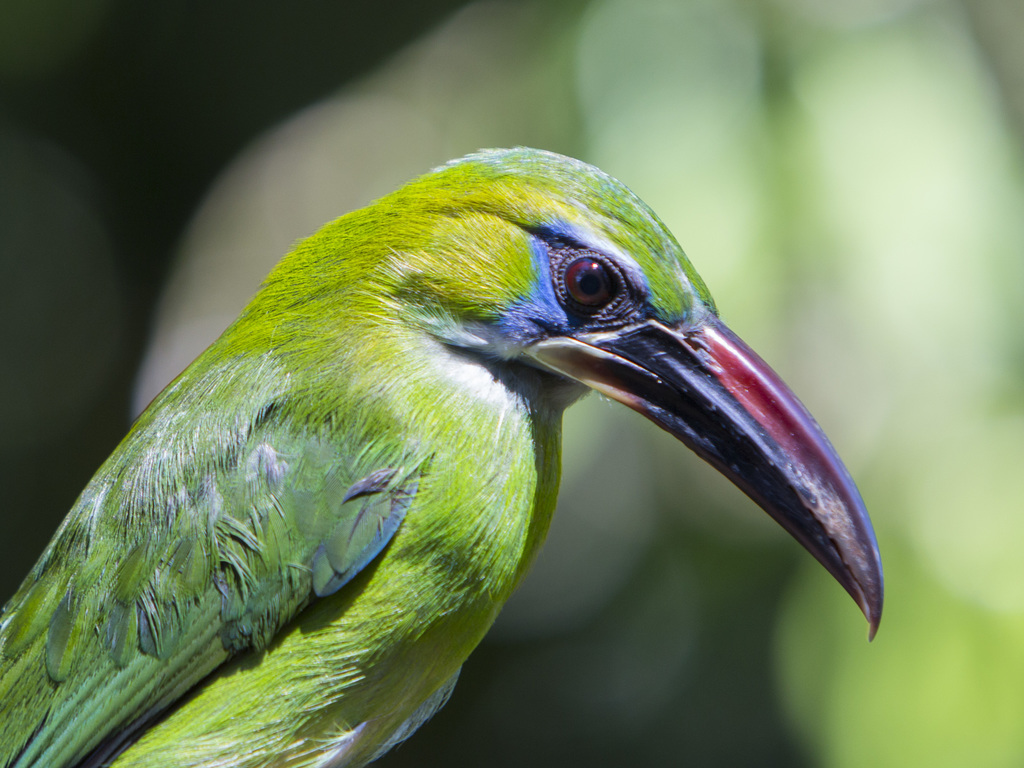
The groove-billed toucanet is 33 to 37 cm (13 to 15 in) long and weighs 130 to 200 g (4.6 to 7.1 oz). Its grooved culmen and mandible give it its English name. In the nominate subspecies and A. s. erythrognathus, most of the bill is wine-red to brown-red with a diagonal black stripe on the mandible. The nominate's bill also has a vertical white stripe at its base. In A. s. calorhynchus the bill is mostly yellow with a reduced amount of black, some orange-red at the base of the mandible, and a white stripe like the nominate's. All subspecies are overall mostly green, with the underparts being lighter and the undertail coverts yellower. The nominate subspecies has a white throat, some gold-bronze on the face, and bare blue skin around the brownish eye. A. s. erythrognathus has essentially the same plumage but with less gold-bronze on the face. A. s. calorhynchus also has similar plumage to the nominate but is larger than it and A. s. erythrognathus.
Range & habitat
The subspecies of groove-billed toucanet are found thus:
A. s. sulcatus, northern Venezuela between Falcón and Miranda states A. s. erythrognathus, mountains of northeastern Venezuela A. s. calorhynchus, Sierra Nevada de Santa Marta and Serranía del Perijá in northeastern Colombia and eastward to Lara in northwestern Venezuela The species primarily inhabits humid montane forest but is also found in semi-open landscapes like secondary forest, forest edges and nearby isolated trees, and gardens. It shuns large open areas. In elevation it mostly ranges between 900 and 2,000 m (3,000 and 6,600 ft) but occurs as low as sea level and as high as about 2,400 m (7,900 ft).
Wikipedia: “Distribution and habitat”
What it does
The groove-billed toucanet forages at all levels of its habitat, sometimes in groups. It has been observed following army ant swarms. Its diet is not known in detail but the species is omnivorous, eating fruit, invertebrates, eggs, and small vertebrates.
Wikipedia: “Feeding”
Listen
Looking for field recordings…
Where it lives
Recorded sightings
—
geo-referenced records in GBIF, from museums, herbaria and field observers.
Drag the globe to turn it. Dots are where records exist, not a range map; darker means more records.
In the stacks
Searching the stacks…
Every page naming Aulacorhynchus sulcatus in the Biodiversity Heritage Library →
This page is assembled live from iNaturalist, GBIF, Wikipedia, the Source Library and the Internet Archive. It is not yet part of the hand-edited codex. iNaturalist taxon 18817.