- Animals
- ›Chordates
- ›Vertebrates
- ›Ray-finned Fishes
- ›Spiny-rayed fishes
- ›Leaffishes, Snakeheads, and Gouramis
- ›Gouramis
- ›Gouramis
- ›Paradisefishes
- ›Macropodus
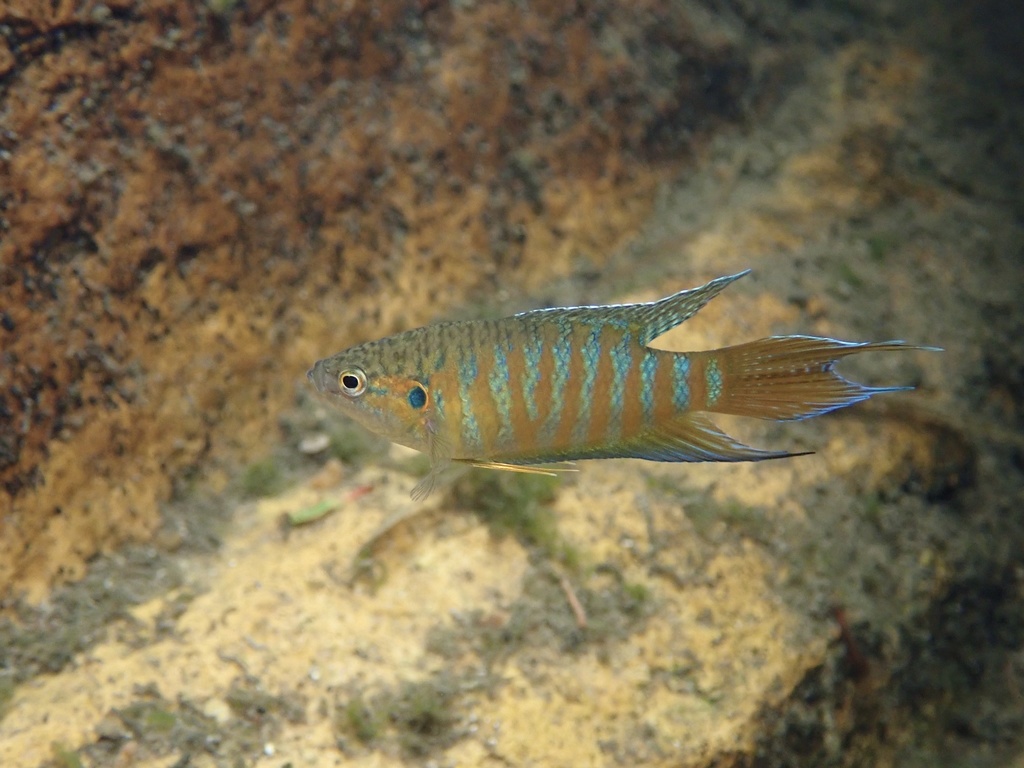
Fork Tailed Paradisefish
Macropodus opercularis
The fork-tailed paradisefish, or paradise gourami (often simply known as paradise fish, paradise-fish, or paradisefish [Macropodus opercularis]), is a species of pelagic, long-finned, freshwater, ray-finned fish in the family Osphronemidae, found in most fresh waters of East Asia ranging from eastern China south to northern Vietnam. This anabantiform fish can reach a standard length of 6.7 cm (2+5⁄8 in), though most are only about 5.5 cm (2+3⁄16 in).
Paradise fish were the second Chinese ornamental fish introduced to the West after the goldfish, and the first freshwater tropical fish successfully bred in captivity in Europe, having been imported 1869 to France by the French aquarium fish importer Pierre Carbonnier in Paris. The paradise fish is one of the more aggressive members of its family. It is more aggressive than the three-spot gourami, yet less pugnacious in nature than the less commonly kept combtail.
From the article Paradise fish on Wikipedia (CC BY-SA), quoted section by section
Range & habitat
Paradise fish are tolerant of a wide range of water conditions, surviving in cool and warm waters alike. In the wild, they are most commonly found in shallow water containing dense vegetation, such as a marsh or rice field. They can be kept in outdoor ponds or even the simplest of unheated aquaria. They accept virtually any food, but should be given a reasonably high-protein diet (as opposed to vegetable-based foods.) They also eat mosquito larvae, black worms, brine shrimp, and small flies.
Wikipedia: “Habitat and diet”
What it does
Paradise fish are fairly combative, harassing and attacking each other, as well as potentially assaulting and killing small fish. During a fight, the paradise fish often changes its color, usually displaying dark blue lateral lines on the sides of its body, extends its fins, and spreads out its operculum. Paradise fish are more likely to show aggressive behavior towards other paradise fish than to fish of a different species. Acts of aggression tend to increase as the distance to the fish's home in Asia increases. In the wild, they are predators, eating insects, invertebrates, and fish fry. The popularity of this species has waned in recent decades, as much more colorful (and often less aggressive) species of gouramis have become widely available to hobbyists. This species is one of the few fish that can change its color (lighter or darker) in response to stimuli. Also, paradise fish apparently are capable of learning through a type of restrictive process. Most forms of active teaching seem to hinder the paradise fish's ability to learn the movements of its owner by careful observation.
Wikipedia: “Behaviour”
Where it lives
Recorded sightings
—
geo-referenced records in GBIF, from museums, herbaria and field observers.
Drag the globe to turn it. Dots are where records exist, not a range map; darker means more records.
In the stacks
Searching the stacks…
Every page naming Macropodus opercularis in the Biodiversity Heritage Library →
This page is assembled live from iNaturalist, GBIF, Wikipedia, the Source Library and the Internet Archive. It is not yet part of the hand-edited codex. iNaturalist taxon 187647.