- Animals
- ›Chordates
- ›Vertebrates
- ›Ray-finned Fishes
- ›Spiny-rayed fishes
- ›Butterflyfishes, Angelfishes, and Allies
- ›Surgeonfishes, Tangs, and Unicornfishes
- ›Ctenochaetus
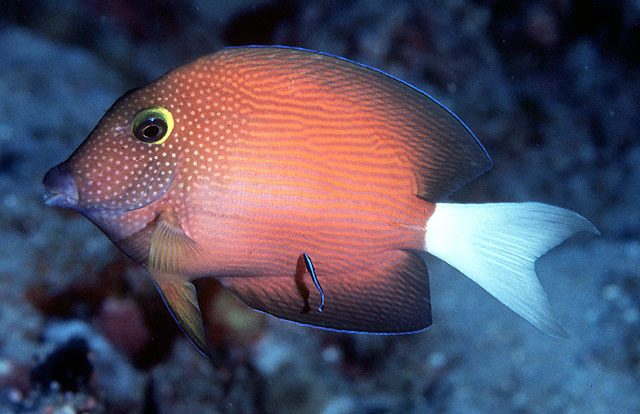
Whitetail Bristletooth
Ctenochaetus flavicauda
Ctenochaetus flavicauda is a tang from the Pacific Ocean. It occasionally makes its way into the aquarium trade. It grows to a size of 11.8 cm (4.6 in) in length, making it the smallest ctenochaetus tang, and also the smallest acanthurid. As a juvenile it is a bright yellow color, as an adult it is reddish-brown color with orange-colored fine horizontal striping, the tail is white and the eye is ringed by bright yellow.
From the article Ctenochaetus flavicauda on Wikipedia (CC BY-SA), quoted section by section
Description
Ctenochaetus flavicauda has its dorsal fin supported by 8 spines and between 26 and 28 soft rays while its anal fin is supported by 3 spines and 23 to 26 soft rays. This species has a maximum published total length of 16 cm (6.3 in). The overall colour is reddish marked with many blue spots on the head and these change into blue lines on the body. The brilliant white caudal fin contrasts sharply with the rest of the body.
Range & habitat
Ctenochaetus flavicauda occurs in the central Pacific Ocean from the Phoenix Islands north to the Line Islands, east to the Pitcairn Islands, south to the Austral Islands and Rapa Iti. It is found on coral reefs down to depths of 30 m (98 ft).
Wikipedia: “Distribution and habitat”
In human culture
Ctenochaetus flavicauda has the specific name flavicauda, meaning "yellow tail", which is a reference to what Fowler described as its "brilliant yellow caudal fin", although subsequent authors have described the caudal fin as pure white.
Wikipedia: “Etymology”
Where it lives
Recorded sightings
—
geo-referenced records in GBIF, from museums, herbaria and field observers.
Drag the globe to turn it. Dots are where records exist, not a range map; darker means more records.
In the stacks
Searching the stacks…
Every page naming Ctenochaetus flavicauda in the Biodiversity Heritage Library →
This page is assembled live from iNaturalist, GBIF, Wikipedia, the Source Library and the Internet Archive. It is not yet part of the hand-edited codex. iNaturalist taxon 187281.