- Animals
- ›Chordates
- ›Vertebrates
- ›Birds
- ›Woodpeckers and Allies
- ›Woodpeckers
- ›Typical woodpeckers
- ›Green Woodpeckers, Flickers, and Allies
- ›Picus
On eBird ↗
Levaillant's Woodpecker
Live sightings near you, the range map, bar charts of when it is seen, and Macaulay Library photos and recordings.
Levaillant's Woodpecker
Picus vaillantii
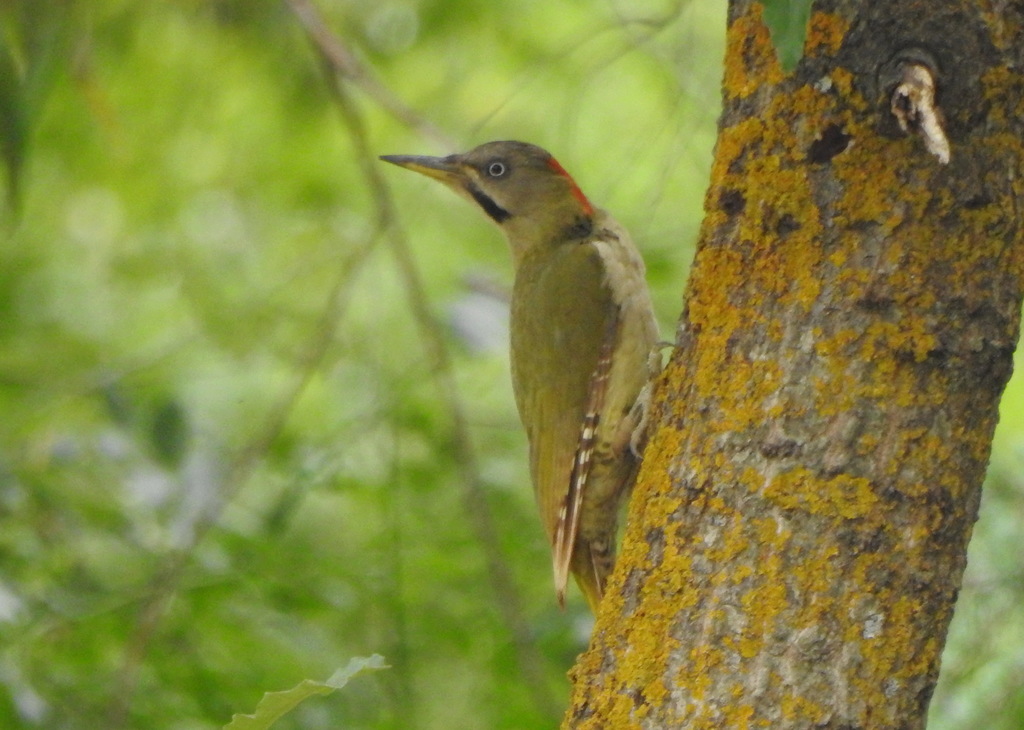
The Levaillant’s woodpecker or Levaillant’s green woodpecker (Picus vaillantii) is a large member of the woodpecker family Piciformes. It occurs as a resident breeder in the three Maghreb countries Morocco, Algeria and Tunisia in northwest Africa. This species was named in honour of the French explorer, collector and ornithologist, François Le Vaillant.
From the article Levaillant's woodpecker on Wikipedia (CC BY-SA), quoted section by section
Description
Levaillant's woodpecker is 30–33 cm in length with a 45–51 cm wingspan. It is very similar to the European green woodpecker P. viridis and the Iberian green woodpecker P. sharpei (especially females). Both Levaillant's woodpecker and the Iberian Green woodpecker were formerly considered subspecies of P. viridis. Levaillant's woodpecker is dark green above and yellowish green below, with a crimson nape. The black moustache has a pale border above. The rump is chrome yellow and the outer webs of the primaries are barred black and white. The bill and feet are slate grey. Sexes are similar except that the male has a crimson crown, whereas the female's crown is grey. Like P. sharpei, both sexes lack the black on the lores and around the eye shown by most forms of the green woodpecker. The call is a loud ringing laugh, plue, plue, plue, very like the green woodpecker's yaffle, but perhaps slightly faster.
Range & habitat
Levaillant's woodpecker is found in the Atlas Mountains in the three Maghreb countries Morocco, Algeria, and Tunisia, in northwest Africa. It breeds in mountain forests up to the treeline at around 2000 metres.
Wikipedia: “Distribution and habitat”
What it does
This woodpecker's insect food, mainly ants, is captured by a rapid outward flick of the long tongue, and gummed to its tip by sticky saliva. Though a large and heavy bird it has an easy, bounding flight. The nest is a hole in a tree, and 4-8 glossy white eggs are laid on wood chips.
== References ==
Wikipedia: “Behaviour”
Listen
Looking for field recordings…
Where it lives
Recorded sightings
—
geo-referenced records in GBIF, from museums, herbaria and field observers.
Drag the globe to turn it. Dots are where records exist, not a range map; darker means more records.
In the stacks
Searching the stacks…
Every page naming Picus vaillantii in the Biodiversity Heritage Library →
This page is assembled live from iNaturalist, GBIF, Wikipedia, the Source Library and the Internet Archive. It is not yet part of the hand-edited codex. iNaturalist taxon 18366.