- Fungi Including Lichens
- ›Ascomycete Fungi
- ›Sac Fungi and Lichens
- ›Common Lichens
- ›Shield Lichens, Sunburst Lichens, Rosette Lichens, and Allies
- ›shield lichens, rim lichens, and allies
- ›shield lichens and allies
- ›typical shield lichens
- ›Imshaugia
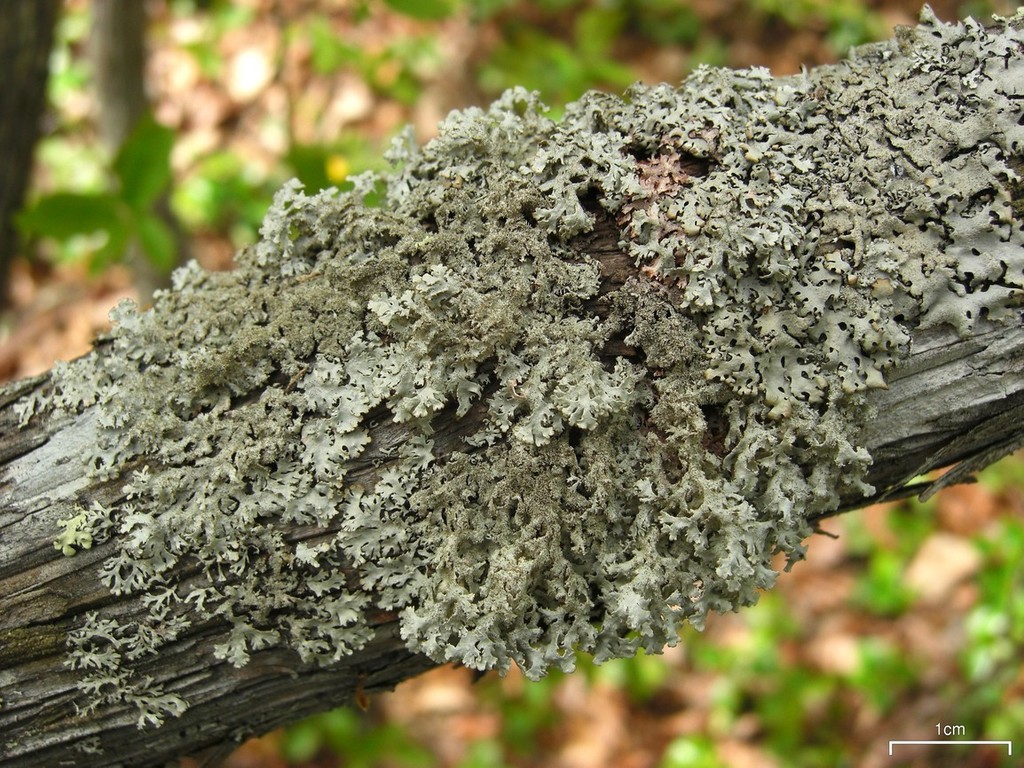
Salted Starburst Lichen
Imshaugia aleurites
Imshaugia aleurites, commonly known as the salted starburst lichen, is a species of foliose lichen in the family Parmeliaceae. It has a wide distribution in Europe and North America, and has also been recorded in China.
From the article Imshaugia aleurites on Wikipedia (CC BY-SA), quoted section by section
Description
The lichen has a whitish to pale gray thallus comprising lobes measuring 0.5–1.2 mm wide. The thallus is covered with cylindrical, brownish-tipped isidia, except at the tips of the lobes. The thallus undersurface is tan to whitish, and numerous short brown rhizines serves as holdfasts that attach the lichen to its substrate. Apothecia and pycnidia are rare in this species.
Range & habitat
Imshaugia aleurites is widely distributed in Canada and the eastern United States, and grows in well-lit conifer forests on the bark or wood of conifers. Its range is also spread out over Europe, where it has been recorded in 32 countries. It was added to the lichen flora of mainland China in 1999.
Wikipedia: “Habitat and distribution”
What it does
Tremella imshaugiae is a lichenicolous fungus that parasitizes Imshaugia aleurites. Infection by the fungus results in the formation of small amber-coloured basidiomata on the thallus surface. It has been found growing on I. aleurites lichen thalli in Scotland and Maine.
== References ==
Wikipedia: “Species interactions”
Where it lives
Recorded sightings
—
geo-referenced records in GBIF, from museums, herbaria and field observers.
Drag the globe to turn it. Dots are where records exist, not a range map; darker means more records.
In the stacks
Searching the stacks…
Every page naming Imshaugia aleurites in the Biodiversity Heritage Library →
This page is assembled live from iNaturalist, GBIF, Wikipedia, the Source Library and the Internet Archive. It is not yet part of the hand-edited codex. iNaturalist taxon 182705.