- Fungi Including Lichens
- ›Ascomycete Fungi
- ›Sac Fungi and Lichens
- ›Common Lichens
- ›wart lichens, script lichens, and allies
- ›script lichens, whitewash lichens, and allies
- ›whitewash lichens and allies
- ›Phlyctis
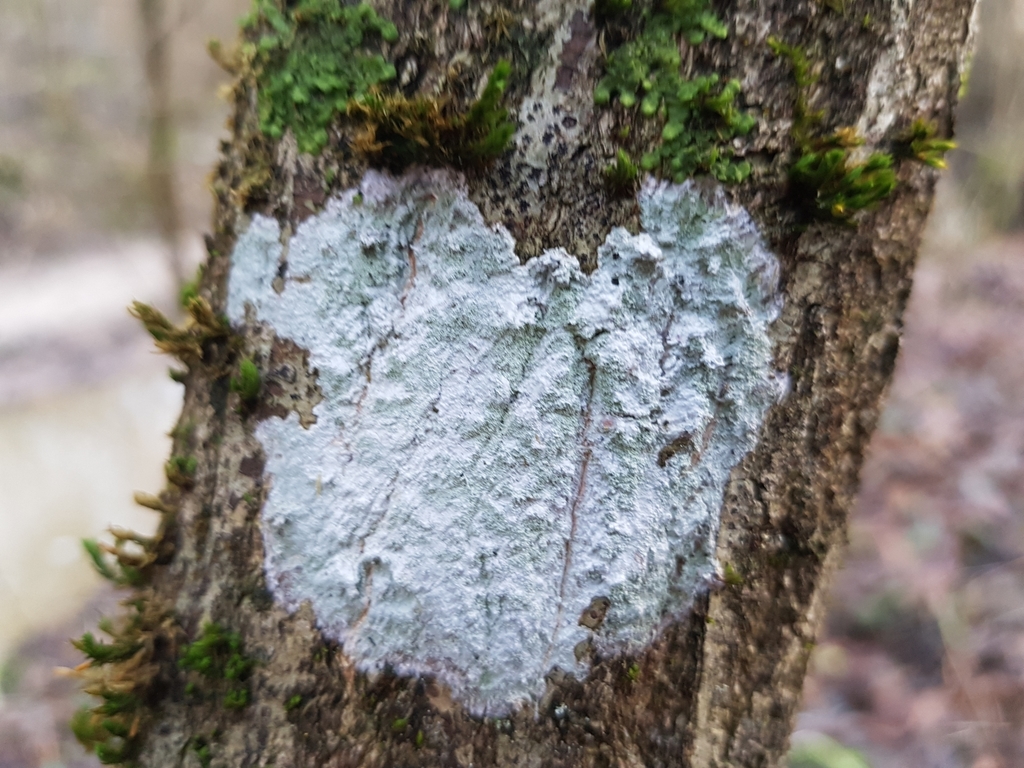
Whitewash Lichen
Phlyctis argena
Phlyctis argena is a species of crustose lichen.
From the article Phlyctis argena on Wikipedia (CC BY-SA), quoted section by section
Description
Phlyctis argena has a thin crustose thallus that is white, greyish or green-grey in colour. The identification can be confirmed with the spot test application a drop of potassium hydroxide (K-test) to the thallus, which will turn yellow and then red.
Range & habitat
Phlyctis argena usually grows as a generalist epiphyte on the bark of deciduous trees, especially Salix cinerea and Fraxinus excelsior. It also occasionally grows on stone, such as gravestones.
Wikipedia: “Habitat”
What it does
The lichen is a generalist epiphyte of deciduous trees and is acidophilic. Its abundance appears to have increased generally since the 1970s, possibly in responses to changes in air pollution levels
Wikipedia: “Ecology”
In human culture
The etymology of the genus name, Phlyctis, comes from the obsolete medical term phlyctidium, meaning a large blister. The species epithet, argena, is derived from the latin "argentum", meaning silver.
Wikipedia: “Etymology”
Where it lives
Recorded sightings
—
geo-referenced records in GBIF, from museums, herbaria and field observers.
Drag the globe to turn it. Dots are where records exist, not a range map; darker means more records.
In the stacks
Searching the stacks…
Every page naming Phlyctis argena in the Biodiversity Heritage Library →
This page is assembled live from iNaturalist, GBIF, Wikipedia, the Source Library and the Internet Archive. It is not yet part of the hand-edited codex. iNaturalist taxon 182631.