- Animals
- ›Chordates
- ›Vertebrates
- ›Birds
- ›Woodpeckers and Allies
- ›Woodpeckers
- ›Typical woodpeckers
- ›Green Woodpeckers, Flickers, and Allies
- ›Colaptes
On eBird ↗
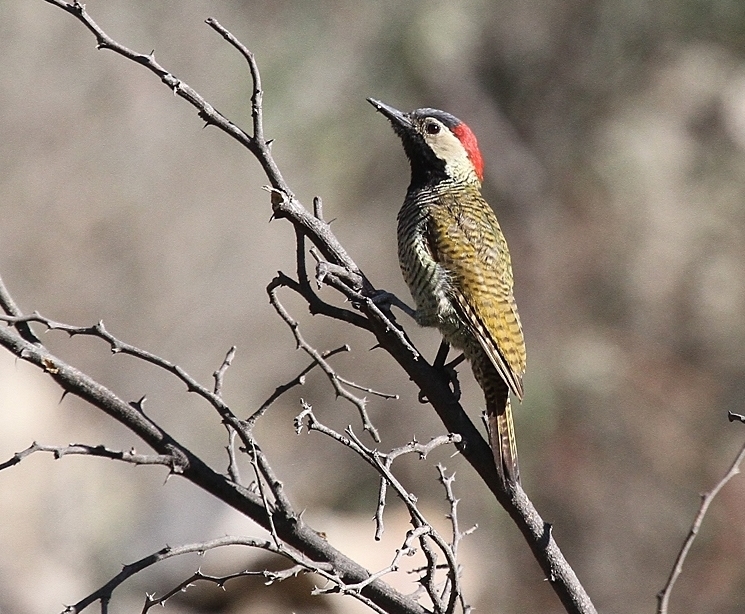
Black-necked Woodpecker
Live sightings near you, the range map, bar charts of when it is seen, and Macaulay Library photos and recordings.
Black-necked Woodpecker
Colaptes atricollis
The black-necked woodpecker or black-necked flicker (Colaptes atricollis) is a species of bird in subfamily Picinae of the woodpecker family Picidae. It is endemic to Peru.
From the article Black-necked woodpecker on Wikipedia (CC BY-SA), quoted section by section
Description
The black-necked woodpecker is 26 to 27 cm (10 to 11 in) long and weighs 73 to 90 g (2.6 to 3.2 oz). Males and females have the same plumage except on their heads. Adult males of the nominate subspecies are dark gray from forehead to forecrown and red on the hindcrown and upper nape; the gray often has red feather tips. They are yellowish white from their lores around the eye to the nape with a red malar stripe below it and a black chin and throat. Adult females have red only on the hindcrown and their malar is blackish. Both sexes have bronze-green upperparts with narrow blackish bars; both colors are paler on their rump and uppertail coverts. Their flight feathers are dark brown with yellowish barring and olive-yellow shafts. Their tail is dark brown; the central feathers and the outer web of the outermost pair have paler barring. Their breast is black and the rest of their underparts are pale yellow with black bars. Their longish bill is black with a paler base, their iris brown to chestnut-brown, and the legs green-gray. Juveniles are generally duller than adults and have a darker face; the top of their head is often red with dark bars, their malar mixed black and red, and the upper- and underparts' barring is more diffuse. Subspecies C. a. peruvianus is smaller than the nominate with a shorter bill. …
Range & habitat
The nominate subspecies of black-necked woodpecker is found on the west slope of the Peruvian Andes between the departments of La Libertad and Tacna. Subspecies C. a. peruvianus is found on the east slope of Peru's Andes from the valley of the Marañón River south into Huánuco Department. The species inhabits a variety of semi-arid to arid landscapes including drier cloudforest, montane scrublands with cacti, desert scrublands, and deciduous woodlands. It also occurs in riparian woodlands, orchards, plantations, and gardens. On the western slope it is mostly found at elevations between 500 and 2,800 m (1,600 and 9,200 ft) but occurs locally as high as 4,000 m (13,100 ft). In the Marañón Valley it is found between 1,700 and 4,300 m (5,600 and 14,100 ft).
Wikipedia: “Distribution and habitat”
What it does
The black-necked woodpecker feeds almost entirely on adult ants, their larvae, and their pupae. It usually forages singly or in pairs, and at any level from the ground to the treetops. It captures its food mostly by gleaning and probing.
Wikipedia: “Feeding”
Listen
Looking for field recordings…
Where it lives
Recorded sightings
—
geo-referenced records in GBIF, from museums, herbaria and field observers.
Drag the globe to turn it. Dots are where records exist, not a range map; darker means more records.
In the stacks
Searching the stacks…
Every page naming Colaptes atricollis in the Biodiversity Heritage Library →
This page is assembled live from iNaturalist, GBIF, Wikipedia, the Source Library and the Internet Archive. It is not yet part of the hand-edited codex. iNaturalist taxon 18247.