- Animals
- ›Chordates
- ›Vertebrates
- ›Birds
- ›Woodpeckers and Allies
- ›Woodpeckers
- ›Typical woodpeckers
- ›Green Woodpeckers, Flickers, and Allies
- ›Colaptes
On eBird ↗
Andean Flicker
Live sightings near you, the range map, bar charts of when it is seen, and Macaulay Library photos and recordings.
Andean Flicker
Colaptes rupicola
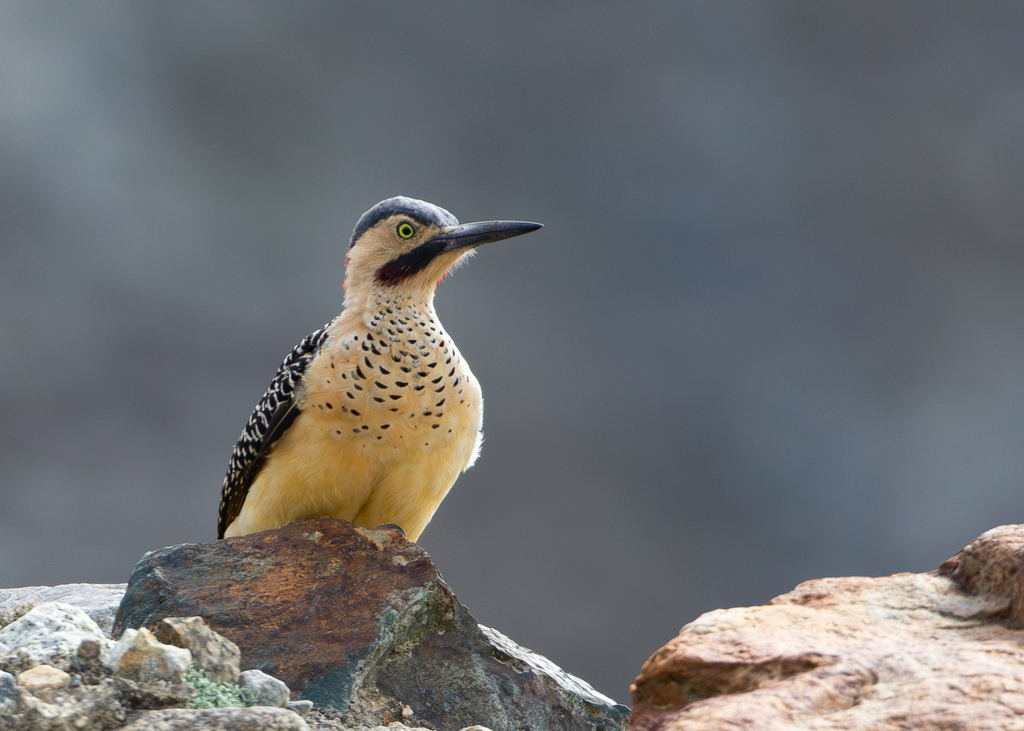
The Andean flicker (Colaptes rupicola) is a South American species of woodpecker. It is found in grassland, shrubland and Polylepis woodland at altitudes of 2,000–5,000 metres (6,600–16,400 ft) in the Puna ecoregion. Together with the campo flicker and ground woodpecker, it is one of the few largely terrestrial woodpeckers.
From the article Andean flicker on Wikipedia (CC BY-SA), quoted section by section
Description
The Andean flicker is about 32 cm (13 in) long. Males and females have the same plumage except on their heads. Adult males of the nominate subspecies are dark slate gray from forehead to hindneck; the last occasionally has a hint of red. Their face, chin, and throat are pale buffy white with a thin black malar stripe with red tips on the feathers. Adult females have an all-black malar stripe and never any red on the hindneck. Both sexes' upperparts are barred with brown, light brown, and buffy white; their uppertail coverts are white with narrow dark bars. Their flight feathers are dark brown with narrow pale buff bars. The top side of their tail is black; the central and outermost feathers have thin paler bars. Their tail's underside is dark brown with sometimes yellowish on the outer edge. Their underparts are whitish with a variable orange-buff wash on the breast and small blackish marks there and sometimes on the flanks. Their long bill is black, their iris lemon yellow, and the legs yellowish gray, greenish, or grayish pink. Juveniles are duller than adults but with pale blue or reddish brown eyes, and they have buff tips on the rear crown feathers and bar-like rather than spotted underparts. Males usually have some red on their nape. Subspecies C. r. puna is similar to the nominate but is darker both above and below. …
Range & habitat
Subspecies C. r. cinereicapillus the Andean flicker is the northernmost. It is found from Loja Province in extreme southern Ecuador south into central Peru as far as the departments of Pasco and Junín. C. r. puna is found in central and southern Peru. The nominate C. r. rupicola is found from northern Chile's Tarapacá Region through western, southern, and central Bolivia into northwestern Argentina as far as Catamarca Province. The Andean flicker is a bird of open country. It inhabits the páramo, the puna, Polylepis woodland, montane scrublands, and other landscapes of mixed rock, grass, and some higher vegetation. It uses rocks, cliffs, and trees as lookout points. In elevation it ranges between 2,000 and 5,000 m (6,600 and 16,400 ft) but usually is above 3,000 m (9,800 ft). The few reports below that elevation are thought to be non-breeding adults roaming to forage.
Wikipedia: “Distribution and habitat”
What it does
The Andean flicker is almost entirely terrestrial in its foraging. Single birds, pairs and gregarious groups of up to about 10 birds move across the landscape. (A group of 21 was once documented.) It typically drops from a vantage point to probe, dig, and sweep away pebbles and debris in search of prey and then returns to the elevated perch. Its diet is insects including beetles both adult and larval, and other large larvae such as those of butterflies. Other adult insects are also taken.
Wikipedia: “Feeding”
Listen
Looking for field recordings…
Where it lives
Recorded sightings
—
geo-referenced records in GBIF, from museums, herbaria and field observers.
Drag the globe to turn it. Dots are where records exist, not a range map; darker means more records.
In the stacks
Searching the stacks…
Every page naming Colaptes rupicola in the Biodiversity Heritage Library →
This page is assembled live from iNaturalist, GBIF, Wikipedia, the Source Library and the Internet Archive. It is not yet part of the hand-edited codex. iNaturalist taxon 18231.