- Animals
- ›Chordates
- ›Vertebrates
- ›Birds
- ›Woodpeckers and Allies
- ›Woodpeckers
- ›Typical woodpeckers
- ›Pied woodpeckers and allies
- ›Melanerpes
On eBird ↗
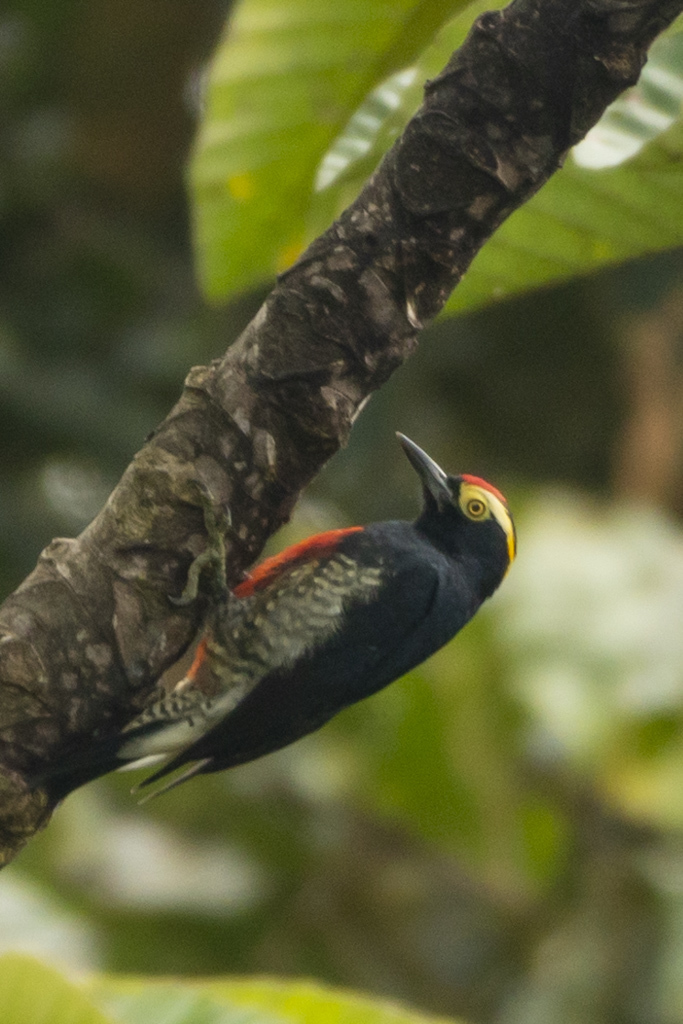
Yellow-tufted Woodpecker
Live sightings near you, the range map, bar charts of when it is seen, and Macaulay Library photos and recordings.
Yellow-tufted Woodpecker
Melanerpes cruentatus
The yellow-tufted woodpecker (Melanerpes cruentatus) is a species of woodpecker. It is found in Bolivia, Brazil, Colombia, Ecuador, French Guiana, Guyana, Peru, Suriname, and Venezuela. Its natural habitats are subtropical or tropical moist lowland forests and heavily degraded former forest.
From the article Yellow-tufted woodpecker on Wikipedia (CC BY-SA), quoted section by section
Description
An adult is about 20 cm (8 in) long. The upper parts are mostly bluish-black, as are the cheeks, chin, throat and chest. The breast and belly are red, although the amount of red is variable, and the flanks and lower belly have black and white undulating barring. The rump and upper tail-coverts are white, this being noticeable in flight, and the tail is black. The underside of the wing is barred in black and white. The beak is blackish, the legs grey, and the iris and orbital ring are yellow. The male differs from the female in having a red fore- and mid-crown while the female has these parts black. In northern and western races, the brow is yellow, cream or buff, and the hind-crown ha yellow or golden feathers, these often being tufted, but in southern races, these areas are black. Juveniles are similar to the adults but the upper parts are browner and the underparts are greyer; juveniles of both sexes have some red on the crown and the belly is more orange than red.
Range & habitat
The yellow-tufted woodpecker is native to northern South America. Its range includes eastern Colombia, western and southern Venezuela, the Guianas, northern and central Brazil, eastern Ecuador, eastern Peru and eastern Bolivia. Its altitudinal range is from sea level to about 1,200 m (3,900 ft), and even higher in Ecuador. It is a species of open humid forest, both varzea and terra firme forest, and is also found in secondary forest, woodland verges and burnt out areas with isolated standing trees. It is a non-migratory species.
Wikipedia: “Distribution and habitat”
What it does
The species is social and gregarious and often forages in groups. Its diet is omnivorous, consisting principally of insects, some of which are caught on the wing, and fruits.
Wikipedia: “Behaviour and ecology”
Listen
Looking for field recordings…
Where it lives
Recorded sightings
—
geo-referenced records in GBIF, from museums, herbaria and field observers.
Drag the globe to turn it. Dots are where records exist, not a range map; darker means more records.
In the stacks
Searching the stacks…
Every page naming Melanerpes cruentatus in the Biodiversity Heritage Library →
This page is assembled live from iNaturalist, GBIF, Wikipedia, the Source Library and the Internet Archive. It is not yet part of the hand-edited codex. iNaturalist taxon 18218.