- Animals
- ›Chordates
- ›Vertebrates
- ›Birds
- ›Woodpeckers and Allies
- ›Woodpeckers
- ›Typical woodpeckers
- ›Pied woodpeckers and allies
- ›Melanerpes
On eBird ↗
Red-headed Woodpecker
Live sightings near you, the range map, bar charts of when it is seen, and Macaulay Library photos and recordings.
Red-headed Woodpecker
Melanerpes erythrocephalus
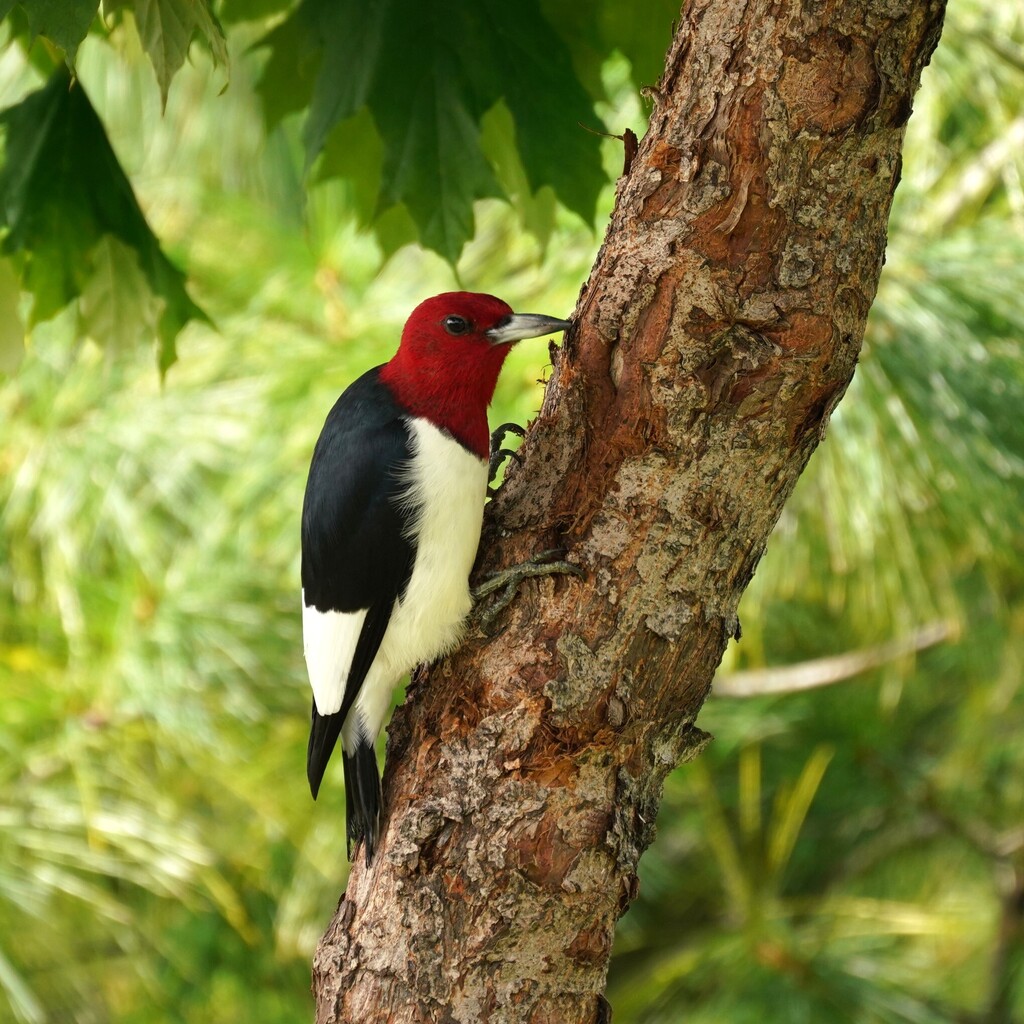
The red-headed woodpecker (Melanerpes erythrocephalus) is a mid-sized woodpecker found in temperate North America. Its breeding habitat is open country across southern Canada and the east-central United States. It is rated as least concern on the International Union for Conservation of Nature (IUCN)'s Red List of Endangered species, having been down-listed from near threatened in 2018.
The red-headed woodpecker should not be confused with the red-bellied woodpecker, which is similar in size but has a vibrant orange-red crown and nape; the red-bellied woodpecker is named for the pale reddish blush of its lower belly and has a distinctly patterned black and white back rather than the solid black one of the red-headed woodpecker.
From the article Red-headed woodpecker on Wikipedia (CC BY-SA), quoted section by section
Description
Adults are distinctly tricolored, with a black back and tail, a white belly and rump, and a red head and neck. The wings are black with white secondary remiges. Adult males and females are identical in plumage. Juveniles have similar markings, but their heads are grey. Red-headed woodpeckers are entirely crimson above their shoulders. These are mid-sized woodpeckers. Both sexes measure from 19 to 25 cm (7.5 to 9.8 in) in length, with a wingspan of 42.5 cm (16.7 in). They weigh from 56 to 97 g (2.0 to 3.4 oz), with an average of 76 g (2.7 oz). Each wing measures 12.7–15 cm (5.0–5.9 in); the tail measures 6.6–8.5 cm (2.6–3.3 in), the bill measures 2.1–3 cm (0.83–1.18 in) and the tarsus measures 1.9–2.5 cm (0.75–0.98 in). The maximum longevity in the wild is 9.9 years. This species gives a tchur-tchur call or a drum on its territory.
What it does
The red-headed woodpecker is omnivorous, eating insects, seeds, fruits, berries, nuts, and occasionally small rodents―even the eggs of other birds. About two-thirds of its diet consists of plants. Red-headed woodpeckers keep food caches. This behavior is only seen in three other species of woodpeckers: the acorn woodpecker, the downy woodpecker, and the red-bellied woodpecker. They have been known to stuff food in tree cavities, crevices, and under tree bark. This keeps them well fed throughout the year.
Wikipedia: “Food and feeding”
In human culture
In 1996, the United States Postal Service issued a 2-cent postage stamp depicting a perched red-headed woodpecker. The stamp was discontinued at some time thereafter, but re-issued in 1999 and remained available for purchase until 2006.
Wikipedia: “Popular culture”
Listen
Looking for field recordings…
Where it lives
Recorded sightings
—
geo-referenced records in GBIF, from museums, herbaria and field observers.
Drag the globe to turn it. Dots are where records exist, not a range map; darker means more records.
In the old herbals & bestiaries

In the stacks
Searching the stacks…
Every page naming Melanerpes erythrocephalus in the Biodiversity Heritage Library →
This page is assembled live from iNaturalist, GBIF, Wikipedia, the Source Library and the Internet Archive. It is not yet part of the hand-edited codex. iNaturalist taxon 18204.