- Animals
- ›Chordates
- ›Vertebrates
- ›Birds
- ›Woodpeckers and Allies
- ›Woodpeckers
- ›Typical woodpeckers
- ›Pied woodpeckers and allies
- ›Melanerpes
On eBird ↗
Gila Woodpecker
Live sightings near you, the range map, bar charts of when it is seen, and Macaulay Library photos and recordings.
Gila Woodpecker
Melanerpes uropygialis
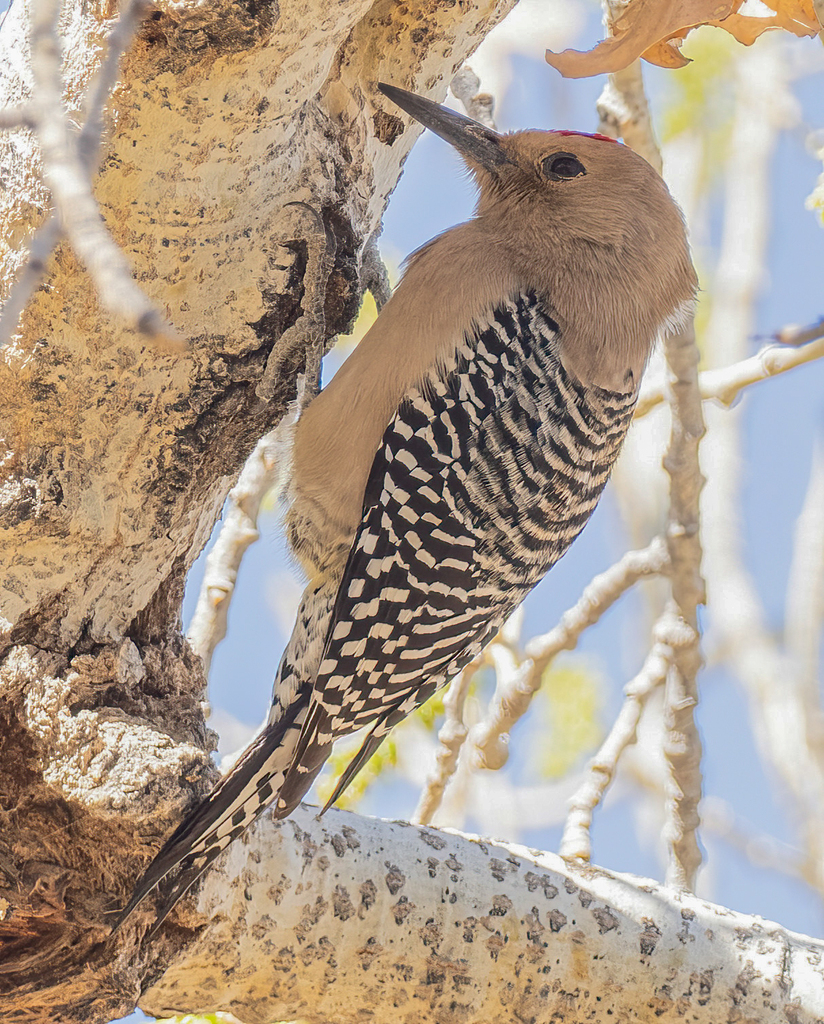
The Gila woodpecker (Melanerpes uropygialis) is a medium-sized woodpecker of the desert regions of the southwestern United States and western Mexico. In the U.S., they range through southeastern California, southern Nevada, Arizona, and New Mexico.
From the article Gila woodpecker on Wikipedia (CC BY-SA), quoted section by section
Description
The back and wings of this bird are spotted and barred with a black and white zebra-like pattern. The neck, throat, belly and head are greyish-tan in color. The male has a small red cap on the top of the head. Females and juveniles birds are similar, but both lack the red cap of the adult male. White wing patches are prominent in flight. The dark tail has white bars on the central tail feathers. The birds range from 8–10 in (20–25 cm) in length. This woodpecker's voice is a rolling churr sound. It also makes a yip yip yip sound and a kee-u, kee-u, kee-u sound. Its drum is long and steady.
Range & habitat
This woodpecker's habitat consists of low desert scrub typical of the Sonoran Desert, as well as arroyos (washes) and small towns.
Wikipedia: “Distribution & habitat”
What it does
As a woodpecker, its diet is composed greatly of insects, which it gains from drilling into bark. Gila woodpeckers are omnivorous, and do take fruits, nectar, seeds, as well as lizards, eggs, worms, and even young chicks of small birds. They are even known to hang on human placed hummingbird feeders and sip up the nectar.
Wikipedia: “Feeding”
Listen
Looking for field recordings…
Where it lives
Recorded sightings
—
geo-referenced records in GBIF, from museums, herbaria and field observers.
Drag the globe to turn it. Dots are where records exist, not a range map; darker means more records.
In the stacks
Searching the stacks…
Every page naming Melanerpes uropygialis in the Biodiversity Heritage Library →
This page is assembled live from iNaturalist, GBIF, Wikipedia, the Source Library and the Internet Archive. It is not yet part of the hand-edited codex. iNaturalist taxon 18161.