- Animals
- ›Chordates
- ›Vertebrates
- ›Birds
- ›Woodpeckers and Allies
- ›Woodpeckers
- ›Typical woodpeckers
- ›Pied woodpeckers and allies
- ›Veniliornis
On eBird ↗
Red-rumped Woodpecker
Live sightings near you, the range map, bar charts of when it is seen, and Macaulay Library photos and recordings.
Red-rumped Woodpecker
Veniliornis kirkii
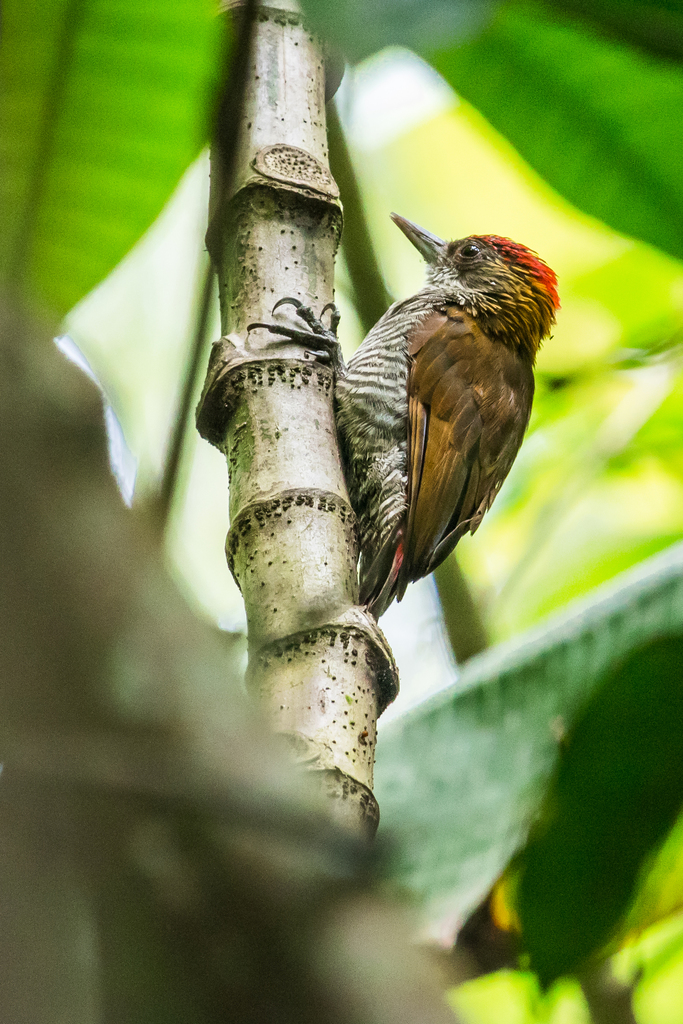
The red-rumped woodpecker (Veniliornis kirkii) is a species of bird in the subfamily Picinae of the woodpecker family Picidae. It is found from Costa Rica south to Peru and east to Brazil, Guyana, and Trinidad and Tobago.
From the article Red-rumped woodpecker on Wikipedia (CC BY-SA), quoted section by section
Description
The red-rumped woodpecker is about 15 to 16 cm (5.9 to 6.3 in) long and weighs 30 to 42 g (1.1 to 1.5 oz). Males and females have the same plumage except on their heads. Males of the nominate subspecies kirkii have a red crown and nape with some dusky brown or dark gray feather tips. The female has a dark brown crown with a tinge of green. Adults of both sexes have mostly olive-brown faces with whitish streaks. Their upperparts are mostly golden olive-brown with some yellow and red feather tips and crimson-red rump and uppertail coverts. Their flight feathers are dark brown with greenish-olive edges. Also, their tails are dark brown with pale buff bars on the outer pairs of feathers. Furthermore, their underparts are barred with dark brown and whitish, with the whitish ones wider on the belly. The iris is dark brown to red-brown, the longish beak blackish with a paler mandible, and the legs are grayish with a green to blue tinge. Juveniles resemble adults except that both sexes have some red on the crown, the male more than the female. Subspecies monticola is larger than the nominate and has heavy blackish barring on its underparts. Subspecies continentalis is smaller than the nominate, has more yellow on its nape, and wider pale bars on its underparts. …
Range & habitat
The subspecies of the red-rumped woodpecker are found thus:
V. (or D.) k. neglectus, southern Costa Rica and western Panama including Coiba Island V. (or D.) k. cecilii, from eastern Panama south through western Colombia and western Ecuador into extreme northwestern Peru V. (or D.) k. continentalis, western and northern Venezuela V. (or D.) k. monticola, the tepui area where central and southeastern Venezuela, western Guyana, and extreme northwestern Brazil meet V. (or D.) k. kirkii, northeastern Venezuela's Paria Peninsula, Trinidad, and Tobago The red-rumped woodpecker inhabits a wide variety of mostly relatively open lowland and foothill landscapes. These include wet forests, secondary forests, the edges of mangroves, gallery forests, dry scrublands, deciduous forests, savannas with scattered trees, and coconut plantations. In elevation, it reaches 900 m (3,000 ft) in Panama, 1,000 m (3,300 ft) in western Venezuela, 1,200 m (3,900 ft) in Ecuador, 1,500 m (4,900 ft) in Peru, and 1,750 m (5,700 ft) in the tepui region.
Wikipedia: “Distribution and habitat”
What it does
The red-rumped woodpecker primarily forages from the forest's mid-level to the canopy but will come lower at the edges. It hunts by pecking and steady hammering, on smallish branches to trunks, and often in thick growth. It usually forages singly, in pairs, or small groups, but will join mixed-species feeding flocks. Its diet includes adults and larvae of wood-boring beetles and other insects.
Wikipedia: “Feeding”
Listen
Looking for field recordings…
Where it lives
Recorded sightings
—
geo-referenced records in GBIF, from museums, herbaria and field observers.
Drag the globe to turn it. Dots are where records exist, not a range map; darker means more records.
In the stacks
Searching the stacks…
Every page naming Veniliornis kirkii in the Biodiversity Heritage Library →
This page is assembled live from iNaturalist, GBIF, Wikipedia, the Source Library and the Internet Archive. It is not yet part of the hand-edited codex. iNaturalist taxon 18020.