- Animals
- ›Chordates
- ›Vertebrates
- ›Birds
- ›Woodpeckers and Allies
- ›Woodpeckers
- ›Typical woodpeckers
- ›Pied woodpeckers and allies
- ›Veniliornis
On eBird ↗
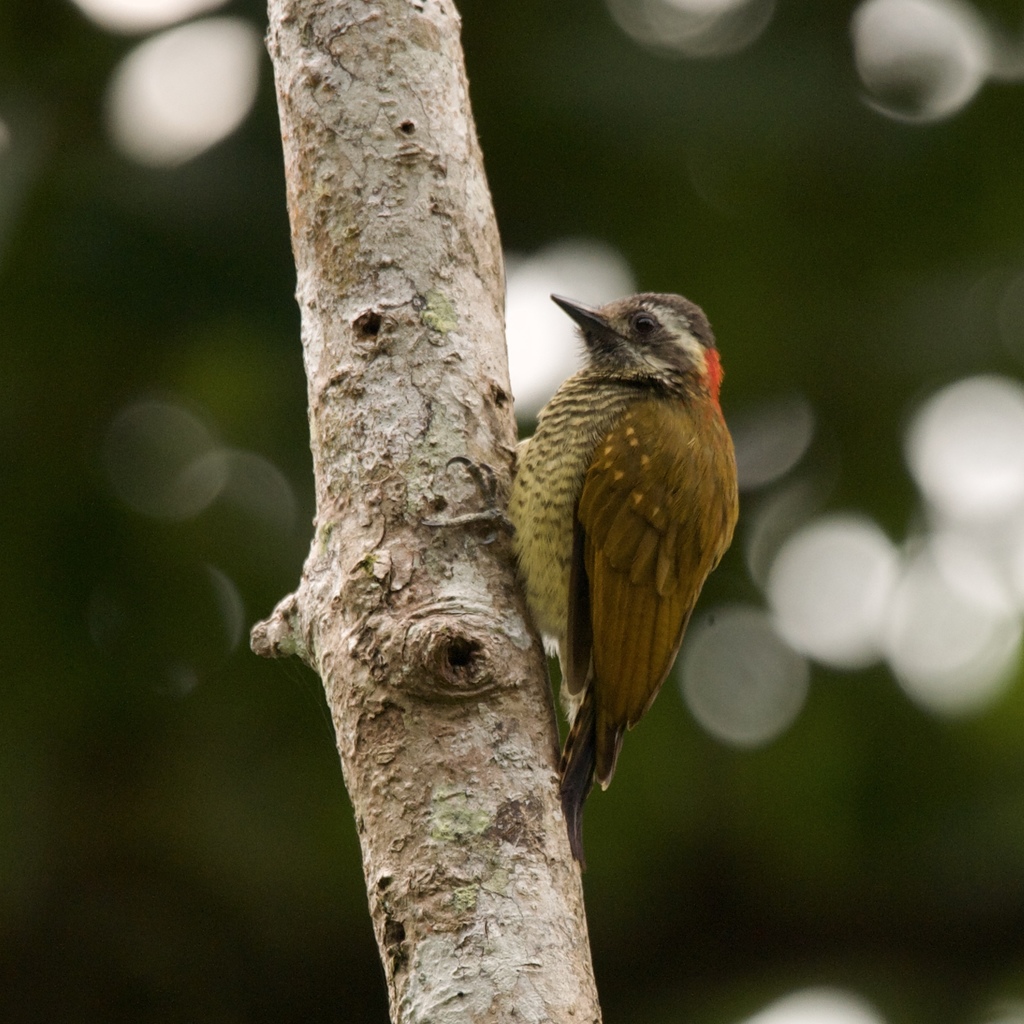
Yellow-vented Woodpecker
Live sightings near you, the range map, bar charts of when it is seen, and Macaulay Library photos and recordings.
Yellow-vented Woodpecker
Veniliornis dignus
The yellow-vented woodpecker (Veniliornis dignus) is a species of bird in the family Picidae. It is found in Colombia, Ecuador, Peru, and Venezuela. Its natural habitat is subtropical or tropical moist montane forests.
From the article Yellow-vented woodpecker on Wikipedia (CC BY-SA), quoted section by section
Description
The yellow-vented woodpecker is 16 to 17 cm (6.3 to 6.7 in) long and weighs 35 to 46 g (1.2 to 1.6 oz). Males and females have the same plumage except on their heads. Adults of both sexes of the nominate subspecies have a mostly blackish olive face with white stripes behind and below the eye. Males are red from forehead to nape with black feather bases showing through. The female is entirely blackish there. Both sexes' mantle and back are yellow-green with a bronze tinge; their rump and uppertail coverts are barred with light and dark olive. Their flight feathers are brownish olive. Their tail is blackish with a yellow cast; the outer two pairs of feathers have pale bars. Their underparts are greenish white becoming yellow in the flanks and belly and with heavy olive-blackish bars from the throat to upper flanks. The iris is brown to red-brown, the medium-long beak blackish with a paler base, and the legs are dark olive-gray. Juveniles are generally duller than adults and have greener upperparts. Both sexes have some red tips on their crown feathers. Subspecies baezae has a shorter beak than the nominate and its underparts' barring is blacker and extends further onto the flanks. Subspecies valdizani has a longer beak than the nominate and less well defined barring on the rump and uppertail coverts.
Range & habitat
The nominate subspecies of yellow-vented woodpecker is found from Táchira in extreme southwestern Venezuela south through the Colombian Andes into the Pacific slope of northern Ecuador's Andes. Subspecies baezae is found on the eastern slope of the Andes in Ecuador. Subspecies valdizani is found on the eastern slope of the Andes in Peru. The species inhabits humid montane forest, in particular cloudforest, and is seldom found outside mature primary forest. In elevation it mostly ranges between 1,200 and 2,700 m (3,900 and 8,900 ft) but is found as low as 700 m (2,300 ft) in Peru.
Wikipedia: “Distribution and habitat”
What it does
The yellow-vented woodpecker forages from the forest's middle strata to the canopy. It is usually single or in pairs but occasionally joins mixed species foraging flocks. It often spends a long time at one spot, hammering on a tree trunk or branch. No details of its diet are known.
Wikipedia: “Feeding”
Listen
Looking for field recordings…
Where it lives
Recorded sightings
—
geo-referenced records in GBIF, from museums, herbaria and field observers.
Drag the globe to turn it. Dots are where records exist, not a range map; darker means more records.
In the stacks
Searching the stacks…
Every page naming Veniliornis dignus in the Biodiversity Heritage Library →
This page is assembled live from iNaturalist, GBIF, Wikipedia, the Source Library and the Internet Archive. It is not yet part of the hand-edited codex. iNaturalist taxon 18015.