- Animals
- ›Chordates
- ›Vertebrates
- ›Birds
- ›Woodpeckers and Allies
- ›Woodpeckers
- ›Typical woodpeckers
- ›Green Woodpeckers, Flickers, and Allies
- ›Mulleripicus
On eBird ↗
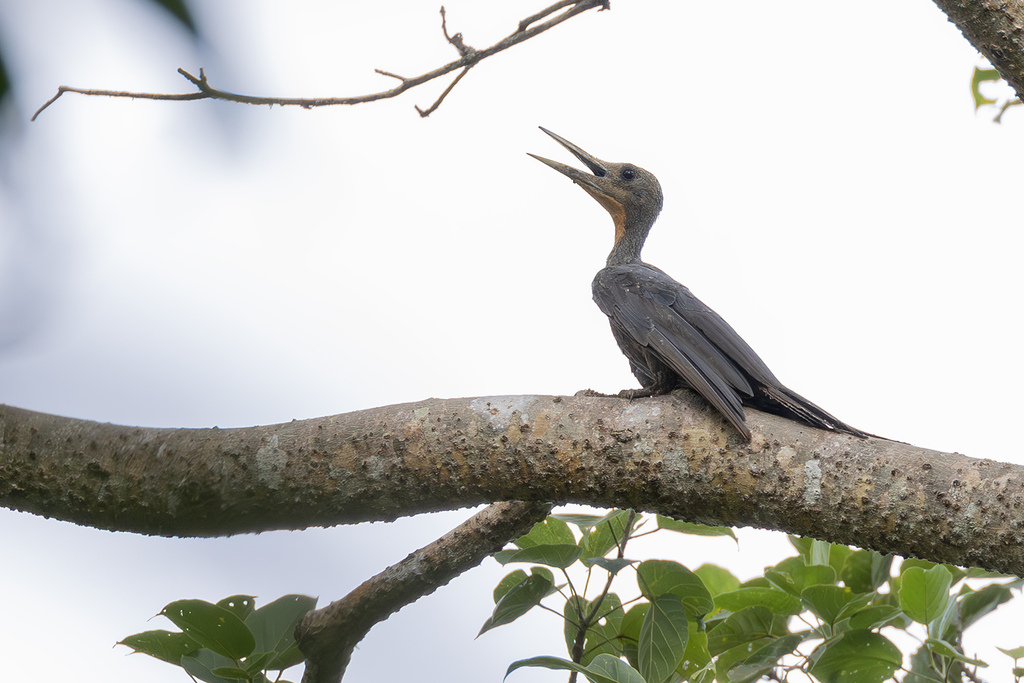
Great Slaty Woodpecker
Live sightings near you, the range map, bar charts of when it is seen, and Macaulay Library photos and recordings.
Great Slaty Woodpecker
Mulleripicus pulverulentus
The great slaty woodpecker (Mulleripicus pulverulentus) is a species of bird in the family Picidae. It is found across the Indian subcontinent and Southeast Asia. A unique and basically unmistakable bird, it is the largest confirmed living woodpecker species, behind the likely extinct imperial woodpecker and ivory-billed woodpecker.
From the article Great slaty woodpecker on Wikipedia (CC BY-SA), quoted section by section
Description
With the probable extinctions of the imperial and ivory-billed woodpeckers, this species, at 45–55 cm (18–22 in) long and a weight of 360–563 g (0.794–1.241 lb), is the largest woodpecker in the world, though the northern Eurasian black woodpecker is nearly as large with some overlap in size. The average weight was claimed in one study as 430 g (15 oz). Among standard measurements, the wing chord is 21.5 to 25 cm (8.5 to 9.8 in), the tail is 13.4 to 16.2 cm (5.3 to 6.4 in), the bill is 6 to 6.5 cm (2.4 to 2.6 in) and the tarsus is 3.6 to 4.1 cm (1.4 to 1.6 in). This unique-looking woodpecker has several obvious distinctive features, with a very long, strong chisel-tipped bill, an elongated neck, and a long tail. A slight crest may occasionally be evident. The plumage is almost entirely dark grey or blackish slate-grey, overlaid with small white spots on the head and neck. The throat is paler grey to yellowish, and males have small red moustache. The size and structure readily distinguish this bird from almost any other species, including other woodpeckers. Occasionally, at first glance, the great slaty woodpecker is mistaken for a hornbill but, obviously, such a resemblance is slight at best. For a bird of such great size, the great slaty woodpecker has a weak, quiet voice, especially compared to other large woodpeckers, which tend to have loud, booming voices. …
Range & habitat
It is found in the Indian subcontinent and Southeast Asia, ranging across Bangladesh, Bhutan, Brunei, Cambodia, India, Indonesia, Laos, Malaysia, Myanmar, Nepal, the Philippines, Singapore, Thailand and Vietnam. It is found in the Greater Sundas, but it does not inhabit Bali.
Wikipedia: “Range”
What it does
Great slaty woodpeckers are mostly seen in groups consisting of 3 to 6 individuals, which consist of a breeding pair and their young from prior years. Groups often forage on shared feeding sites in the form of nests of social insects such as ants, termites, wood-boring beetles and stingless bees. Ants seem to be generally favoured in the diet, though larvae of other species may be eaten quite regularly as well. Occasionally, small fruit may supplement the diet. Females spend more time searching for feeding sources and males, which have slightly larger bills, spend more time opening the sources. Preferred feeding sources are mostly found in large branches or trunks of large, living trees. The groups will travel considerable distance to access these trees and, as such, the home ranges of the species are quite large. Occasionally, though, they will feed at lower levels in trees and even amongst saplings. Usually, feeding groups of these woodpeckers do not linger in any given area for long. Sometimes this species associates with slightly smaller white-bellied woodpeckers and considerably smaller greater flamebacks; the foraging methods of these very different woodpeckers minimise competition between the species. Perhaps more marked competition for food sources generally comes in the form of hornbills and arboreal (or tree-dwelling) mammals. …
Wikipedia: “Ecology”
Listen
Looking for field recordings…
Where it lives
Recorded sightings
—
geo-referenced records in GBIF, from museums, herbaria and field observers.
Drag the globe to turn it. Dots are where records exist, not a range map; darker means more records.
In the stacks
Searching the stacks…
Every page naming Mulleripicus pulverulentus in the Biodiversity Heritage Library →
This page is assembled live from iNaturalist, GBIF, Wikipedia, the Source Library and the Internet Archive. It is not yet part of the hand-edited codex. iNaturalist taxon 18009.