- Animals
- ›Chordates
- ›Vertebrates
- ›Ray-finned Fishes
- ›Spiny-rayed fishes
- ›Needlefishes, Halfbeaks, and Allies
- ›Halfbeaks
- ›Hemiramphus
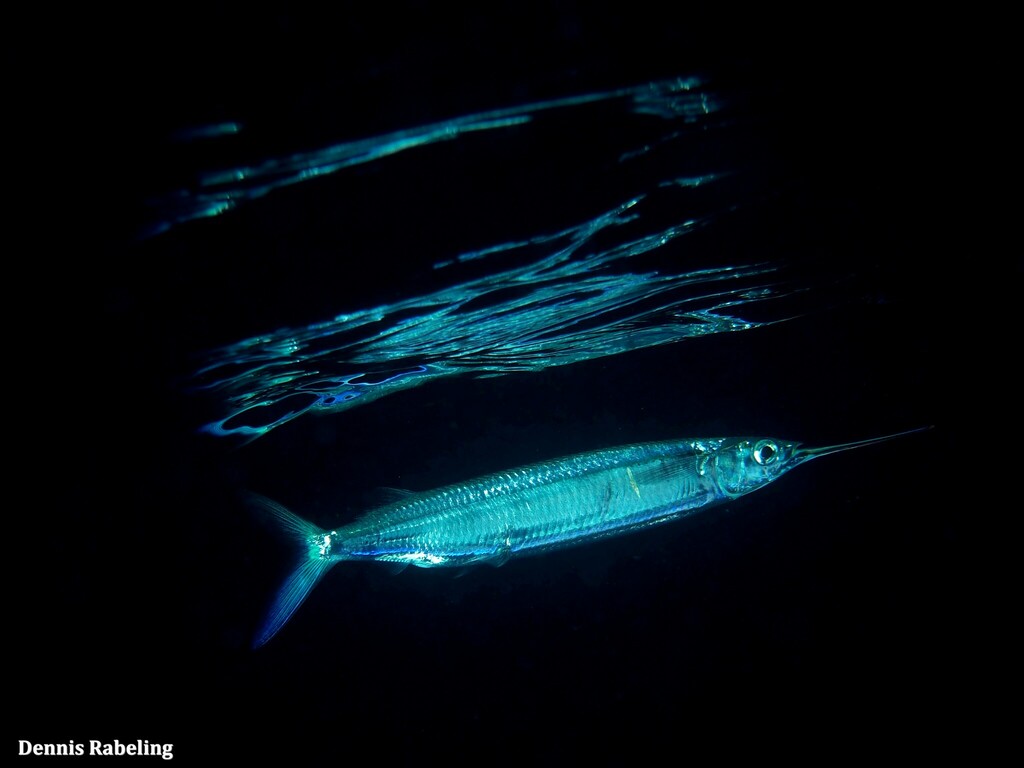
Balao Halfbeak
Hemiramphus balao
The balao halfbeak (Hemiramphus balao), occasionally called the balao for short, is an ocean-going species of fish in the family Hemiramphidae. It was first described by French naturalist Charles Alexandre Lesueur in 1821. They are used as cut bait and for trolling purposes by saltwater sportsmen.
From the article Balao halfbeak on Wikipedia (CC BY-SA), quoted section by section
Description
The balao halfbeak is similar in appearance to its relative the ballyhoo (H. brasiliensis). The main difference between the two is that the distance from the nares to the base of the pectoral fin is greater than the length of the ballyhoo's pectoral fin, while that difference is less than the length of the balao halfbeak's pectoral fin. They have no spines on their fins, but do have 11–15 rays on their dorsal fins and 10–13 rays on their anal fins. Balao halfbeaks have blue-gray skin on their backs, while their undersides are silver or white. The longest recorded balao halfbeak was 40 cm long.
Range & habitat
Balao halfbeaks are found only in the Atlantic Ocean. In the west, they are known from New York south to Brazil, including much of the Gulf of Mexico and the Caribbean. In the eastern Atlantic, they are known from the Canary Islands and the Gulf of Guinea from Victoria, Nigeria to Luanda, Angola. Balao halfbeak have also been recorded from Côte d'Ivoire. Balao halfbeaks can form fairly large schools, in which they feed on smaller fishes and zooplankton. They can be found in both brackish and marine waters and are associated with reefs. Although they are mainly used by humans as baitfish for sailfish and marlin, they are also used as food in the West Indies. Balao halfbeaks are also preyed upon by the brown noddy and the sooty tern.
Wikipedia: “Distribution and habitat”
Where it lives
Recorded sightings
—
geo-referenced records in GBIF, from museums, herbaria and field observers.
Drag the globe to turn it. Dots are where records exist, not a range map; darker means more records.
In the stacks
Searching the stacks…
Every page naming Hemiramphus balao in the Biodiversity Heritage Library →
This page is assembled live from iNaturalist, GBIF, Wikipedia, the Source Library and the Internet Archive. It is not yet part of the hand-edited codex. iNaturalist taxon 179573.