- Animals
- ›Chordates
- ›Vertebrates
- ›Ray-finned Fishes
- ›Spiny-rayed fishes
- ›Jacks, Flounders, Barracudas, and Allies
- ›Flatfishes
- ›Large-tooth Flounders
- ›Paralichthys
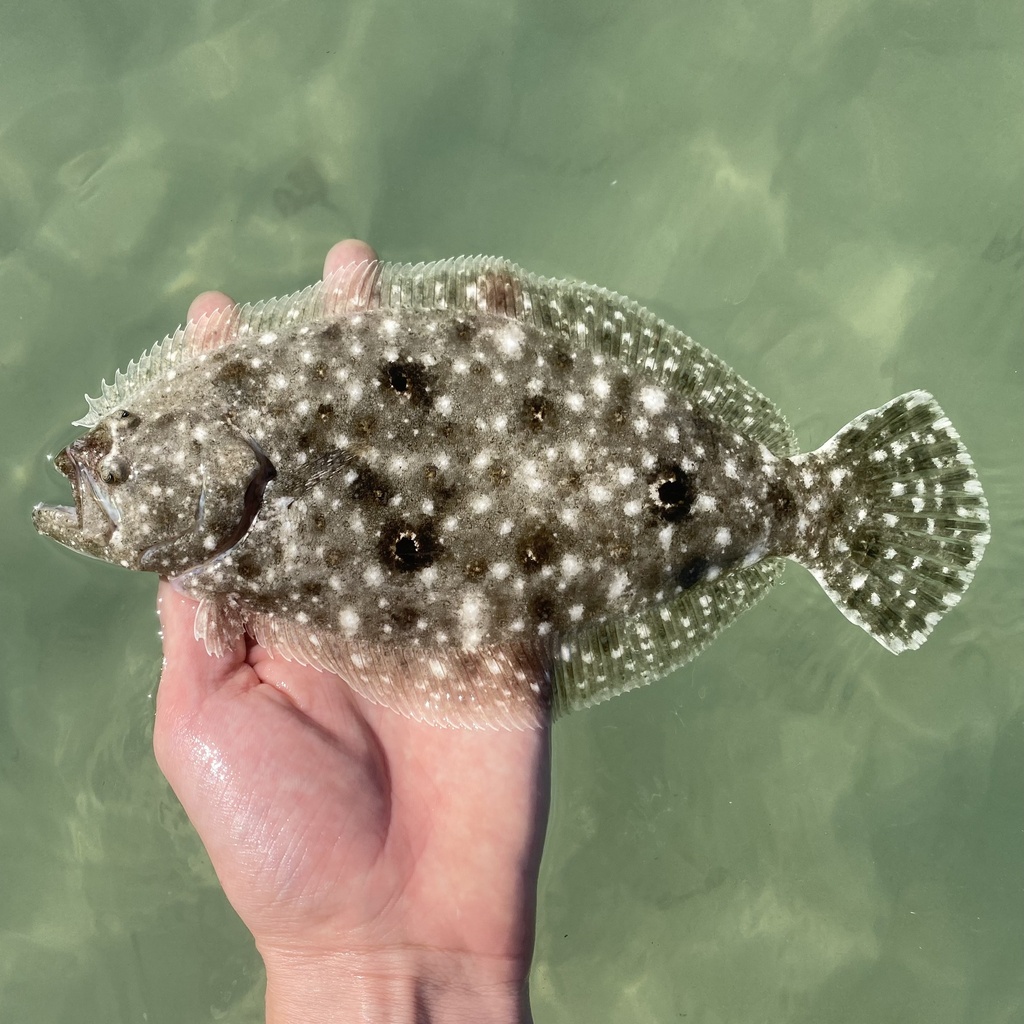
Gulf Flounder
Paralichthys albigutta
The Gulf flounder (Paralichthys albiguttata) is a species of saltwater flounder.
From the article Gulf flounder on Wikipedia (CC BY-SA), quoted section by section
Description
The Gulf flounder is a flatfish that swims on its side. Their two eyes look upward when swimming. They have sharp teeth, two eyes on their left side, and a white side opposite. Paralichthys albigutta is widely distributed in the Gulf of Mexico and a portion of the western North Atlantic. Adults are found in a variety of habitats, but generally prefer hard, sandy bottoms; juveniles settle in high salinity seagrass beds. Longevity is 7–10 years and females reach maturity between 1 and 2 years. It is commercially and recreationally exploited. The center of abundance of Paralichthys albigutta in the Gulf of Mexico is along its northeastern coast. West of the Mississippi River delta, it occurs in very low numbers. It appears to naturally occur in low abundance in seagrass beds. It is common in museum collections (660 lots). Many species of fishes, including P. albigutta, have experienced declines in abundance in the Northern Gulf of Mexico from 1970 to 2000; although Fodrie et al. (2010) attributed this at least in part to the effects of global rises in sea temperature, there are also a number of other factors (e.g., bycatch in trawl fisheries, increased recreational landings: T. Munroe pers. comm. 2015) that may contribute to these declines. …
Range & habitat
This demersal species occurs in shallow depths within estuaries and coastal environments; it is most commonly found on the continental shelf at depths of 18–92 m, but has been collected to about 130 m. It is found in a variety of habitats, including seagrass beds, coastal lagoons, flat hard-bottom and limestone ledges. It prefers hard, sandy bottoms. Juveniles utilize vegetation for habitat or are found adjacent to vegetation in estuaries. Juveniles inhabit high salinity seagrass beds and older adults occur offshore in deeper depths. It undergoes ontogenetic shifts in dietary preference, feeding on amphipods and small crustaceans at small sizes, and feeding primarily on fishes as adults. Adults spend most of the year in bays and estuaries, migrating into deeper offshore waters to spawn during fall and winter (peaking between late October and mid-December). Specimens with ripe gonads have been collected at depths of 20–40 m in the eastern Gulf of Mexico. Larvae migrate inshore during January–February. The age at maturity for females is 1 year (FWRI 2010) with all mature by 2 years and size at 50% maturity is 35–38 cm TL. Males reach maturity between 30 and 35 cm TL. Females grow faster and larger than males. Longevity for males is 8–11 years and females is 7 years (Munroe 2002).
Wikipedia: “Habitat”
Where it lives
Recorded sightings
—
geo-referenced records in GBIF, from museums, herbaria and field observers.
Drag the globe to turn it. Dots are where records exist, not a range map; darker means more records.
In the stacks
Searching the stacks…
Every page naming Paralichthys albigutta in the Biodiversity Heritage Library →
This page is assembled live from iNaturalist, GBIF, Wikipedia, the Source Library and the Internet Archive. It is not yet part of the hand-edited codex. iNaturalist taxon 179501.