- Animals
- ›Chordates
- ›Vertebrates
- ›Birds
- ›Cuckoos
- ›Cuckoos
- ›Typical Cuckoos, Malkohas, and allies
- ›Chrysococcyx
On eBird ↗
Dideric Cuckoo
Live sightings near you, the range map, bar charts of when it is seen, and Macaulay Library photos and recordings.
Diederik Cuckoo
Chrysococcyx caprius
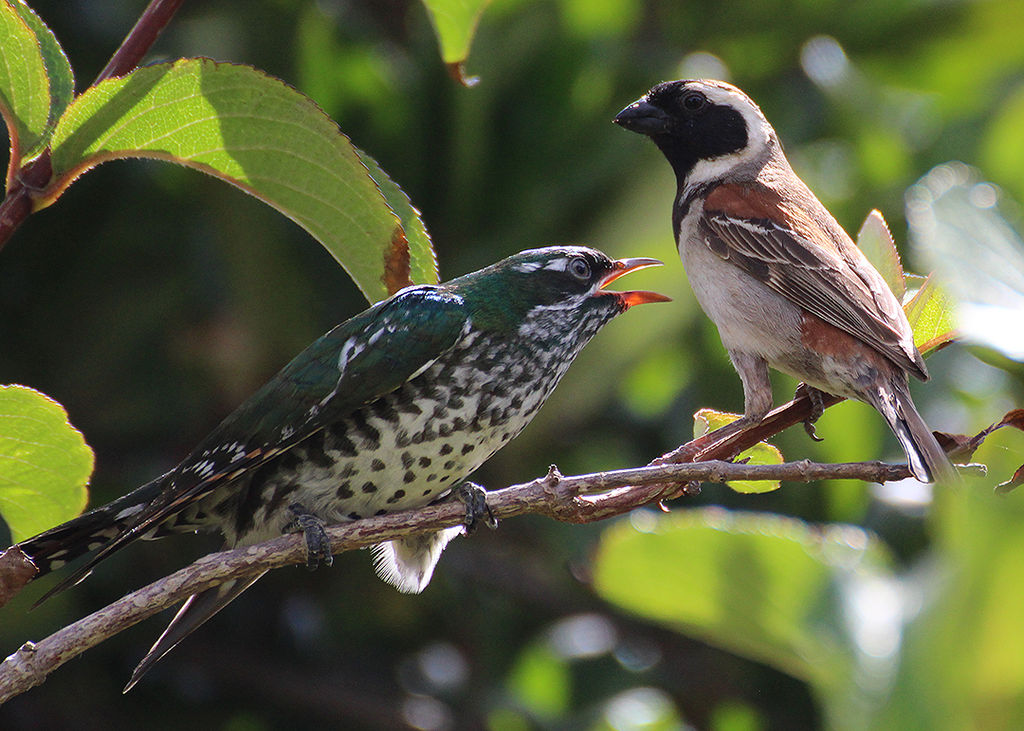
The diederik cuckoo (Chrysococcyx caprius), formerly dideric cuckoo or didric cuckoo, and sometimes called Diederik's cuckoo, is a member of the cuckoo order of birds, the Cuculiformes, which also includes the roadrunners and the anis.
From the article Diederik cuckoo on Wikipedia (CC BY-SA), quoted section by section
Description
The diederik cuckoo is a smallish cuckoo at 18 to 20 cm. Adult males are glossy green above with copper-sheened areas on the back and whitish underparts. They have a broken white eye-stripe and a short, green malar stripe. All remiges have three to four white spots on the inner vanes. The four green outer tail feathers are tipped white, and the outermost pair are spotted white on both vanes. Females show more copper above, and have coppery barring on the flanks. The underparts are often washed brownish. Juveniles have a red bill, streaky throat and a white wing-bar. They are more copper-coloured above and browner below than the females, and the flank markings are brown blotches.
Range & habitat
It is a common resident breeder in Sub-Saharan Africa and the southern Arabian Peninsula. It has been recorded as far north as Cyprus (1982 & 2023). It is a short-distance seasonal migrant, moving with the rains. It is a solitary bird, found in open woodland, savanna and riverside bushes.
Wikipedia: “Distribution and habitat”
What it does
The diederik cuckoo takes a variety of insects and insect larvae. It is a noisy species, with the persistent and loud deed-deed-deed-deed-er-ick call from which it gets its name. Usually four clear, roughly identical, notes followed by a little twitter.
Wikipedia: “Feeding”
Listen
Looking for field recordings…
Where it lives
Recorded sightings
—
geo-referenced records in GBIF, from museums, herbaria and field observers.
Drag the globe to turn it. Dots are where records exist, not a range map; darker means more records.
In the stacks
Searching the stacks…
Every page naming Chrysococcyx caprius in the Biodiversity Heritage Library →
This page is assembled live from iNaturalist, GBIF, Wikipedia, the Source Library and the Internet Archive. It is not yet part of the hand-edited codex. iNaturalist taxon 1738.