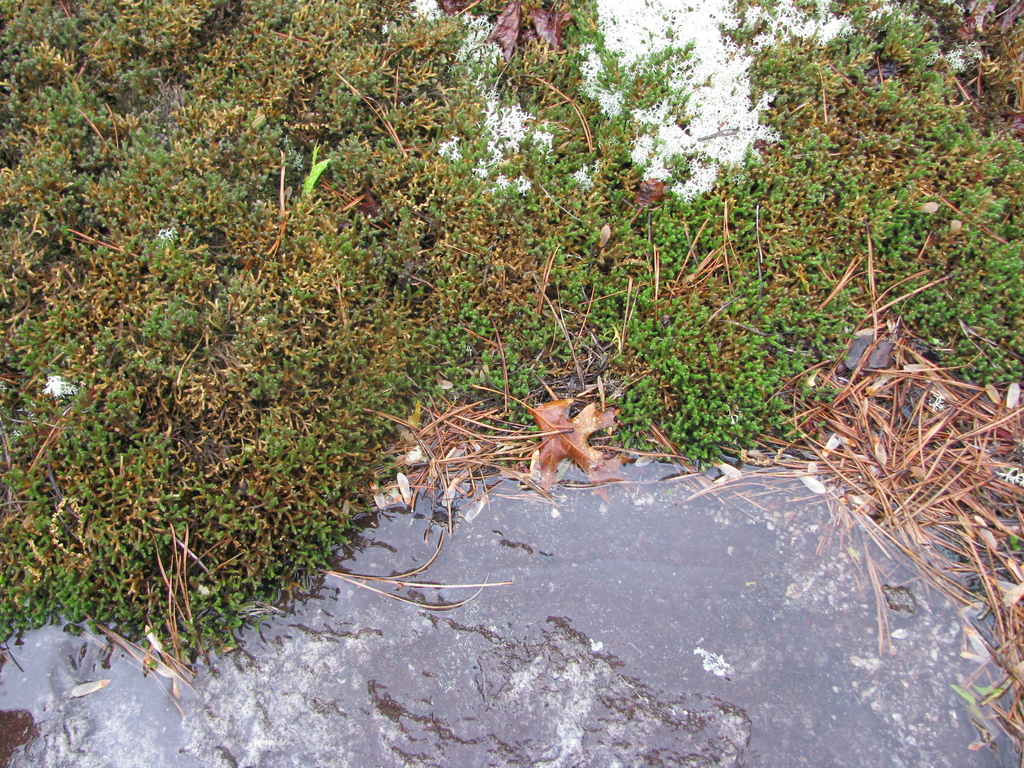
Twistedhair Spikemoss
Selaginella tortipila
Selaginella tortipila is a species in the family Selaginellaceae commonly known as twistedhiar spikemoss. It is mainly found in southeastern United States in states like North Carolina, South Carolina, Georgia and Alabama, specifically in the region of Appalachian mountains and piedmont. S. tortipila is a small and green plant which grows on rocky outcrops and granitic surfaces. Historically, there has been a long debate over whether S. tortipila and its closely relative Selaginella sherwoodii with some scientist claiming that taxonomically they are the same species. Recently, some classified S. sherwoodii as an ecological form of S. tortipila. The naming of S. tortipila is retraced back in 1865 by A. Braun and the description of S. sherwoodii by Lucien Underwood in 1902.
From the article Selaginella tortipila on Wikipedia (CC BY-SA), quoted section by section
Description
Growth and development Selaginella tortipila is frequently encountered in a vegetative developing state, during which cushion like mats characteristics can be observed in its growth. Its also can completely appear morphologically different under different conditions or in different habitats. Its stems would grow erectly with several leaves in drought like conditions in exposed regions. With enough moisture and humidity (shaded region) its stems grow prostrate with widely spread leaves. Such characterized plasticity is the origin of the debate surrounding the difference between S. tortipila and S. sherwoodii relative. Reproductive Structures Selaginella tortipila develops reproductive structures only in favorable conditions. The latter are cone-like structures called strobili. This phase of its life is crucial for survival but also important in colonization of a new habitat. It reproduces with spores. Spores remain the most vital part of the S. tortipila species, thus changes in spores structure could reshape morphologically and taxonomically the species. Scientists have recorded two sizes of spores in S. tortipila species. Megaspores with a diameter size between 0.25 mm and 0.41 mm have been observed in populations of straw-yellow to lemon chrome color range with rugose surfaces. Meanwhile, population of S. …
Wikipedia: “Morphology and life cycle”
Range & habitat
Selaginella tortipila is mainly encountered on exposed granite and granite-gneiss rock. It colonizes very high elevations ranging from 1,500 to 4,500 ft (460 to 1,370 m). In such regions, temperature is highly variable and nutrients and water are scarce. The regions with confirmed presence of S. tortipila are:
North Carolina. South Carolina. Georgia. The species have been reported seen in Tennessee but remains unconfirmed. In these regions, S. tortipila grows on rocks where it leaves grayish-green masses on slopy rocky granite. It is dependent on moss mats that provide nutrient to the spores of S. tortipila for germination.
Wikipedia: “Habitat and distribution”
What it does
Territorial Control and Dominance Selaginella tortipila completely dominates the communities and species on the rocky surfaces according to Steven S. Larson and Wade T. Batson; mainly in the regions of S. tortipila's abundance including Pickens and Greenville countries of South Carolina. High and relevant statistical percent frequency values and plant density have been well documented providing strong evidence of its dominance in the region. The strategy is to take possession of large areas on the surface of rock and then expand in all directions once well established on the surface of granite. Competition Selaginella tortipila does not grows on empty non colonized surfaces of rock. Its challenged by lack of minimum nutrients in such scenarios. In order to ensure resource provision, S. tortipila colonized preoccupied region where live pioneer succession mosses (e.g., Rhacomitrium, Andreaea) and lichen from Cladonia subspecies. Such behavior earned it the characterization of successional invader by Oosting and Lewis. Despite its high fitness in these extreme conditions, S. tortipila does not remain in control for long. As soon as species like large Lichens like Cladonia rugiferina arrive in the habitat, they outcompete S. …
Wikipedia: “Ecology”
Where it lives
Recorded sightings
—
geo-referenced records in GBIF, from museums, herbaria and field observers.
Drag the globe to turn it. Dots are where records exist, not a range map; darker means more records.
In the stacks
Searching the stacks…
Every page naming Selaginella tortipila in the Biodiversity Heritage Library →
This page is assembled live from iNaturalist, GBIF, Wikipedia, the Source Library and the Internet Archive. It is not yet part of the hand-edited codex. iNaturalist taxon 168770.