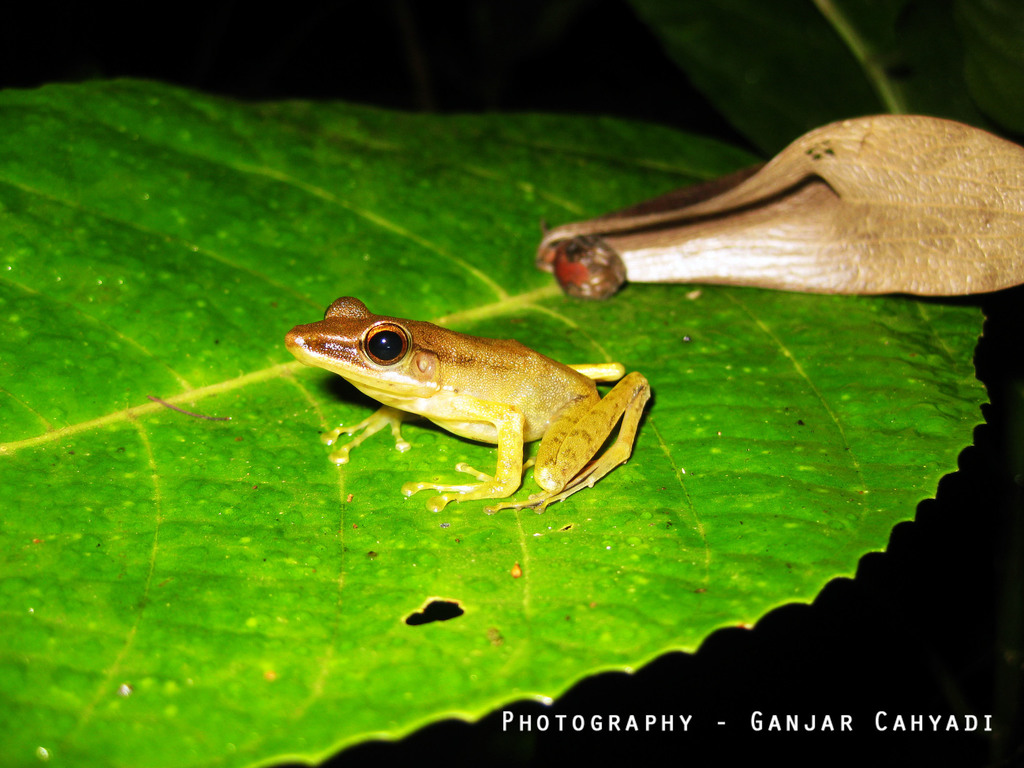
North Sumatra White-lipped Frog
Hylarana parvaccola
Chalcorana parvaccola is a species of "true frog" in the family Ranidae. It is endemic to Sumatra, Indonesia. It was split off from Chalcorana chalconota by Robert Inger and colleagues in 2009, along with a number of other species. The specific name parvaccola is derived from Latin parvus meaning small and accola meaning neighbor, and refers to this species being smaller than its "neighbor", the related Sumatran species Chalcorana rufipes.
From the article Chalcorana parvaccola on Wikipedia (CC BY-SA), quoted section by section
Description
Chalcorana parvaccola are relatively small frogs: adult males measure 28–38 mm (1.1–1.5 in) and females 38–43 mm (1.5–1.7 in) in snout–vent length. Body is slender and legs are long. The snout is narrowly rounded. The tympanum is distinct, larger in males than in females. The outer fingers have large discs; no webbing is present. The toe tips have discs that are smaller than the fingers ones. The webbing between the toes is extensive. Preserved specimens are brown dorsally and on the sides. The sides of the head are darker. The upper lip is lighter but is dusted with melanophores. There are small black spots on the dorsal surfaces. The venter is whitish and lightly dusted with melanophores. Most individuals lack dark crossbars on the hind limbs. The webbing between the toes is ventrally black.
Range & habitat
Chalcorana parvaccola is found in both pristine and disturbed rainforests as well as in gardens and artificial ponds near villages at elevations of 31–1,539 m (102–5,049 ft) above sea level. Breeding presumably takes place in water. It is a widespread and locally common frog. It could be threatened by pollution from human settlements and by expanding oil palm plantations and human settlements. It is present in several protected areas.
== References ==
Wikipedia: “Habitat and conservation”
Listen
Looking for field recordings…
Where it lives
Recorded sightings
—
geo-referenced records in GBIF, from museums, herbaria and field observers.
Drag the globe to turn it. Dots are where records exist, not a range map; darker means more records.
In the stacks
Searching the stacks…
Every page naming Hylarana parvaccola in the Biodiversity Heritage Library →
This page is assembled live from iNaturalist, GBIF, Wikipedia, the Source Library and the Internet Archive. It is not yet part of the hand-edited codex. iNaturalist taxon 1677698.