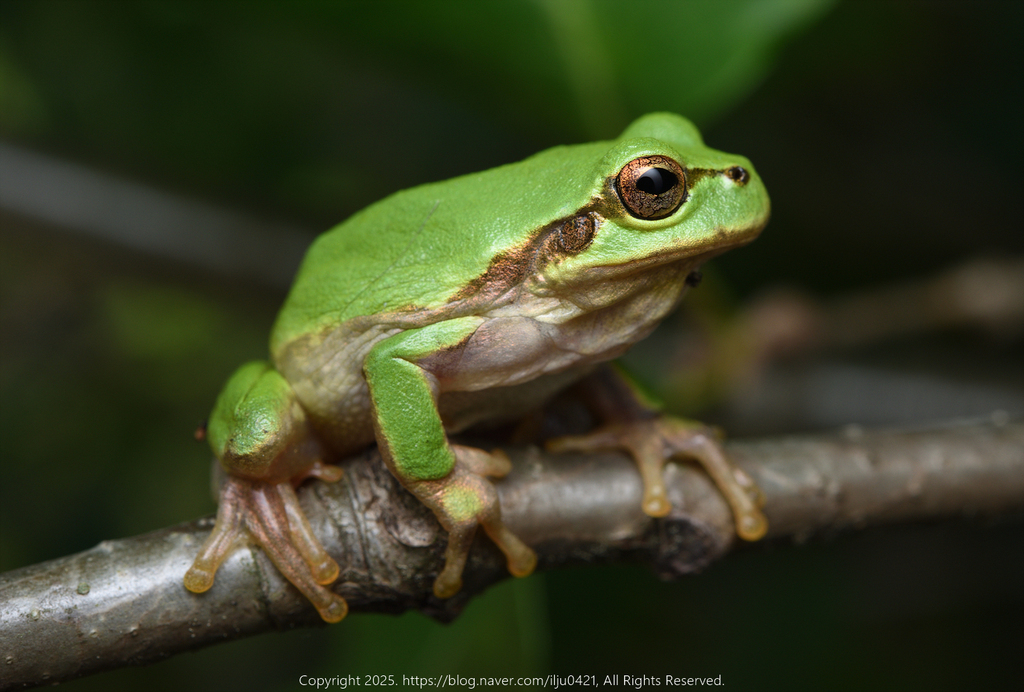
Japanese Tree Frog
Dryophytes japonicus
Dryophytes japonicus, with frequently used synonym Hyla japonica, commonly known as the Japanese tree frog, is a species of anuran native to Japan, China, and Korea. It is unique in its ability to withstand extreme cold, with some individuals showing cold resistance at temperatures as low as −30 °C for up to 120 days. Japanese tree frogs are not currently facing any notable risk of extinction and are classified by the IUCN as a species of "least concern". Notably, it has been sent to space in a study that explored the effect of microgravity on Japanese tree frogs. Some consider that Dryophytes japonicus is synonymous with Hyla japonica. However, a 2025 study treated that this species as Dryophytes japonicus again, and separated northern species as Dryophytes leopardus.
The Japanese tree frog lives in a variety of habitats such as wetlands, forests, rivers, and mountains. They are generally located near vegetation near water sources and forests. They are carnivores that prey on insects and spiders. Their average clutch size is around 340–1,500 eggs, and their lifespan is usually around six years. There is an estimated 100 million of these frogs in Japan, but the accuracy is limited due to difficulty in counting.
From the article Japanese tree frog on Wikipedia (CC BY-SA), quoted section by section
Description
Japanese tree frogs are on average 32.81±0.96 mm in length. They have an average skull width of 12.02±0.36 mm and an average skull length of 9.38±0.14 mm. The dorsal body of Japanese tree frog is green/brown and the ventral body is white. It is also characterized by a dark spot on the upper lip below the eye. Female Japanese tree frogs, on average, are larger in size compared to male. It has a dark vocal sac.
Abnormal coloration. Some Japanese tree frogs are abnormally colored. Frogs observed in South Korea were found to be entirely blue, while others yellow, with green dorsal patterns. Another frog found in Russia was observed to be fully blue, and was captured for observation, where it ultimately returned to a green/brown color. Specific reasons behind such observations in color are currently unexplained, but mutations and maladaptations have been put forth by scientists as possible explanations. Further work must be conducted in order to elucidate the mechanisms behind these color changes.
Range & habitat
Japanese tree frogs are found in many parts of Asia, specifically in Japan, China, Korea, Mongolia, and Russia. It inhabits forest-like environments, bushlands, meadows, swamps, and river valleys. Japanese tree frog, like most frog species, inhabit locations with both aquatic and terrestrial features. This is due to the necessity of the frog life cycle for both water and land.
Changes in availability of native Japanese tree frog habitats have resulted in rice paddies serving as lodging for it. It seems to be able to inhabit these rice paddies successfully and have a demonstrated preference for sites high in vegetation.
Wikipedia: “Habitat and distribution”
What it does
The behavior of Japanese tree frog when exposed to microgravity has been experimentally investigated. These frogs, under such microgravity conditions, would bend their neck backwards. These frogs would also walk backwards, an observation consistent with the behavior of sick frogs. The combination of neck backwards movement and backward walking could be indicators of motion sickness in the frogs. They were shown to adapt to the microgravity and were able to improve their jumping and perching activity over time. Japanese tree frogs, under micro-gravitational conditions, were also observed to attempt to eat but were unable to ingest the food. All the frogs that were sent to space were safely recovered and were observed to resume normal function after 2.5 hours back under normal gravity.
Wikipedia: “Behavior”
Toxicity
Japanese tree frogs have evolved against predation in arboreal environments by producing special Anntoxin-like neurotoxins from their skin. Anntoxin is a 60-residue toxic peptide that inhibits ion channels such as tetrodotoxin-sensitive voltage-gated sodium channels. While these peptides display analgesic properties after binding onto ion channels, they can harm and kill predators after frog skin consumption. Such a mechanism deters predators from further frog hunting.
Wikipedia: “Predator defense by toxic peptide secretion”
Listen
Looking for field recordings…
Where it lives
Recorded sightings
—
geo-referenced records in GBIF, from museums, herbaria and field observers.
Drag the globe to turn it. Dots are where records exist, not a range map; darker means more records.
In the stacks
Searching the stacks…
Every page naming Dryophytes japonicus in the Biodiversity Heritage Library →
This page is assembled live from iNaturalist, GBIF, Wikipedia, the Source Library and the Internet Archive. It is not yet part of the hand-edited codex. iNaturalist taxon 1668965.