- Animals
- ›Chordates
- ›Vertebrates
- ›Amphibians
- ›Frogs and Toads
- ›Hylid Tree Frogs
- ›Dryophytes
- ›Dryophytes versicolor
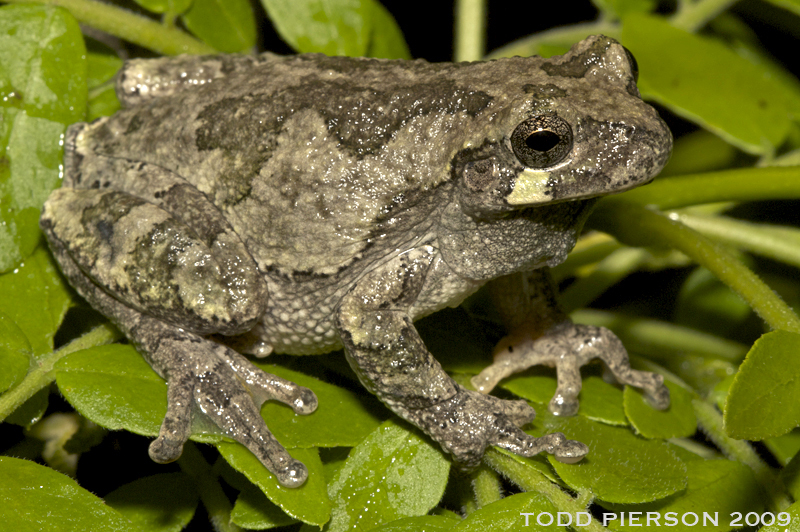
Gray Treefrog
Dryophytes versicolor
The gray treefrog (Dryophytes versicolor) is a species of small arboreal frog in the family Hylidae. The species is native to much of the eastern United States and southeastern Canada.
It is sometimes referred to as the eastern gray treefrog, northern gray treefrog, common gray treefrog, or tetraploid gray treefrog to distinguish it from its more southern, genetically distinct relative, Cope's gray treefrog.
From the article Gray treefrog on Wikipedia (CC BY-SA), quoted section by section
Description
As the specific name versicolor implies, the gray treefrog is variable in color. This ability to vary its color provides it with the ability to camouflage itself from gray to green or brown, depending on the environment around it. Dryophytes versicolor can change from nearly black to nearly white. It changes color at a slower rate than a chameleon. A unique aspect of the appearance of the gray treefrog is that its legs feature a dark band-like pattern which then contrast sharply with the black-marked bright yellow or orange under the sides of its legs and arms. Dead gray treefrogs and ones in unnatural surroundings are predominantly gray. The female does not call; however, the male does call. The female gray treefrog is usually larger than its male counterpart. The gray treefrog is relatively small compared to other North American frog species, typically attaining no more than 1.5 to 2 in (3.8 to 5.1 cm) in snout-to-vent length (SVL). The skin has a lumpy texture to it, giving it a warty appearance. This species is virtually indistinguishable from Cope's gray treefrog, the only readily noticeable difference being that Cope's gray treefrog has a shorter, faster call. This varies depending on the temperature, however, as the call rates of both gray treefrogs are temperature dependent. …
Range & habitat
The gray treefrog inhabits a wide geographic range, and can be found in most of the eastern half of the United States and as far west as central Texas and Oklahoma. It also ranges into Canada in the provinces of Quebec, Ontario, and Manitoba, with an isolated population in New Brunswick. The gray treefrog is capable of surviving freezing of its internal body fluids to temperatures as low as −8 °C (18 °F). However, when exposed to Batrachochytrium dendrobatidis, a fungal pathogen responsible for global amphibian declines, their critical temperature minimum increases, resulting in reduced cold tolerance and a greater possibility for overwintering mortality. The gray treefrog is most common in forested areas, as it is highly arboreal. Its calls are often heard in rural residential areas of the East Coast and the Midwest. It prefers to breed in semipermanent woodland ponds without fish, but it also lays eggs in swamps, vernal pools, man-made fountains and water gardens, and even in rainwater-filled swimming pool covers.
Wikipedia: “Distribution and habitat”
What it does
Male gray treefrogs rarely have large choruses, as they are mostly solitary animals, but might vocalize competitively at the height of breeding periods. The gray treefrog has been observed to congregate around windows and porch lights to eat insects that are attracted to the light. Insect larvae, mites, spiders, plant lice, harvestmen, and snails also contribute towards the diet of the gray treefrog. Some populations have a diet high in ants and beetles. However, like most frogs, Dryophytes versicolor is opportunistic and may also eat smaller frogs, including other treefrogs. There is a positive correlation between the mass of the frog's stomach contents and the distance from the pond: more beetles were found in the frog's stomach at increasing distances from the pond. During the day, it often rests on horizontal tree branches or leaves out in the open. The gray treefrog has also been observed to lie out in the direct sun. The gray tree frog is less prone to overheating and desiccation than other amphibians and relies on its camouflage to hide itself from predators.
Wikipedia: “Behavior”
Listen
Looking for field recordings…
Where it lives
Recorded sightings
—
geo-referenced records in GBIF, from museums, herbaria and field observers.
Drag the globe to turn it. Dots are where records exist, not a range map; darker means more records.
In the stacks
Searching the stacks…
Every page naming Dryophytes versicolor in the Biodiversity Heritage Library →
This page is assembled live from iNaturalist, GBIF, Wikipedia, the Source Library and the Internet Archive. It is not yet part of the hand-edited codex. iNaturalist taxon 1668923.