On eBird ↗
Blue-headed Coucal
Live sightings near you, the range map, bar charts of when it is seen, and Macaulay Library photos and recordings.
Blue-headed Coucal
Centropus monachus
The blue-headed coucal (Centropus monachus) is a species of cuckoo in the Cuculidae family. It is native to tropical central Africa where its typical habitat is swamps, river banks, forest edges and generally wet locations. It is a common bird with a wide range, and the International Union for Conservation of Nature has rated its conservation status as being of "least concern".
From the article Blue-headed coucal on Wikipedia (CC BY-SA), quoted section by section
Description
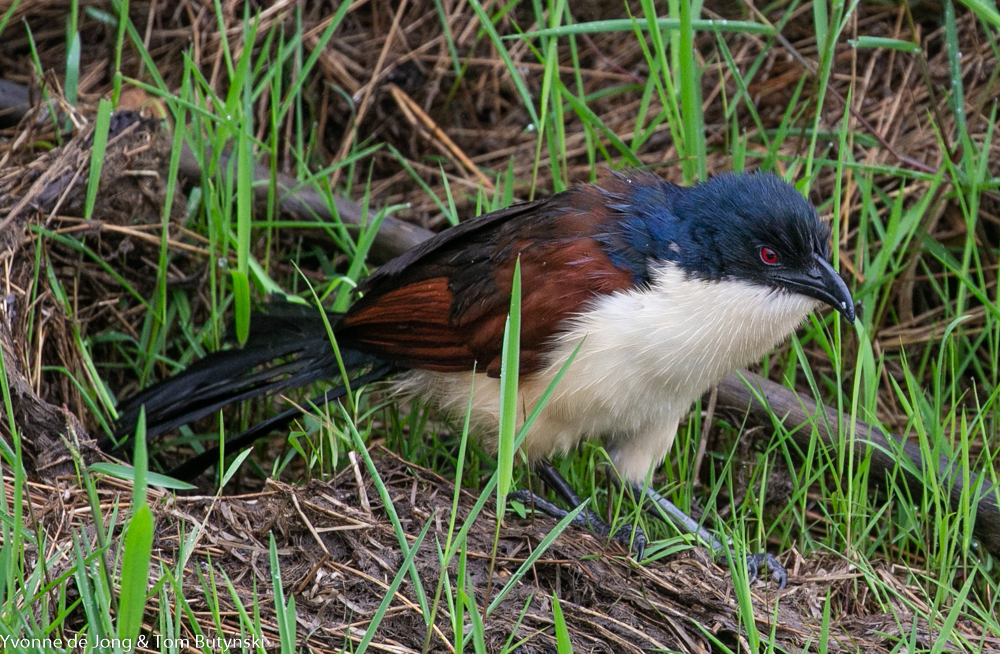
The blue-headed coucal is a medium-sized species growing to 45 to 52 cm (18 to 20 in) in length. The sexes are similar, the adult having the head, sides of neck and back black, glossed with blue, the lower back and rump black, the wings predominantly deep chestnut and the tail black, glossed with green or bronze. The underparts are white or pale buff. The eyes are dark red, the beak black and the legs and feet greyish-black. The juvenile is similar to the adult but the black areas are dull rather than glossy; the head is streaked with rufous-buff, the wings are dark chestnut heavily barred with dark brown, and the back and tail are barred with buff. The throat and breast feathers are spotted with black.
Range & habitat
The blue-headed coucal occurs in tropical central Africa at altitudes of up to 3,000 m (9,800 ft), generally at higher altitudes than the Senegal coucal (Centropus senegalensis). It is found in Angola, Benin, Burundi, Cameroon, Central African Republic, Chad, Republic of the Congo, Democratic Republic of the Congo, Ivory Coast, Equatorial Guinea, Eritrea, Ethiopia, Gabon, Ghana, Guinea, Guinea-Bissau, Kenya, Liberia, Mali, Nigeria, Rwanda, Sudan, Tanzania, Togo, and Uganda. Its habitat is swamps and marshes, tall grassland, river banks, wet savannah, plantations, secondary growth forest, farmland and villages.
== References ==
Wikipedia: “Distribution and habitat”
Listen
Looking for field recordings…
Where it lives
Recorded sightings
—
geo-referenced records in GBIF, from museums, herbaria and field observers.
Drag the globe to turn it. Dots are where records exist, not a range map; darker means more records.
In the stacks
Searching the stacks…
Every page naming Centropus monachus in the Biodiversity Heritage Library →
This page is assembled live from iNaturalist, GBIF, Wikipedia, the Source Library and the Internet Archive. It is not yet part of the hand-edited codex. iNaturalist taxon 1653.