Green Tree Frog
Pelodryas caerulea
The Australian green tree frog (Pelodryas caerulea), also known as simply green tree frog in Australia, White's tree frog, or dumpy tree frog, is a species of tree frog native to Australia and New Guinea, with introduced populations in the United States and New Zealand, though the latter is believed to have died out. It is morphologically similar to some other members of its family, particularly the magnificent tree frog (P. splendida) and the white-lipped tree frog (Sandyrana infrafrenata).
Larger than most Australian frogs, the Australian green tree frog reaches 10 cm (4 in) or more in length. Its average lifespan in captivity, about 16 years, is long compared with most frogs. Docile and well suited to living near human dwellings, Australian green tree frogs are often found on window sills or inside houses, eating insects drawn by the light. The green tree frog screams when it is in danger to scare off its foe, and squeaks when it is touched.
From the article Australian green tree frog on Wikipedia (CC BY-SA), quoted section by section
Description
The green tree frog is a plump, rather large tree frog, and can grow up to 11.5 cm (4.5 in) in length, with fully grown females being slightly larger than males. A distinctive fatty ridge is seen over the eye, and the parotoid gland is moderately large. The iris is golden and has a horizontally slit pupil, and the tympanum (a skin membrane similar to an eardrum) is visible just behind the eye. Selective breeding has also resulted in blue irises. The forelimbs are short and robust while the hind limbs extend to be very long, and large, circular adhesive discs at the end of each digit provide grip while climbing. The fingers are about one-third webbed, and the toes nearly three-quarters webbed. The dorsal colour depends on the temperature and nature of the environment, ranging from brown, brownish- or greyish-green, to bright emerald green. Selective breeding in captivity has also resulted in "honey"-toned individuals whose colors vary from mauve to pale yellow. The frog occasionally has small, irregularly shaped white spots on its back. Selective breeding in captivity has resulted in individuals with a greater number of these white spots. Males have a wrinkled vocal sac under the throat which can vary in color from grey to yellow, while the throat of females is white and the skin is more taut. …
Range & habitat
The green tree frog is native to northern and eastern regions of Australia and to the lowlands of New Guinea. Distribution is limited mostly to areas with warm, wet tropical climates. Its range spans from Irian Jaya to Port Moresby, and is most abundant on Daru Island. The IUCN suggests "scattered locations" in both New Guinea and Indonesia. In Australia, its range extends from the Kimberley region of Western Australia through the Northern Territory and Queensland to north and central New South Wales and the extreme northeasterly part of South Australia. Its total extent of land occupancy is around 4,078,600 square kilometres (1,574,800 sq mi). The species has been introduced to both the United States and New Zealand. In the United States, it is restricted to two regions within Florida, where it was possibly introduced through the pet trade. Only small populations have been found there, and whether they have caused any ecological damage as an invasive species is unknown. In New Zealand, several individuals were liberated in various locations in 1897 and 1899, and a further accidental introduction was made in the 1940s. No sightings have been reported of this species since the 1950s. Depending on their location, green tree frogs occupy various habitats. They prefer moist forests but are not strictly limited to tropical rainforests. …
Wikipedia: “Distribution and habitat”
What it does
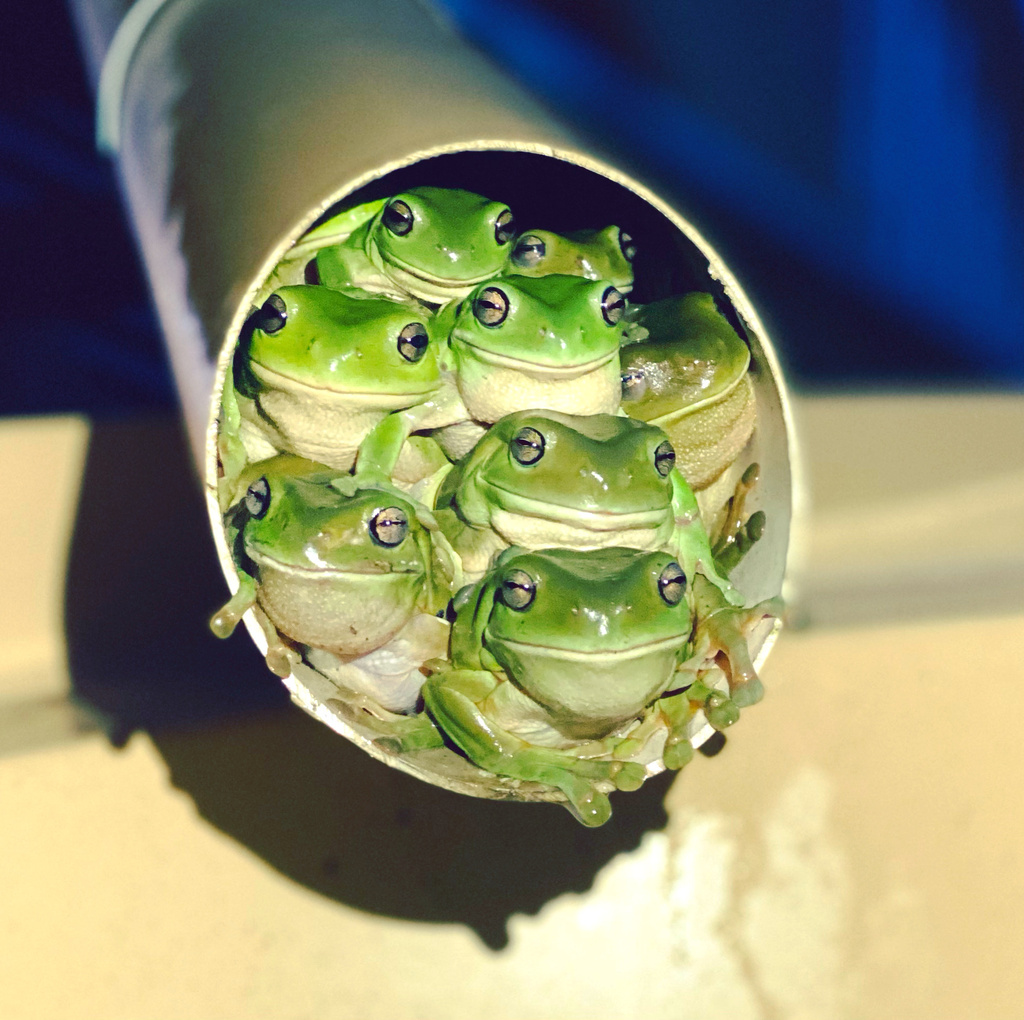
Australian green tree frogs are very docile and unafraid of humans. They are nocturnal and come out in early evenings to call (in spring and summer) and hunt for food. During the day, they find cool, dark, and moist areas, such as tree holes or rock crevices, in which to sleep. They are not a rainforest species, but make use of the rain that falls almost daily and collects on leaves and in crevices, to keep themselves moist. Their skin exudes a waxy coating that helps prevent evaporation. In dry periods, they avoid desiccation by concealing themselves in a cool spot, perhaps by burrowing, and enveloping themselves in a cocoon made of shed skin and mucus. While there is insufficient evidence proving that they are a social species, they have also been shown to gather together in "clumps" while sleeping, possibly to conserve moisture through skin-to-skin contact. The diet of the green tree frog consists mainly of insects such as moths, cockroaches, and locusts. They also eat spiders and can include smaller frogs and even small mammals (including bats, such as little bent-wing bats, microbats and other unidentified bats) among their prey. Frog teeth are not suited to cutting up prey, so the food item must be small enough to fit inside its mouth.
Many frogs flick out their sticky tongues at prey and the victim sticks to the tip and is drawn back into the mouth and consumed. …
Wikipedia: “Ecology and behaviour”
Listen
Looking for field recordings…
Where it lives
Recorded sightings
—
geo-referenced records in GBIF, from museums, herbaria and field observers.
Drag the globe to turn it. Dots are where records exist, not a range map; darker means more records.
In the old herbals & bestiaries

Mark Catesby — Piscium, serpentum, insectorum (pt. 1) (1750)
Mark Catesby · 1750 · p.222

August Johann Rösel von Rosenhof — Historia naturalis ranarum nostratium (1758)
August Johann Rösel von Rosenhof · 1758 · p.109

The Natural History of Carolina Florida and Bahama Islands Vol. 2
Mark Catesby · 1743 · p.220
In the stacks
Searching the stacks…
Every page naming Pelodryas caerulea in the Biodiversity Heritage Library →
This page is assembled live from iNaturalist, GBIF, Wikipedia, the Source Library and the Internet Archive. It is not yet part of the hand-edited codex. iNaturalist taxon 1633145.