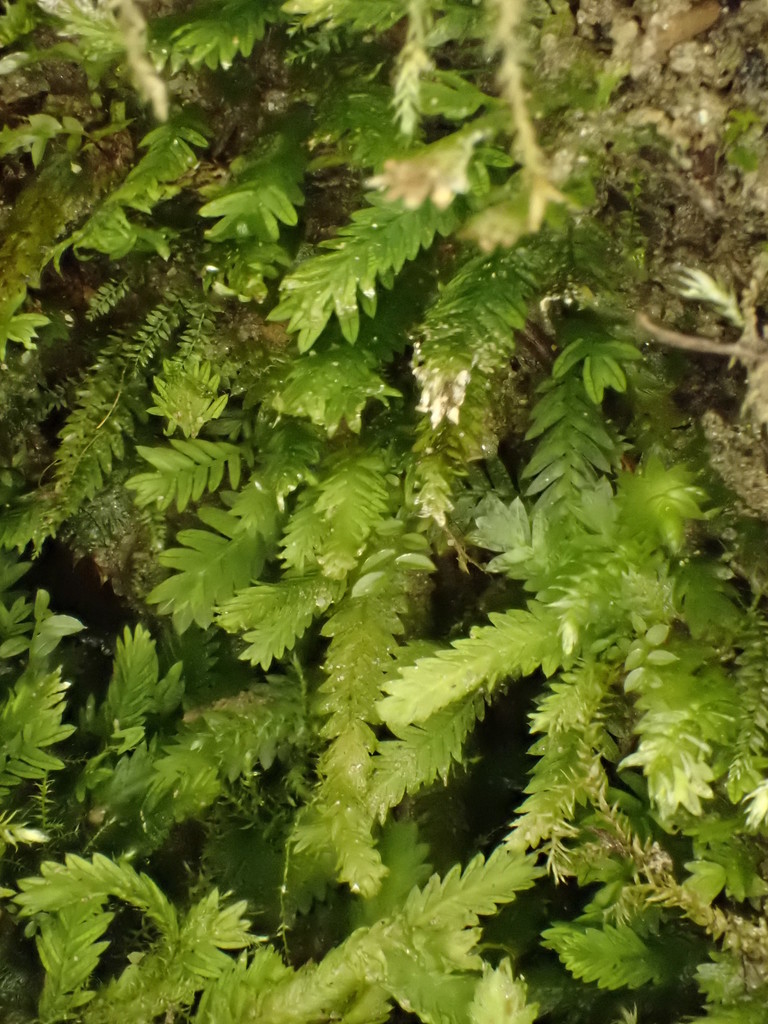
Common Pocket-moss
Fissidens taxifolius
Fissidens taxifolius, the common pocket moss, is a species of moss in the family Fissidentaceae. First described by Johann Hedwig in 1801, it is a small to medium-sized moss that typically grows in dense, yellowish-green to dark green tufts. The species is characterised by its distinctive flattened appearance, with leaves arranged in two opposite rows resembling tiny fern fronds, and by its pointed leaf tips with projecting central nerves. It can grow in artificial light and is known to form extensive turfs in suitable conditions.
The species has a nearly cosmopolitan distribution, being particularly common in the Northern Hemisphere across Europe, North America, Asia, and Africa, with populations in the Pacific region. While primarily growing on soil and soil-covered rocks in wet, shaded areas, it also occurs in modified environments such as urban parks and gardens. The species shows significant regional variation in both morphology and reproduction. In Europe and North America, populations are typically autoicous, with both male and female organs on the same plant, and readily produce spores, whereas Pacific populations are often dioicous and reproduce primarily through vegetative means. Fissidens taxifolius is assessed as a least-concern species on the IUCN Red List due to its large, stable populations across its range and the lack of major threats to its survival.
From the article Fissidens taxifolius on Wikipedia (CC BY-SA), quoted section by section
Description
Fissidens taxifolius is a small to medium-sized moss. It typically grows in dense, yellowish-green to dark green tufts. The plant's upright stems grow 5–22 mm tall and up to 4 mm wide, often branching from the base. Like other members of the genus Fissidens, it has a distinctive flattened appearance, with leaves arranged in two opposite rows that resemble a tiny fern frond. The individual leaves are oblong-lanceolate (spear-shaped) and measure 1.4–2.4 mm in length. A notable characteristic is the leaf tip, which comes to a sharp point (acute) and usually extends into a small projection (mucro or cusp). The leaves have a unique folded structure typical of Fissidens species, with the lower portion forming a sheath that wraps around the stem for half to two-thirds of the leaf length. The species produces smooth rhizoids, unlike some related species like F. osmundoides which has papillose rhizoids (covered with small bumps). Each leaf has a strong central nerve (costa) that typically extends beyond the leaf tip. The leaf margins are finely toothed (serrulate). The cells making up the leaf surface are small, square to hexagonal in shape, and slightly bulging, giving the leaves a cloudy or opaque appearance. These cells measure about 8–10 micrometres (μm) in length, with some variation. The species can reproduce both sexually and asexually. …
Range & habitat
Fissidens taxifolius has an incompletely cosmopolitan distribution, being particularly common in the Northern Hemisphere. The species has been documented across Europe, North and South America, Asia, Africa, and the Pacific region. It is absent from Antarctica, very rare in sub-Saharan Africa, and not known from Australia. The species is rare or absent in boreal and arctic regions. It has an exceptionally wide presence, occurring in Algeria, Armenia, Austria, Bermuda, Brazil, Burma, Canada, Chad, Cuba, Denmark, Dominican Republic, Egypt, France, Germany, Guatemala, Haiti Islands, Honduras, Ireland, Japan, Mexico, Netherlands, New Zealand, Norway, Papua New Guinea, Poland, Portugal, Russia, Spain, Sweden, Switzerland, Taiwan, Thailand, Turkey, United Kingdom, and United States of America. Fissidens taxifolius is known to be able to use artificial light to grow in places which are otherwise devoid of natural light, such as Crystal Cave in Wisconsin.
Habitat and ecology. The species typically grows on bare earth in lightly shaded conditions, forming extensive turfs that can cover several square metres when conditions are favourable. It is particularly characteristic of woodland and forest on base-rich and neutral soils, and commonly occurs in stream valleys and rocky slopes. …
Wikipedia: “Habitat, distribution, and ecology”
What it does
The species exhibits different reproductive patterns across its range. In Europe and North America, it is autoicous, meaning both male and female reproductive organs are found on the same plant. However, in other regions including New Zealand, Hawaii, and Papua New Guinea, populations appear to be dioicous, with male and female reproductive organs on separate plants. In some Pacific regions, only female plants have been found, and the species appears to reproduce primarily through vegetative means rather than spore production.
Wikipedia: “Reproduction”
Where it lives
Recorded sightings
—
geo-referenced records in GBIF, from museums, herbaria and field observers.
Drag the globe to turn it. Dots are where records exist, not a range map; darker means more records.
In the stacks
Searching the stacks…
Every page naming Fissidens taxifolius in the Biodiversity Heritage Library →
This page is assembled live from iNaturalist, GBIF, Wikipedia, the Source Library and the Internet Archive. It is not yet part of the hand-edited codex. iNaturalist taxon 163024.