- Animals
- ›Chordates
- ›Vertebrates
- ›Birds
- ›Cranes, Rails, and Allies
- ›Rails, Gallinules, and Coots
- ›Rufirallus
On eBird ↗
Red-and-white Crake
Live sightings near you, the range map, bar charts of when it is seen, and Macaulay Library photos and recordings.
Red-and-white Crake
Rufirallus leucopyrrhus
The red-and-white crake (Rufirallus leucopyrrhus) is a species of bird in subfamily Rallinae of family Rallidae, the rails, gallinules, and coots. It is found in Argentina, Brazil, Paraguay, and Uruguay. This species was formerly placed in the genus Laterallus.
From the article Red-and-white crake on Wikipedia (CC BY-SA), quoted section by section
Description
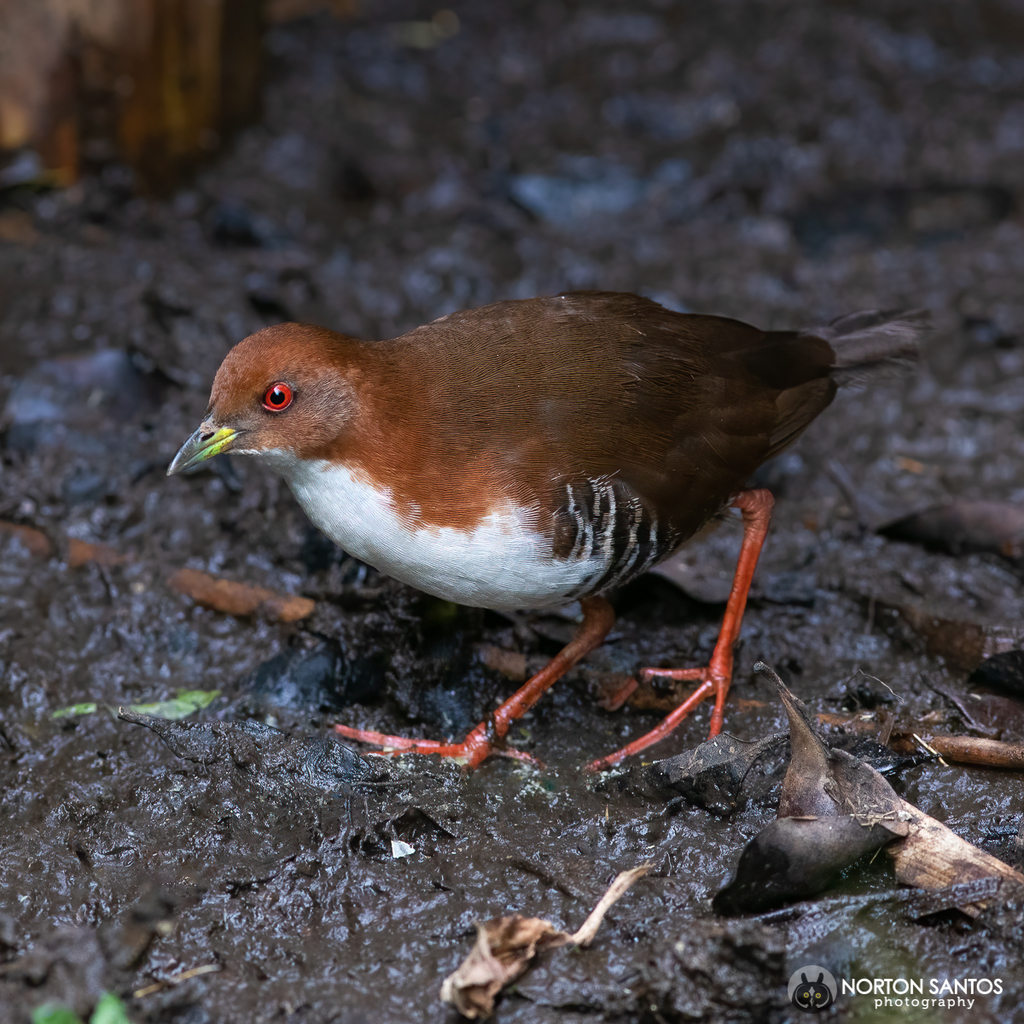
The red-and-white crake is 14 to 17 cm (5.5 to 6.7 in) long and weighs 34 to 52 g (1.2 to 1.8 oz) with an average of about 45 g (1.6 oz)). The sexes are alike. Their head, neck and back are bright chestnut with a sharp demarcation from their white throat and breast. The rest of their upperparts are dark olive brown, and their flanks are barred black and white. Their unique undertail coverts as a whole have a black center and white edges. Their legs are bright coral red to salmon-pink and their bill is black with a yellow base and mandible and a light green to light blue tip. The song is "a prolonged throaty chatter; also described as a resonant trill", sometimes given in duet. An alarm call is "a low cui whistle" and a call believed to be aggressive is a "harsh chrrrrrr...".
Range & habitat
The red-and-white crake is found in southeastern Brazil from Río de Janeiro state south through eastern Paraguay and much of Uruguay into northeastern Argentina as far as northern Buenos Aires Province. It inhabits a variety of wet landscapes that generally have shallow water to moist soil, tall or matted grasses or reeds, and often shrubs, thickets, and scattered small trees. It appears to be a year-round resident throughout its range.
Wikipedia: “Distribution and habitat”
What it does
The red-and-white crake usually forages by itself, walking on the ground or climbing among vegetation. Its diet is mostly small invertebrates such as insects and worms, and also includes seeds.
Wikipedia: “Feeding”
Listen
Looking for field recordings…
Where it lives
Recorded sightings
—
geo-referenced records in GBIF, from museums, herbaria and field observers.
Drag the globe to turn it. Dots are where records exist, not a range map; darker means more records.
In the stacks
Searching the stacks…
Every page naming Rufirallus leucopyrrhus in the Biodiversity Heritage Library →
This page is assembled live from iNaturalist, GBIF, Wikipedia, the Source Library and the Internet Archive. It is not yet part of the hand-edited codex. iNaturalist taxon 1583682.