On eBird ↗
Three-banded Plover
Live sightings near you, the range map, bar charts of when it is seen, and Macaulay Library photos and recordings.
Three-banded Plover
Thinornis tricollaris
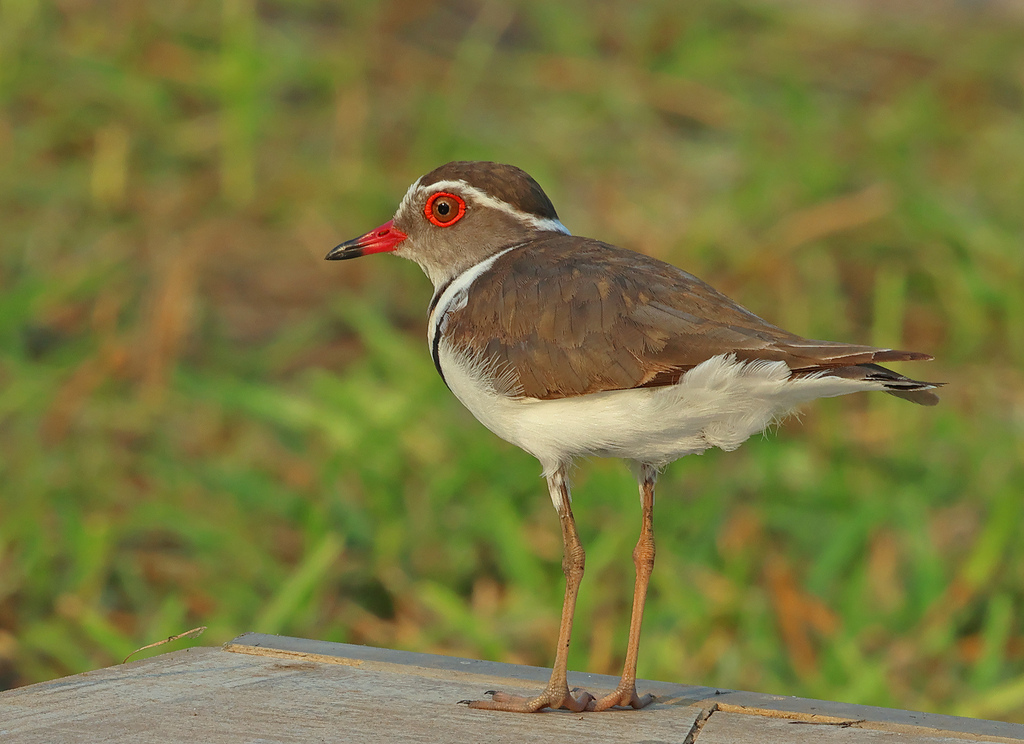
The three-banded plover, or three-banded sandplover (Charadrius tricollaris, syn.: Thinornis tricollaris), is a small wader. This plover is resident and generally sedentary in much of East Africa, southern Africa and Madagascar. It occurs mainly on inland rivers, pools, lakes and pans, frequenting their exposed shores. This species is often seen as single individuals, but it will form small flocks. It hunts by sight for insects, worms and other invertebrates. Three-banded plovers have a sharp whistled weeet-weet call. Its larger and darker-plumaged sister species, Forbes's plover, replaces it in West Africa and in the moist tropics. The two species have largely allopatric breeding ranges. Both species present a distinctively elongated profile, due to their proportionally long tail and wings.
From the article Three-banded plover on Wikipedia (CC BY-SA), quoted section by section
Description
The adult three-banded plover is 18 cm in length. It has long wings and a very long tail, and therefore looks different from most other small plovers in flight, the exception being the closely related Forbes's plover. The adult three-banded plover has medium brown upperparts, and the underparts are white except for the two black breast bands, separated by a white band, which give this species its common and scientific names. The head is strikingly patterned, with a black crown, white supercilia extending from the white forehead to meet on the back of the neck, and a grey face becoming brown on the neck. The orbital ring is orange-red, and the base of the otherwise black bill is rosy red in colour. The Malagasy subspecies C. t. bifrontatus has a grey band between the bill and the white forehead, and the sides of the head are grey. A genetic study reported genetic differentiation between Madagascar and the mainland population. The sexes are similar with respect to plumage and size. Juveniles of the nominate and Malagasy subspecies also resemble the adults, although the forehead is brownish for a short time, and the wing coverts show buff fringes. This species is distinguished from the larger and darker Forbes's plover in that the latter has a brown forehead and lacks a white wingbar.
Listen
Looking for field recordings…
Where it lives
Recorded sightings
—
geo-referenced records in GBIF, from museums, herbaria and field observers.
Drag the globe to turn it. Dots are where records exist, not a range map; darker means more records.
In the stacks
Searching the stacks…
Every page naming Thinornis tricollaris in the Biodiversity Heritage Library →
This page is assembled live from iNaturalist, GBIF, Wikipedia, the Source Library and the Internet Archive. It is not yet part of the hand-edited codex. iNaturalist taxon 1580335.