- Animals
- ›Chordates
- ›Vertebrates
- ›Birds
- ›Hawks, Eagles, Kites, and Allies
- ›Hawks, Eagles, and Kites
- ›Typical Hawks and Harriers
- ›Astur
On eBird ↗
Cooper's Hawk
Live sightings near you, the range map, bar charts of when it is seen, and Macaulay Library photos and recordings.
Cooper's Hawk
Astur cooperii
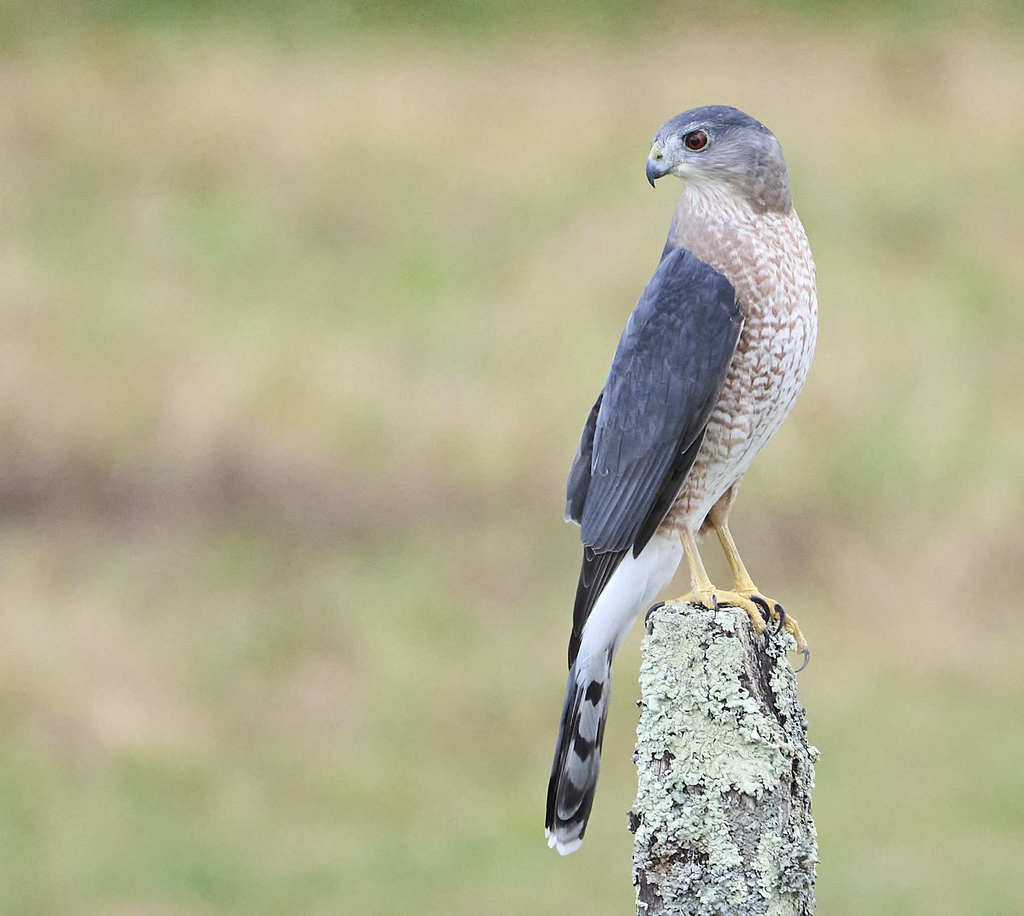
Cooper's hawk (Astur cooperii) is a medium-sized hawk native to the North American continent and found from southern Canada to Mexico. This species was formerly placed in the genus Accipiter.
As in many birds of prey, the male is smaller than the female. The birds found east of the Mississippi River tend to be larger on average than the birds found to the west. It is easily confused with the smaller but similar sharp-shinned hawk (Accipiter striatus).
From the article Cooper's hawk on Wikipedia (CC BY-SA), quoted section by section
Description
The Cooper's Hawk is a medium-sized hawk, though it errs on the smaller size compared to other species within Astur. Compared to related species, it tends to have moderate-length wings, a long, often graduated or even wedge-shaped tail, and long though moderately thick legs and toes. Its eyes tend to be set well forward in the sides of the relatively large and squarish-looking head (though the head can look somewhat rounded if the feathers on the nape are held flush) and a relatively short but robust bill. It has a hooked bill well-adapted for tearing the flesh of prey, as is typical of raptors. Generally, Cooper's hawks can be considered secretive, often perching within the canopy, but uses more open perches, especially in the western part of the range or in winter, when they may use leafless or isolated trees, utility poles, or exposed stumps. On perched hawks, the wing tips tend to appear to cover less than one-third of the tail, sometimes seeming to barely cover the covert feathers. As adults, they may be a solid blue-gray or brown-gray color above. Adults usually have a well-defined crown of blackish-brown feathers above a paler nape and hind neck offset against their streaked, rufous cheeks. Their tails are blue-gray on top and pale underneath, barred with three black bands in a rather even pattern and ending in a rather conspicuous white tip. …
Range & habitat
Cooper's hawk's breeding range extends from southern Canada to northern Mexico. In southern Canada, they breed (but do not normally winter) in the southerly parts of the provinces of British Columbia, Alberta, Saskatchewan, Manitoba, Ontario, Quebec to extreme southwestern Nova Scotia. The northern extent of their breeding range reaches roughly to Jasper National Park and Cedar Lake, Manitoba. Cooper's hawks can be found across the entirety of the contiguous United States at some part of the year, excepting the northernmost region of Maine. Their breeding range terminates along the Gulf Coast and south Florida, and south of the Rio Grande, excepting their Mexican breeding range consisting of northern Baja California, the mountains from eastern Sonora and Chihuahua to Durango, also recently in northern Coahuila, formerly east into Nuevo Leon and south to Michoacán and possibly still in Guerrero. In Oaxaca, records show that the species has been recorded year-around with the first confirmed breeding reported in 2001. In winter, they are found up to the southern half of Washington, the southern two-thirds of Idaho and Wyoming, southern South Dakota, the southern parts of Minnesota, Wisconsin, and Michigan, extreme southwestern Ontario, southwestern and southeastern New York, and New England through all but northwestern Massachusetts and to the southeastern part of New Hampshire. …
Wikipedia: “Distribution and habitat”
What it does
This species tends to be active earlier in the morning than sharp-shinned hawks and in the morning than in the afternoon. These hawks may readily take to conifers to roost, generally sleeping with their heads tucked in. During daylight hours, they tend to preen while sitting on a perch about 11 times a day, and may take about up to 20 minutes to do so. When drinking, Cooper's hawks prefer relatively secluded waterways. In more arid regions, they may seek artificial bodies of water to drink from. Although a rare behavior, several cases of juvenile hawks proning, wherein they lie on their backs along a branch (or rarely the ground), apparently as a form of sunning, have been reported. Cooper's hawks may walk on ground to gather nesting materials or hunt. Their well-developed muscle mass powers their flight, especially helping with acceleration during hunts and when carrying heavy prey, but some other nonraptorial birds may have similar muscularity relative to their mass, such as the Canada goose (Branta canadensis) and even pied-billed grebes (Podilymbus podiceps), and these ample muscle masses may be correlated with migratory (rather than hunting) behavior. Cooper's hawks have been recorded as engaging in an exaggerated, nighthawk-like flight in noncourtship circumstances, such as during migration or by recent fledglings.
Migration. …
Wikipedia: “Behavior”
Listen
Looking for field recordings…
Where it lives
Recorded sightings
—
geo-referenced records in GBIF, from museums, herbaria and field observers.
Drag the globe to turn it. Dots are where records exist, not a range map; darker means more records.
In the stacks
Searching the stacks…
Every page naming Astur cooperii in the Biodiversity Heritage Library →
This page is assembled live from iNaturalist, GBIF, Wikipedia, the Source Library and the Internet Archive. It is not yet part of the hand-edited codex. iNaturalist taxon 1579017.