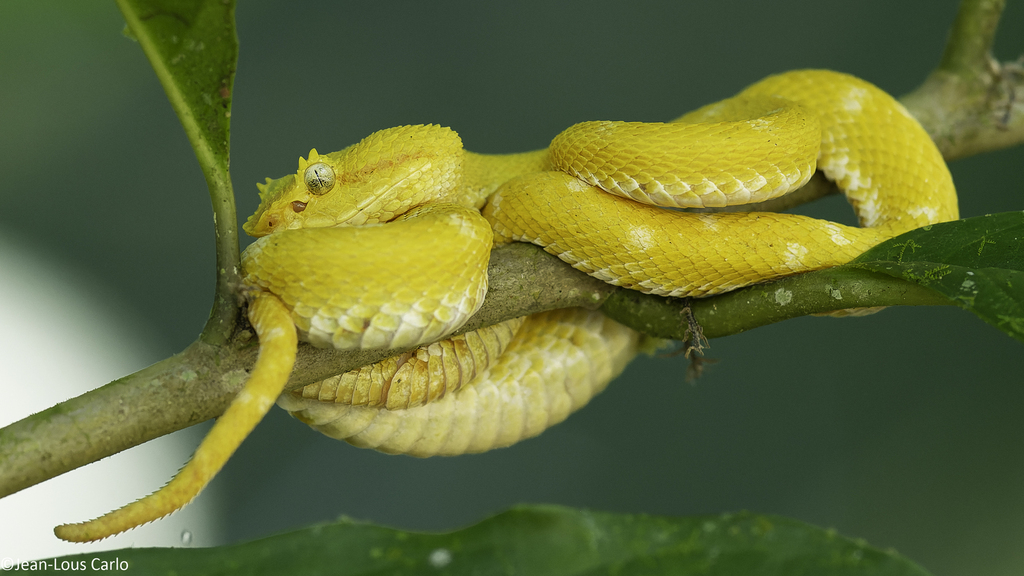
Central American Eyelash-Viper
Bothriechis nigroadspersus
The Central American eyelash-pitviper (Bothriechis nigroadspersus) (from Latin, nigrum, meaning "black", and adspersus meaning "sprinkled") is a species of pit viper.
Although once listed as a synonym of Bothriechis schlegelii, it was revalidated in a 2024 revision of the latter species.
From the article Bothriechis nigroadspersus on Wikipedia (CC BY-SA), quoted section by section
Range & habitat
This species is widely distributed. It ranges across much of Mesoamerica, from as far north as the isthmus of Tehuantepec in Mexico to as far south as extreme northwestern Colombia (Cerro Tacarcuna) along the border with Panama. Near Panama, the range of B. nigroadspersus slightly overlaps with that of B. supraciliaris. The species has been recorded at elevations 0–1,434 m above sea level.
Wikipedia: “Range”
What it does
Although primarily ambush predators, they also forage actively for food. Captive juveniles are known to feed on frogs, attracting them by means of moving their bright yellow tails as a lure. Wild adults are known to feed on frogs (primarily treefrogs and rainfrogs), lizards (anoles, whiptails, and geckos), birds (including hummingbirds), and mammals (bats, mice, and mouse opossums).
Wikipedia: “Diet”
Toxicity
In Costa Rica, 90-100 bites from this species occur per year, of which up to 6% of bites result in death. In 1979, 18.9% of snake bites in the country were attributable to this species. The average bite injects ~0.5 cc of venom. The venom is hemotoxic and strongly myonecrotic (muscle tissue death) compared to other Central American vipers. In humans, it causes intense localized pain, progressive hemorrhagic edema, and less commonly hemorrhagic blisters or hives, ecchymoses, and necrosis. Despite being closely related to Bothriechis torvus, their venom properties differ drastically. The venom of B. nigroadspersus is more edematous, hemorrhagic, and lethal. The LD50 of this species' venom is estimated as 1.7–5.6 mg/kg in B. nigroadspersus, as opposed to 9.24 mg/kg in B. torvus.
== References ==
Wikipedia: “Venom”
Where it lives
Recorded sightings
—
geo-referenced records in GBIF, from museums, herbaria and field observers.
Drag the globe to turn it. Dots are where records exist, not a range map; darker means more records.
In the stacks
Searching the stacks…
Every page naming Bothriechis nigroadspersus in the Biodiversity Heritage Library →
This page is assembled live from iNaturalist, GBIF, Wikipedia, the Source Library and the Internet Archive. It is not yet part of the hand-edited codex. iNaturalist taxon 1545912.