- Fungi Including Lichens
- ›Basidiomycete Fungi
- ›Higher Basidiomycetes
- ›Mushrooms, Bracket Fungi, Puffballs, and Allies
- ›Shelf Fungi
- ›Bracket Polypores
- ›Fomitopsis
- ›Fomitopsis quercina
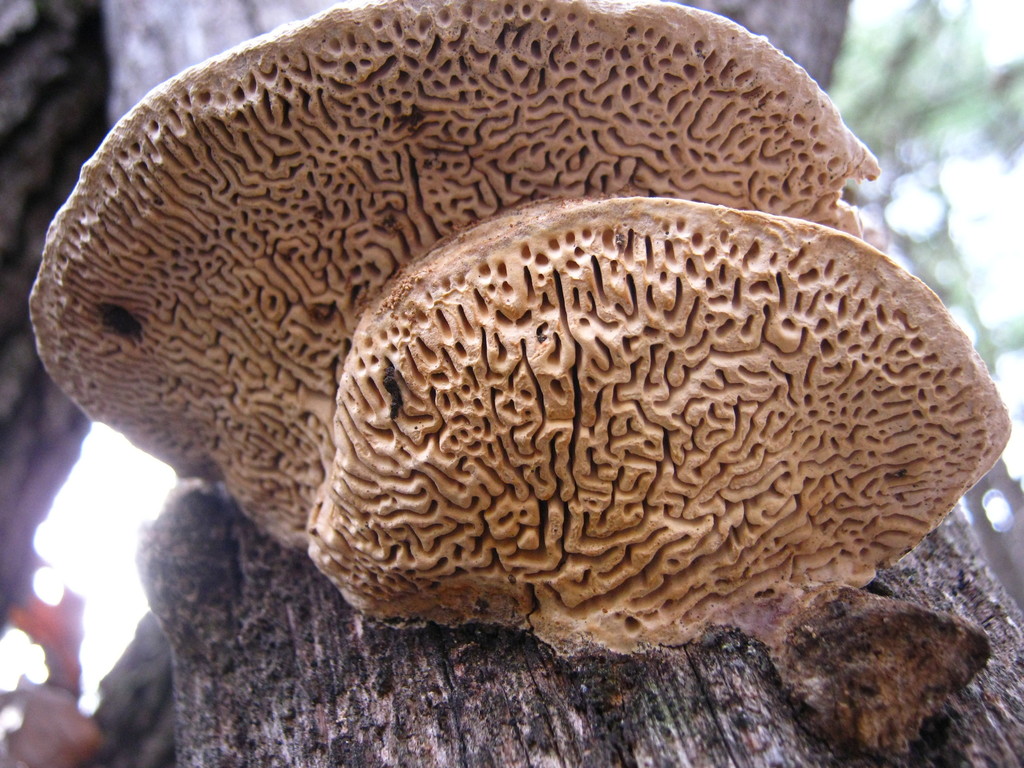
Oak mazegill
Fomitopsis quercina
Fomitopsis quercina is a species of mushroom in the order Polyporales. Commonly known as the thick-walled maze polypore, maze-gill fungus oak-loving maze polypore, or oak mazegill, the specific epithet refers to the oak genus Quercus, upon which it frequently grows, causing a brown rot. It is found in Europe, Asia, Northern Africa and Australasia. Though inedible, it can be used as a natural comb and has been the subject of chemical research.
From the article Fomitopsis quercina on Wikipedia (CC BY-SA), quoted section by section
Description
The sessile, fan-shaped fruiting bodies are typically 3–20 centimetres (1–8 in) wide and up to 8 cm thick. They are found singly or in tiered groups, usually on rotting oak. The upper surface of the cap may be various shades of brown, and is sometimes zonate. The pore surface, white to tan in color, is initially porous, but as the fruit body matures, some of the pore walls break down, forming slits with blunt partitions. This results in the characteristic maze-like (daedaloid or labyrinthinine/labyrinthiform) appearance. The tube walls are 10–30 mm (0.39–1.18 in) long, with thick walls. The basidiospores are 5–7 × 2–4 μm, smooth, and elliptical in shape. In deposit the spores are white. A variant has been described that has large, angular pores similar to those in the genus Trametes, named F. quercina forma trametea.
Range & habitat
Although Fomitopsis quercina prefers to grow on Quercus species, it has also been found on the tree species Fagus grandifolia, Fraxinus americana, Juglans nigra, and Ulmus americana. It has been reported from nearly all European countries, following the pattern of oak distribution. It has also been reported in Northern Africa, North America, (Tunisia), Asia from Caucasus to India, and also Australia.
Wikipedia: “Habitat and distribution”
At the table
The fruit bodies have been used as a natural comb and aphrodisiac, employed for brushing down horses with tender skin. Gilbertson notes that in England, smoldering fruit bodies were used for anesthetizing bees. This species has been investigated for application in bioremediation. The lignin-degrading enzyme laccase, isolated and purified from F. quercina, has shown use in biodegrading a variety of toxic dyes and pigments. The compound quercinol (a chromene derivative), isolated from the oak mazegill, has anti-inflammatory activity, and inhibits the enzymes cyclooxygenase-2, xanthine oxidase, and horseradish peroxidase. The mushroom is inedible due to its toughness.
Wikipedia: “Uses”
Where it lives
Recorded sightings
—
geo-referenced records in GBIF, from museums, herbaria and field observers.
Drag the globe to turn it. Dots are where records exist, not a range map; darker means more records.
In the old herbals & bestiaries

In the stacks
Searching the stacks…
Every page naming Fomitopsis quercina in the Biodiversity Heritage Library →
This page is assembled live from iNaturalist, GBIF, Wikipedia, the Source Library and the Internet Archive. It is not yet part of the hand-edited codex. iNaturalist taxon 1536892.