- Animals
- ›Chordates
- ›Vertebrates
- ›Ray-finned Fishes
- ›Spiny-rayed fishes
- ›Butterflyfishes, Angelfishes, and Allies
- ›Surgeonfishes, Tangs, and Unicornfishes
- ›Naso
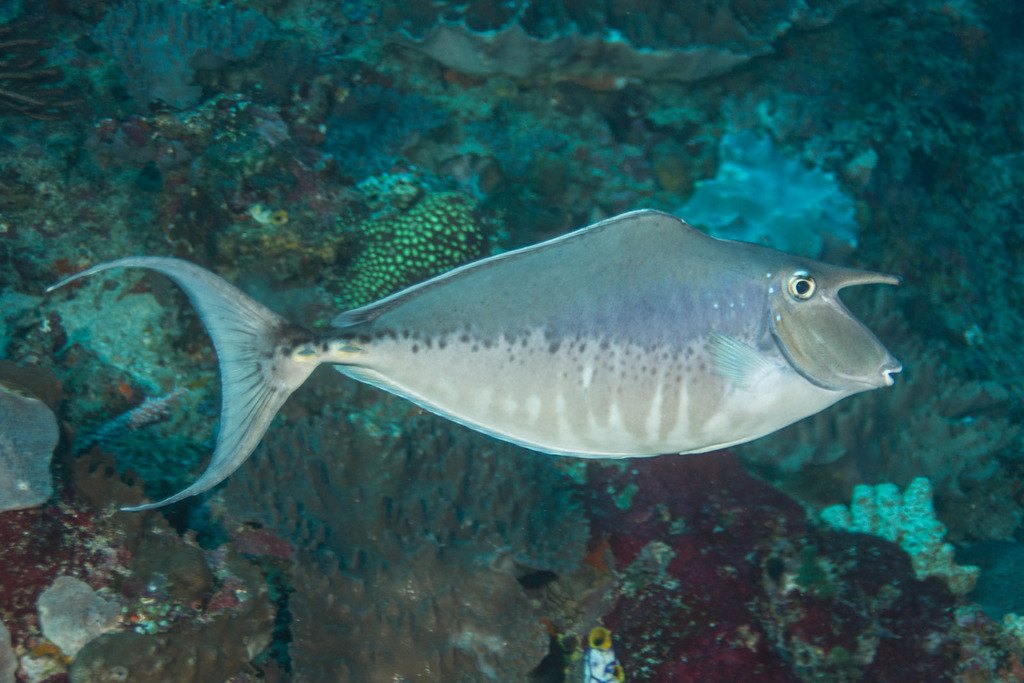
Humpback Unicornfish
Naso brachycentron
The humpback unicornfish (Naso brachycentron) is a species of unicornfish commonly found in tropical reefs, so named because of its distinctive humped back. Its habitat includes most of the coastline of the Indonesian islands and some areas off the coast of Africa.
From the article Naso brachycentron on Wikipedia (CC BY-SA), quoted section by section
Description
Naso brachycentron has 4 or 5 spines and between 28 and 30 soft rays supporting the dorsal fin while the anal fin is supported by 2 spines and 27 or 28 soft rays. The depth of the body fits into its standard length between 2.2 and 2.7 times. In fish with a standard length greater than about 20 cm (7.9 in) a hump begins to develop in the back so that the dorsal profile is concave between the intraorbital area and the soft-rayed portion of the dorsal fin. The snout is steeply sloped and in the adult males there is a long, tapering bony protuberance in front of the eyes which may extend past the mouth in adult males but is a small bump in females. A pair of bony plates with a blade-like keel are on each side of the caudal peduncle. The overall colour is grey on the upper body and head and paler yellowish or whitish on the lower body with the coloured areas irregularly demarcated. There are frequently blue spots behind the eyes and the larger males may have dark bars on the lower flanks. This is a relatively large species reaching a maximum published fork length of 90 cm (35 in).
Range & habitat
Naso brachycentron has a wide distribution in the Indian and Pacific Oceans, although it is absent from the Red Sea, the Gulf of Oman and the Persian Gulf. It is found along the eastern coast of Africa from Kenya in the north to Sodwana Bay in South Africa, through most of the islands of the Indian Ocean east into the Pacific Ocean where it reaches east to French Polynesia and the Mariana Islands, north to the Ryukyu Islands and south to the Great Barrier Reef of Australia. They are found as solitary fish or in small aggregations in shallow reef areas.
Wikipedia: “Distribution and habitat”
In human culture
Naso brachycentron has a specific name which combines brachy, meaning "short", with centron, which means "thorn" or "spine". This is an allusion to the shorter spines in the dorsal fin when compared to the type species of Naso, N. fronticornis.
Wikipedia: “Etymology”
Where it lives
Recorded sightings
—
geo-referenced records in GBIF, from museums, herbaria and field observers.
Drag the globe to turn it. Dots are where records exist, not a range map; darker means more records.
In the stacks
Searching the stacks…
Every page naming Naso brachycentron in the Biodiversity Heritage Library →
This page is assembled live from iNaturalist, GBIF, Wikipedia, the Source Library and the Internet Archive. It is not yet part of the hand-edited codex. iNaturalist taxon 153281.