- Animals
- ›Chordates
- ›Vertebrates
- ›Ray-finned Fishes
- ›Spiny-rayed fishes
- ›Blennies, Damselfishes and Allies
- ›Damselfishes
- ›Typical Damselfishes and Anemonefishes
- ›Neoglyphidodon
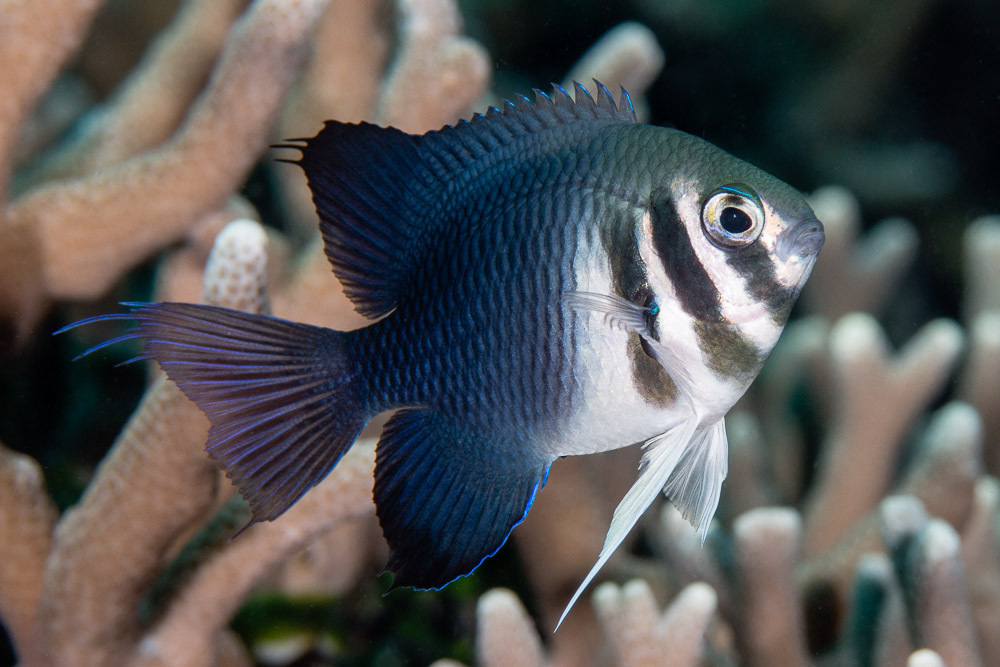
Barhead Damsel
Neoglyphidodon thoracotaeniatus
Neoglyphidodon thoracotaeniatus is a species of damselfish in the family Pomacentridae. It is found in the Indo-Pacific mainly in the Pacific Ocean. Adults can grow up to 13.5 centimetres (5.3 in). It is found in the aquarium trade.
From the article Neoglyphidodon thoracotaeniatus on Wikipedia (CC BY-SA), quoted section by section
Description
Adults can grow up to 13.5 centimetres (5.3 in). Its fins have 13 dorsal spines, 12 to 14 dorsal soft rays, 2 anal spines, and 13 to 14 anal soft rays. Like most species of damselfish in the genus Neoglyphidodon, adults and juveniles have different colouration. Adults are black. They have a white area extending from its eye to the pectoral fin in the bottom. They have 3 vertical dark bands in their front. Juveniles have the same pattern but they are yellow. Around their dorsal fin, juveniles have a dark spot. There are turquoise lines around their dark spot and extends to its eyes.
Range & habitat
This fish is found in the Indo-Pacific mainly in the Pacific Ocean. Populations in the Indian Ocean only occur around Java in Indonesia. The rest of the populations occur in the Pacific Ocean around Indonesia, Australia, Vietnam, the Philippines, Papua New Guinea, and the Solomon Islands. Usually, they are found in coral reefs. It lives around a depth range of 10 to 45 metres (33 to 148 ft).
Wikipedia: “Distribution and habitat”
What it does
Juveniles stay near the substrate while adults stay more above to feed on drifting plankton.
Wikipedia: “Behaviour”
Where it lives
Recorded sightings
—
geo-referenced records in GBIF, from museums, herbaria and field observers.
Drag the globe to turn it. Dots are where records exist, not a range map; darker means more records.
In the stacks
This page is assembled live from iNaturalist, GBIF, Wikipedia, the Source Library and the Internet Archive. It is not yet part of the hand-edited codex. iNaturalist taxon 153273.