On eBird ↗
Polynesian Ground Dove
Live sightings near you, the range map, bar charts of when it is seen, and Macaulay Library photos and recordings.
Polynesian Ground Dove
Pampusana erythroptera
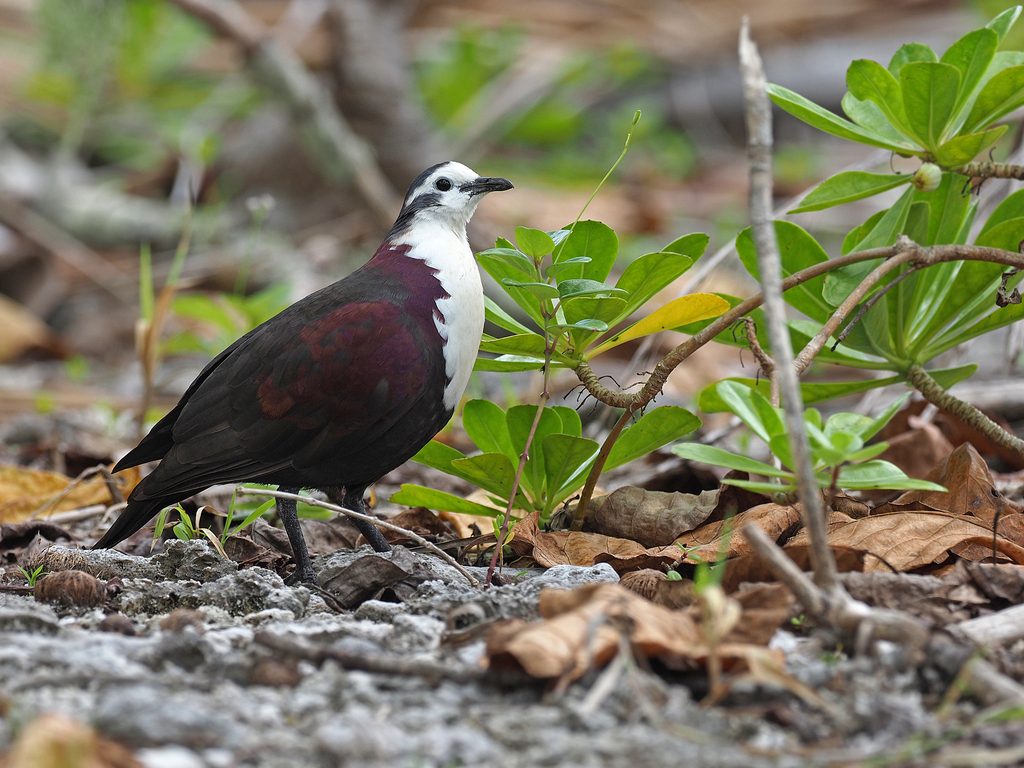
The Polynesian ground dove or Society Islands ground dove (Pampusana erythroptera) or Tutururu is a critically endangered species of bird in the family Columbidae. Originally endemic to the Society Islands and Tuamotus in French Polynesia, it has now been extirpated from most of its former range by habitat loss and predation by introduced species such as cats and rats, and the species is now endemic only in the Acteon islands. The total population is estimated to be around 100-120 birds.
It favors tropical forests, especially with Pandanus tectorius, Pisonia grandis and shrubs, but it has also been recorded from dense shrub growing below coconut palms.
From the article Polynesian ground dove on Wikipedia (CC BY-SA), quoted section by section
Description
The Polynesian ground dove is a small, plump ground dove that displays sexual dimorphism. The male Polynesian ground doves of the nominate subspecies have white foreheads, cheeks, throats, and breasts. The crown, nape, and auricular stripe are grey. The upperparts are a dark olive grey with purple or, if the feathers have faded, chestnut red iridescence on the hindneck and wing-coverts. The underparts are blackish. In males of the subspecies albicollis, the head is completely white. Females of both subspecies look the same: they are a bright reddish brown overall, tinged strongly with reddish-purple on the crown, neck, and wing-coverts. The mantle, back, rump, and inner wing-coverts are a dark olive, and there is a pale breast shield. This plumage frequently fades in intensity due to wear. The juvenile Polynesian ground dove is red overall, with many of its feathers fringed with a cinnamon-rufous. The white parts of the face and underparts are suffused with grey. Juvenile males can be differentiated from juvenile females through the absence of a pale breast shield and purple-edged feathers on the scapulars and lesser coverts. The adult Polynesian ground dove is about 23.5 to 26 cm (9.3 to 10.2 in) in length, and weighs about 105 to 122 g (3.7 to 4.3 oz). The ground dove's iris is brown, while the bill is black. …
Range & habitat
The Polynesian ground dove was originally found in both the Tuamotu Archipelago and the Society Islands. It has since been extirpated from the Society Islands, where it was found on Tahiti and Moorea. In the Tuamotus it has been recorded on Arakita, Hao, Hiti, Maria Est, Marutea Sud, Matureivavao, Rangiroa, Tenararo, Tenarunga, and Vanavana. In addition, local reports have suggested that the Polynesian Ground Dove likely lived on Fakarava, Fangatau, Katiu, Makemo, Manihi, Reao, Tahanea, Tematagi, Tikehau, Tuanake, Vahanga and Vahitahi, although no specimens were ever collected from these islands. Originally, the Polynesian ground dove inhabited mountainous volcanic islands and nearby atolls and islets. However, the introduction of feral cats and rats have extirpated the ground dove from the mountainous volcanic islands. On the islets and atolls it lives in forests with a well-developed understory of dense bushes, ferns, and grasses, in areas of low, dense scrub, and in groves of Pandanus plants with sparse ground vegetation.
Wikipedia: “Distribution and habitat”
What it does
The Polynesian ground dove is a terrestrial and elusive dove. It primarily feeds by scratching for seeds on the ground, such as those from Morinda and Tournefortia plants; however, it is also known to feed in trees and shrubs, where it eats the buds of Portulaca, the seeds of Digitaria, and the leaves of Euphorbia. The ground dove flushes in a manner similar to a partridge, while its wings produce a whirring sound. Little is known about the species' breeding behavior, although juveniles have been observed in January and April.
Wikipedia: “Behaviour and ecology”
Listen
Looking for field recordings…
Where it lives
Recorded sightings
—
geo-referenced records in GBIF, from museums, herbaria and field observers.
Drag the globe to turn it. Dots are where records exist, not a range map; darker means more records.
In the stacks
Searching the stacks…
Every page naming Pampusana erythroptera in the Biodiversity Heritage Library →
This page is assembled live from iNaturalist, GBIF, Wikipedia, the Source Library and the Internet Archive. It is not yet part of the hand-edited codex. iNaturalist taxon 1505945.