- Animals
- ›Chordates
- ›Vertebrates
- ›Birds
- ›Woodpeckers and Allies
- ›Woodpeckers
- ›Typical woodpeckers
- ›Green Woodpeckers, Flickers, and Allies
- ›Meiglyptes
On eBird ↗
Buff-rumped Woodpecker
Live sightings near you, the range map, bar charts of when it is seen, and Macaulay Library photos and recordings.
Buff-rumped Woodpecker
Meiglyptes grammithorax
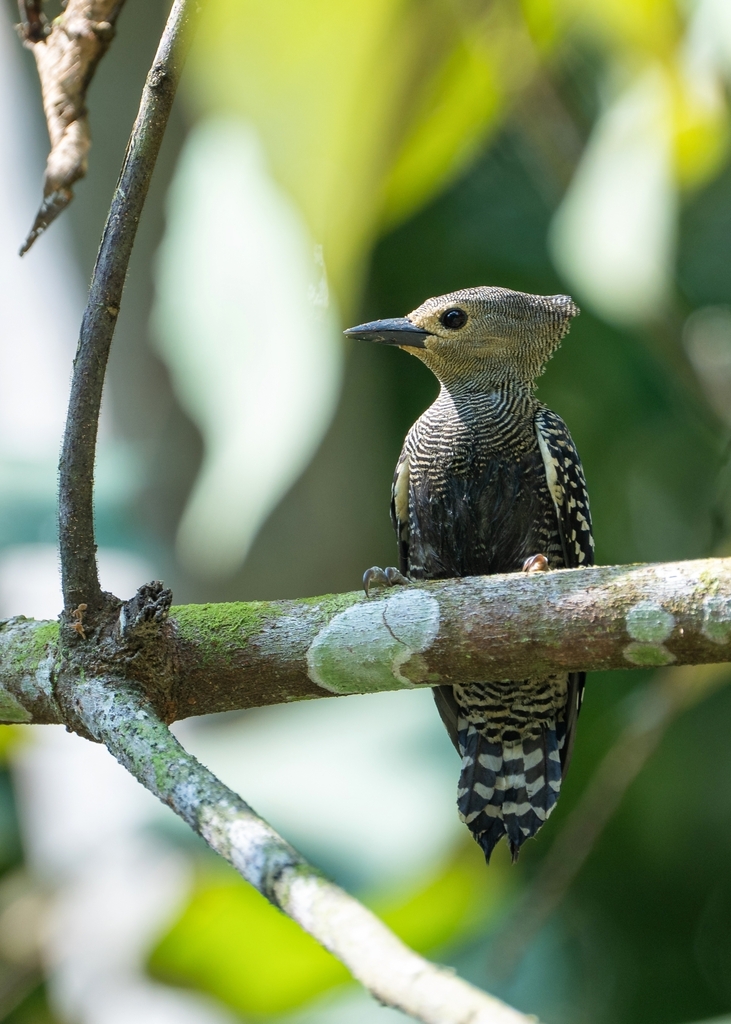
The buff-rumped woodpecker (Meiglyptes grammithorax) is a species of bird in the family Picidae. It is found in southern Myanmar, Thailand, Malaya, Sumatra and Borneo. Its natural habitats are subtropical or tropical dry forests and subtropical or tropical moist lowland forests. It was previously considered conspecific with the zebra woodpecker.
From the article Buff-rumped woodpecker on Wikipedia (CC BY-SA), quoted section by section
Description
The buff-rumped woodpecker has a small nuchal crest, black-and-white wings and fine barring on the belly. Males have a red "mustache" stripe. The buff-rumped woodpecker is distinguished by a prominent whitish-buff rump patch (though this is not always visible). The American ornithologist James Chapin noted that first primary feather in the juvenal (or juvenile) plumage of M. grammithorax was reduced, a feature not seen in the adult plumage. A similar reduction of one or more of the primary features was noted in several other species of woodpeckers.
Wikipedia: “Morphology”
Range & habitat
M. grammithorax is found in southern Myanmar, Thailand, Malaya, Sumatra and Borneo where it primarily occupies subtropical or tropical dry forests and subtropical or tropical moist lowland forests. It was previously observed in Singapore but is thought to be locally extirpated due to habitat loss.
Wikipedia: “Distribution”
What it does
Buff-rumped woodpeckers often forage in pairs and have been observed joining mixed flocks with other insectivorous birds. They have been observed leaf-gleaning and foraging for ants in the forest canopy. An observational study of banded woodpeckers conducted in 2025 noted a pair of buff-rumped woodpeckers repurposing and excavating an old nest-hole used by another species.
Wikipedia: “Behavior”
In human culture
A specimen of M. grammithorax was included in a collection of twenty-one Sumatran bird specimens presented to Lord Edward Smith-Stanley in 1825 by Sir Stamford Raffles, who labelled it as a zebra woodpecker (then called Picus tristis). As of 2020 the original specimen was still held at the National Museums Liverpool. M. grammithorax was described as a distinct species in 1862 by the French magistrate and amateur naturalist Alfred Malherbe in his four-volume work Monographie des picidées.
Wikipedia: “History and Taxonomy”
Listen
Looking for field recordings…
Where it lives
Recorded sightings
—
geo-referenced records in GBIF, from museums, herbaria and field observers.
Drag the globe to turn it. Dots are where records exist, not a range map; darker means more records.
In the stacks
Searching the stacks…
Every page naming Meiglyptes grammithorax in the Biodiversity Heritage Library →
This page is assembled live from iNaturalist, GBIF, Wikipedia, the Source Library and the Internet Archive. It is not yet part of the hand-edited codex. iNaturalist taxon 1505545.