- Fungi Including Lichens
- ›Basidiomycete Fungi
- ›Higher Basidiomycetes
- ›Mushrooms, Bracket Fungi, Puffballs, and Allies
- ›Agaricomycetidae
- ›Amylocorticiales
- ›Amylocorticiaceae
- ›Plicatura
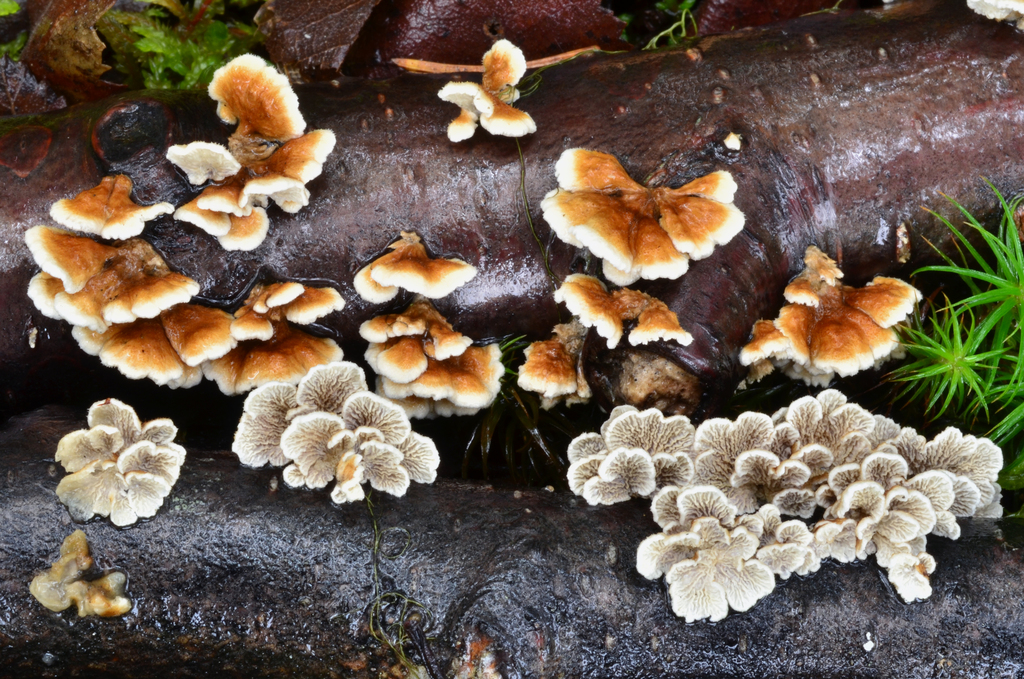
crimped gill
Plicatura crispa
Plicaturopsis crispa, the crimped gill or crispling, is a saprotrophic species of fungus in the genus Plicaturopsis that can be found in temperate regions year-round, often on hazel, alder, and beech trees.
The fungus has a wide distribution, having been recorded in Europe, Asia, Australia, and North America. In Britain, its range has been rapidly increasing with 78% of all records of P. crispa in the FRDBI (Fungal Records Database of Britain & Ireland) being from after the year 2000, many of which are in areas with no previous recordings of the species.
From the article Plicaturopsis crispa on Wikipedia (CC BY-SA), quoted section by section
Description
It forms clusters on typically deciduous trees on decomposing branches. Fruit bodies are generally 1-3 cm in length with bracket-like semi-circular shell shapes. Upper surface is normally concentrically zoned getting paler as it approaches the edge. Underside is made up of pale forked folds, giving a gill-like appearance. It produces white spores which are small, narrow allantoid, weakly amyloid, and only 3–4.5 x 1–1.2 μm.
What it does
Plicaturopsis crispa is an effective participant in the initial phase of decay, colonizing predominantly dead branches of deciduous trees (Fagus and Betula) and is associated with a white rot. A few years into the succession of wood decomposition, strong competitors such as Trametes versicolor and the split-gill fungus Schizophyllum commune often displace P. crispa.
Wikipedia: “Ecology”
Where it lives
Recorded sightings
—
geo-referenced records in GBIF, from museums, herbaria and field observers.
Drag the globe to turn it. Dots are where records exist, not a range map; darker means more records.
In the stacks
Searching the stacks…
Every page naming Plicatura crispa in the Biodiversity Heritage Library →
This page is assembled live from iNaturalist, GBIF, Wikipedia, the Source Library and the Internet Archive. It is not yet part of the hand-edited codex. iNaturalist taxon 1503458.