- Fungi Including Lichens
- ›Ascomycete Fungi
- ›Sac Fungi and Lichens
- ›Common Lichens
- ›wart lichens, script lichens, and allies
- ›wart lichens, water lichens, and allies
- ›wart lichens, pore lichens, and allies
- ›Lepra
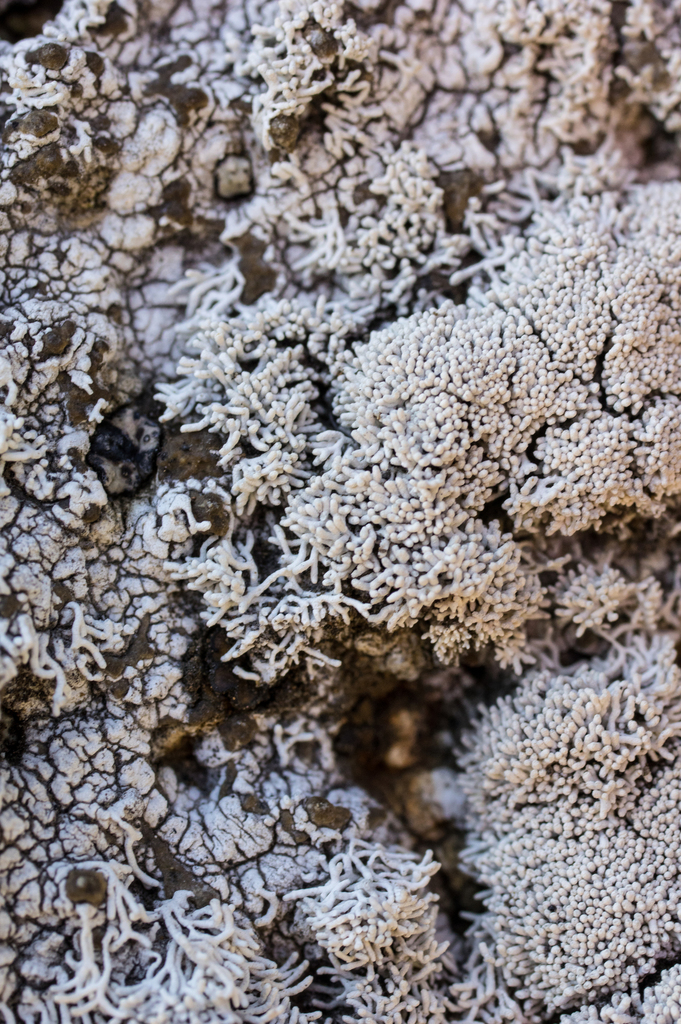
Lepra corallina
Lepra corallina is a species of saxicolous (rock-dwelling) crustose lichen in the family Pertusariaceae. First described by Carl Linnaeus in 1767 as Lichen corallinus, it was long known as Pertusaria corallina until molecular studies showed that Pertusaria in its traditional sense was not a natural group; the species was transferred to Lepra in 2016. The lichen forms a thick whitish to grey crust on acidic, lime-free rocks and is characterized by abundant coral-like isidia that often cover much of the surface. Fertile structures are rare. When present, they appear as small wart-like swellings containing a few apothecia with very large, two-spored asci. The lichen's chemistry is dominated by thamnolic acid, a secondary metabolite that contributes to its characteristic reactions to chemical tests.
Lepra corallina is widely distributed across temperate and boreal regions of the Northern Hemisphere, with records from western Europe, Scandinavia, Russia, Greenland, and eastern Asia. It grows mainly on steep or vertical faces of hard siliceous rock, from coastal outcrops to alpine ridges. The lichen actively weathers its rock substrate by excreting oxalic acid, which dissolves minerals and produces calcium oxalate crystals within the thallus. On manganese-rich ores it forms manganese oxalate, the first documented natural occurrence of that mineral. Field studies in Norway and Wales have shown it to be a habitat generalist and a relatively strong competitor, capable of overgrowing neighbouring crustose lichens, though its dominance can be transient.
From the article Lepra corallina on Wikipedia (CC BY-SA), quoted section by section
Description
Lepra corallina forms a thick, crustose thallus that is pure white to pale or dark grey. The thallus is usually continuous but often cracked into small, irregular plates (rimose-areolate), and is bordered by a conspicuous white prothallus. It is characteristically covered by abundant isidia, 0.1–0.3 mm in diameter, which begin as simple cylindrical outgrowths and often become more branched and coral-like. These isidia are mostly erect or more or less lying flat on the surface, and may form a dense layer that obscures much of the underlying thallus. Fresh thalli of Lepra corallina are greyish white, but older parts often become more or less reddish with age, apparently reflecting variation in the concentration of thamnolic acid. Fertile structures are rare. When present, they form wart-like swellings 1.5–2 mm in diameter that are strongly constricted at the base and often have an uneven or warted upper surface. Each of these warts contains a small group of apothecia, typically 2–4 but occasionally up to 11. The apothecial discs are relatively small (0.3–0.5 mm across), flat to slightly convex, pale to dark brown, and often faintly dusted with a white pruina. …
Range & habitat
Lepra corallina grows mainly on steep to vertical faces of hard, lime-free siliceous rock, from coastal outcrops to alpine elevations. It has been characterized as a Holarctic species of boreal to temperate, montane to alpine regions, widespread in the Alps—especially in wetter districts—though becoming sparser farther south in Italy. Although normally saxicolous, it has occasionally been recorded on an unusual substrate: an Austrian exsiccata specimen (Dupla Graecensia Lichenum no. 1145) documented it on dead remains of vascular plants and bryophytes on a windblown alpine ridge at 1,980 m, with typical rock-dwelling thalli on nearby boulders. In Scotland, the species is described as widespread on basalt outcrops along the west coast. At Killundine near Lochaline in Argyll, it forms thick crusts on basalt at around 120 m elevation, incorporating small grains of the underlying rock into its thallus. At the Lecht mines in north-east Scotland it colonizes spoil tips of manganese–iron ore. …
Wikipedia: “Habitat and distribution”
What it does
Lepra corallina actively weathers the rock surfaces it colonizes. Detailed microscopic work on Scottish material has shown that the fungal partner excretes oxalic acid, which dissolves calcium and other elements from basalt and leads to the formation of tiny plate-like calcium oxalate crystals within the thallus. At the lichen–rock interface, common basalt minerals such as labradorite feldspar and dark iron-rich silicates become heavily etched and break down into a thin ochre-coloured crust of poorly ordered iron- and aluminium-rich material mixed with organic matter. Experimental treatments of these minerals with oxalic acid and with an oxalate-producing soil fungus produced similar etching and secondary products, confirming that oxalic acid from the lichen is largely responsible for the observed weathering. This chemical interaction can also involve rarer elements. On manganese ore from the Lecht mines in Scotland, the lichen produces abundant microscopic crystals of manganese oxalate dihydrate (containing some zinc), formed where excreted oxalic acid reacts with manganese released from the ore. This was the first documented natural occurrence of manganese oxalate. …
Wikipedia: “Rock weathering and mineral interactions”
Where it lives
Recorded sightings
—
geo-referenced records in GBIF, from museums, herbaria and field observers.
Drag the globe to turn it. Dots are where records exist, not a range map; darker means more records.
In the stacks
Searching the stacks…
Every page naming Lepra corallina in the Biodiversity Heritage Library →
This page is assembled live from iNaturalist, GBIF, Wikipedia, the Source Library and the Internet Archive. It is not yet part of the hand-edited codex. iNaturalist taxon 1490638.