- Animals
- ›Chordates
- ›Vertebrates
- ›Reptiles
- ›Snakes and Lizards
- ›Snakes
- ›Colubrid Snakes
- ›Colubrine Snakes
- ›Opheodrys
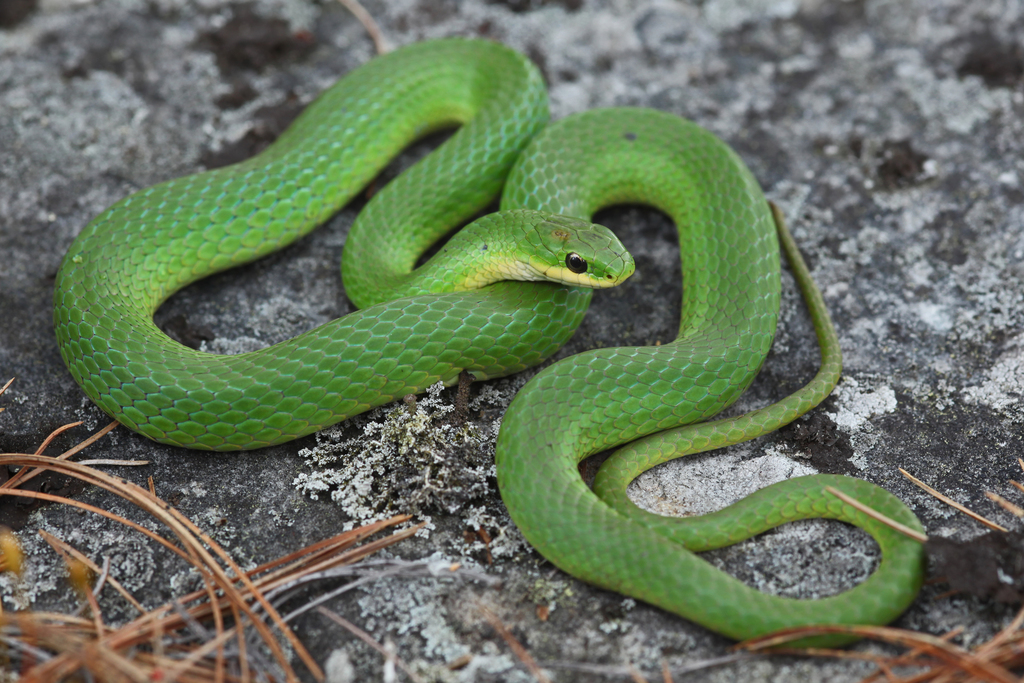
Smooth Greensnake
Opheodrys vernalis
The smooth green snake (Opheodrys vernalis) is a species of North American nonvenomous snake in the family Colubridae. The species is also referred to as the grass snake. It is a slender, "small medium" snake that measures 36–51 cm (14–20 in) as an adult. It gets its common name from its smooth dorsal scales, as opposed to the rough green snake, which has keeled dorsal scales. The smooth green snake is found in marshes, meadows, open woods, and along stream edges, and is native to regions of Canada, the United States, and northern Mexico. A non-aggressive snake, it seldom bites and usually flees when threatened. It mates in late spring to summer, and females lay their eggs from June to September. The smooth green snake will often bob its head in order to mimic vegetation blowing in the wind.
From the article Smooth green snake on Wikipedia (CC BY-SA), quoted section by section
Description
The smooth green snake is slender. In size, it is classified as a "small medium" snake, reaching to 36–51 cm (14–20 in) in total length (including tail) as an adult. The longest smooth green snake was measured as being 66 cm (26 in) in total length. The tail makes up about 1/4 to 1/2 the total length of the snake; males have longer tails than females. It is uniform light green on its back, with a yellow or white belly, and has smooth dorsal scales, unlike those of the rough green snake, which are keeled. Its smooth dorsal scales are arranged in 15 rows at midbody. At birth, its dorsal coloration is different from that when it matures. At first, it can be olive green, blue-gray, or even brown, but after it sheds its skin for the first time, it becomes the characteristic bright green. The dorsal coloration can also vary depending on location: bluish in Kansas, olive-tinted light brown in southeastern Texas, and bronze in northern Wisconsin. It uses its tongue, red with a black end, by flicking it in and out of its mouth to "smell" its surroundings.
Range & habitat
The smooth green snake is native to the Nearctic region. The range spreads through southeastern Canada, west to Saskatchewan, and south through Illinois and Virginia. It can also be found in other areas, such as in Wyoming, Colorado, New Mexico, Iowa, Missouri, Texas, and Northern Mexico.
Wikipedia: “Geographic range”
What it does
The smooth green snake relies on an environment matching its green scales for camouflage to protect itself from predators. If threatened, a smooth green snake will usually flee. It is a docile snake, seldom biting and usually allowing humans to come close. If provoked, it can secrete a substance from its anal gland, causing a foul smell. When handled by humans, it usually shows excited behavior and calms down after wrapping itself around a finger. When it hunts, it turns its head from side to side, finding prey with its tongue. The flicking of the tongue gathers air near the snake's head, and the Jacobson's organ (on the roof of its mouth) interprets the airborne pheromones and chemical signals. The green snake has no ears, relying on vibrations to figure out its surroundings. Its sight is relatively strong, at least over short distances. Due to the stretchy ligaments in its jaw, it can swallow prey whole, even prey that is larger than its own body diameter. It can shed its skin as often as every four to five weeks, allowing for new growth. During months when the weather is warmer, the smooth green snake tends to be active both day and night; in the colder, winter months, it hibernates in social groups. Ant hills and burrows of other animals are used during hibernation as part-time homes.
Wikipedia: “Behavior”
In human culture
The subspecific name, blanchardi, is in honor of American herpetologist Frank N. Blanchard.
Wikipedia: “Etymology”
Where it lives
Recorded sightings
—
geo-referenced records in GBIF, from museums, herbaria and field observers.
Drag the globe to turn it. Dots are where records exist, not a range map; darker means more records.
In the stacks
Searching the stacks…
Every page naming Opheodrys vernalis in the Biodiversity Heritage Library →
This page is assembled live from iNaturalist, GBIF, Wikipedia, the Source Library and the Internet Archive. It is not yet part of the hand-edited codex. iNaturalist taxon 146314.