- Animals
- ›Chordates
- ›Vertebrates
- ›Reptiles
- ›Snakes and Lizards
- ›Lizards
- ›Iguanas and Allies
- ›Dragons and Chameleons
- ›Chameleons
- ›Archaius
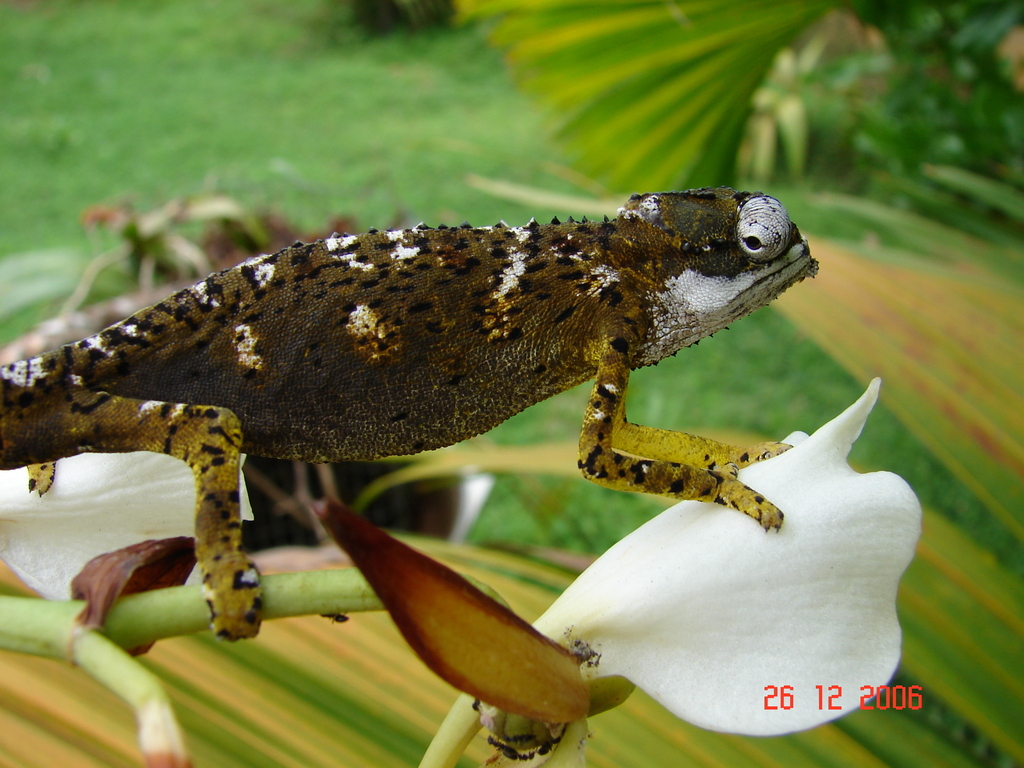
Tiger Chameleon
Archaius tigris
The tiger chameleon (Archaius tigris), (from Greek αρχαίος, meaning "ancient", archaic) also known as the Seychelles tiger chameleon, is the only species in the resurrected genus Archaius. Initially placed into Chamaeleo, it was for some time moved to the genus Calumma by some (Klaver & Böhme, 1986). It is an endangered species of chameleon, found only on the Seychelles islands of Mahé, Silhouette, Sainte Anne and Praslin.
From the article Tiger chameleon on Wikipedia (CC BY-SA), quoted section by section
Description
With a length of just 16 cm (6.3 in), this species is relatively small for a chameleon. Body colour varies from inconspicuous light-grey to a bold yellow-orange, or even green or dark brown, usually with scattered black spots and a pale grey chin and throat. One of the tiger chameleon's most distinctive features, however, is the pointed projection on its chin, which can be up to 3 millimetres long and sits amongst a comb of smaller, spiky outgrowths that border the underside of the chin.
Range & habitat
The tiger chameleon is endemic to the Seychelles, occurring only on the islands of Mahé, Silhouette and Praslin. Being an arboreal species, it is found in primary tropical forest, secondary forest where there is high plant diversity, and upland rural gardens, from sea level to 550 metres.
Wikipedia: “Habitat and distribution”
What it does
After a short warming up phase in the morning, this chameleon goes in search of insects and other small animals on which to feed. Like all chameleons, this species hunts by rapidly projecting its elongated sticky tongue at prey. The tongue is tipped by a suction pad capable of ensnaring prey. Reproduction on the island of Mahé is associated with introduced pineapple plants, in which the tiger chameleon lays its eggs. These plants are not used on Silhouette or Praslin, and the natural nesting sites remain unknown, although the endemic Pandanus and palms are thought to be used. In captivity, clutches contain between five and twelve eggs.
Wikipedia: “Behaviour and breeding”
Toxicity
It is listed as endangered on the IUCN Red List, as well as on CITES Appendix II (The Convention on International Trade in Endangered Species of Wild Fauna and Flora), with its distribution limited to an area covering 45 km2 (17 sq mi). A 2006 survey estimated the remaining global population to be just under 2,000 individuals.
Wikipedia: “Endangered status”
Where it lives
Recorded sightings
—
geo-referenced records in GBIF, from museums, herbaria and field observers.
Drag the globe to turn it. Dots are where records exist, not a range map; darker means more records.
In the stacks
Searching the stacks…
Every page naming Archaius tigris in the Biodiversity Heritage Library →
This page is assembled live from iNaturalist, GBIF, Wikipedia, the Source Library and the Internet Archive. It is not yet part of the hand-edited codex. iNaturalist taxon 145913.