- Animals
- ›Chordates
- ›Vertebrates
- ›Birds
- ›Cuckoos
- ›Cuckoos
- ›Typical Cuckoos, Malkohas, and allies
- ›Surniculus
On eBird ↗
Philippine Drongo-Cuckoo
Live sightings near you, the range map, bar charts of when it is seen, and Macaulay Library photos and recordings.
Philippine Drongo-Cuckoo
Surniculus velutinus
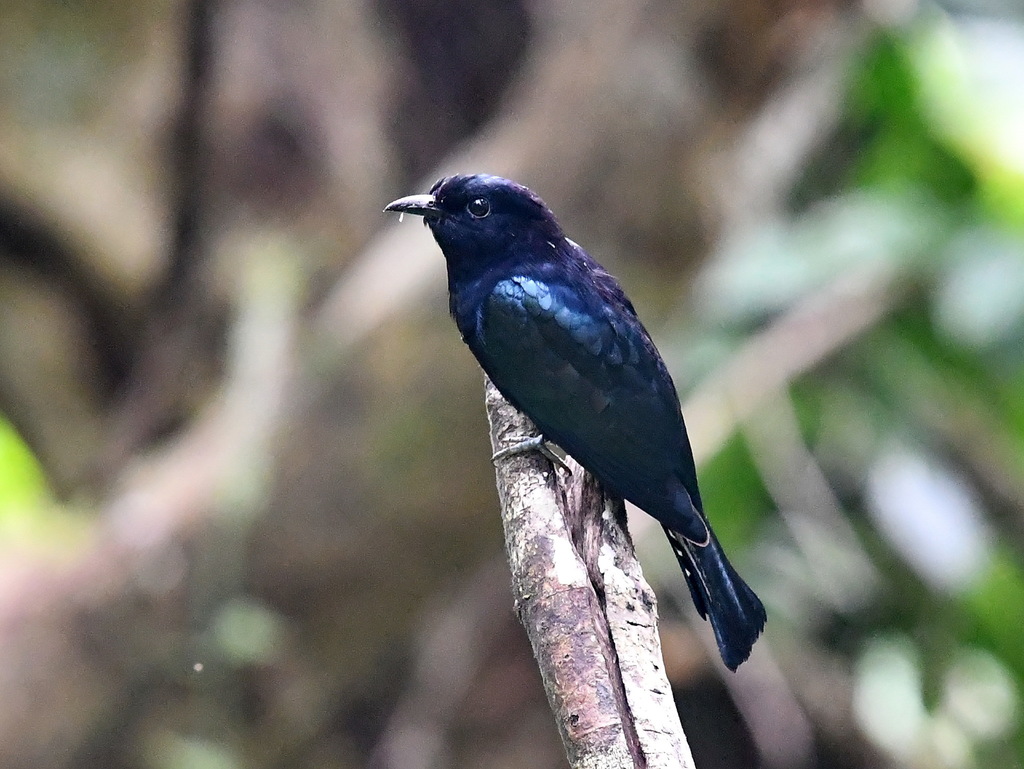
The Philippine drongo-cuckoo (Surniculus velutinus) is a bird of the cuckoo family found only in the Philippines. It belongs to the genus Surniculus along with the Asian drongo-cuckoo (S. lugubris). The two were previously classified as a single species but are now often separated based on differences in calls and juvenile plumage.
From the article Philippine drongo-cuckoo on Wikipedia (CC BY-SA), quoted section by section
Description
It is 23 centimetres (9.1 in) long. The black bill is slender and curved and the tail is fairly long and slightly forked. The plumage is mostly glossy blue-black apart from a white bar on the underwing and white marks on the thigh feathers and on the underside of the tail. Young birds are duller than the adults but otherwise similar unlike young Square-tailed drongo-cuckoo which are spotted white. The call is a repeated series of 8 or 9 ascending notes. It belongs to the genus Surniculus along with the Square-tailed drongo-cuckoo (S. lugubris). The two were previously classified as a single species but are now often separated based on differences in calls and juvenile plumage.
Subspecies. Two subspecies are recognized:
S. v. velutinus – Found on Mindanao, Samar, Leyte, Bohol and the Mindanao S. v. chalybaeus – Found on Luzon, Panay and Negros. S. v. suluensis – Found on Sulu Archipelago
Wikipedia: “Description and taxonomy”
Range & habitat
Its natural habitats at tropical moist lowland primary forest, secondary forest and bamboo woodland up to 1,000 meters above sea level. The IUCN has classified the species as being of Least Concern where it is said to be locally common. However, the population is believed to be declining due to deforestation from land conversion, Illegal logging and slash-and-burn farming. Occurs in a many protected areas in Bataan National Park, Bulusan Volcano Natural Park, Angat Watershed Forest Reserve, Northern Sierra Madre Natural Park on Luzon, Pasonanca Natural Park, Mount Kitanglad, Mount Apo on Mindanao and Rajah Sikatuna Protected Landscape in Bohol and Samar Island Natural Park in Samar. While all of these areas are protected by law, deforestation, mining, hunting and habitat loss still continue in some of these protected areas.
Wikipedia: “Habitat and conservation status”
What it does
It inhabits the canopy and middle storey of lowland forest where it feeds on insects. . It is usually shy and solitary. Nothing is known about its breeding habits, nest and fledgeling.
Wikipedia: “Ecology and behavior”
Listen
Looking for field recordings…
Where it lives
Recorded sightings
—
geo-referenced records in GBIF, from museums, herbaria and field observers.
Drag the globe to turn it. Dots are where records exist, not a range map; darker means more records.
In the stacks
Searching the stacks…
Every page naming Surniculus velutinus in the Biodiversity Heritage Library →
This page is assembled live from iNaturalist, GBIF, Wikipedia, the Source Library and the Internet Archive. It is not yet part of the hand-edited codex. iNaturalist taxon 144583.