On eBird ↗
Rose-fronted Parakeet
Live sightings near you, the range map, bar charts of when it is seen, and Macaulay Library photos and recordings.
Rose-fronted Parakeet
Pyrrhura roseifrons
The rose-fronted parakeet (Pyrrhura roseifrons), also known as the red-crowned parakeet (leading to easy confusion with the Cyanoramphus novaezelandiae), or, in aviculture, the rose-fronted conure, is a species of parrot in the family Psittacidae. It is found in the western Amazon basin in eastern Peru, far south-eastern Ecuador, north-western Bolivia and far western Brazil. It includes the wavy-breasted parakeet (P. roseifrons peruviana), also known as the wavy-breasted conure, which sometimes is considered a separate species (see...
From the article Rose-fronted parakeet on Wikipedia (CC BY-SA), quoted section by section
Description
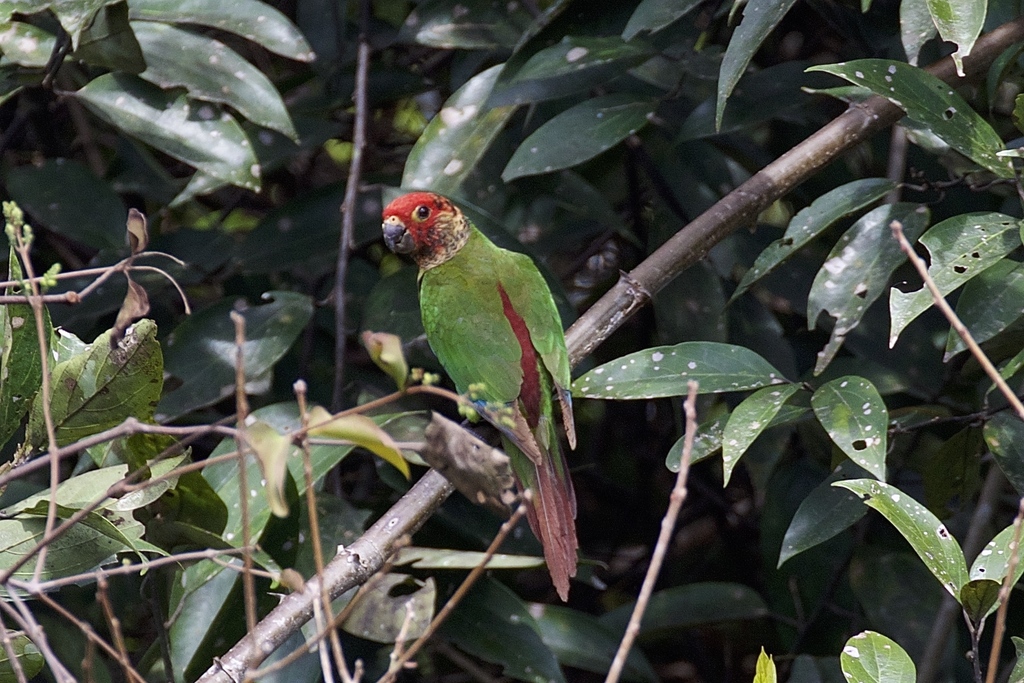
The rose-fronted parakeet is 20 to 23 cm (7.9 to 9.1 in) long. The sexes are the same in all subspecies. Adults of the nominate subspecies P. r. roseifrons have a bright red crown and face and dirty whitish ear coverts. Their upperparts are mostly green with a maroon-red red lower back and rump. The hindcrown, throat, and breast are dark with buff to buffy-white edges to the feathers. The center of their belly is deep red to brownish red, and the rest of their underparts are yellowish green. Their wing is mostly green with blue primaries. Their tail is maroon. The iris is orange-brown to dark brown with pale pinkish white to blackish bare skin around it. Their bill is blackish with a whitish cere and their legs and feet are blackish gray. Immatures are similar to adults but without the red crown and face. Subspecies P. r. peruviana has a deep maroon forehead, a greenish blue forecrown, a dusky gray hindcrown and nape, and a thin light blue band on the upper hindneck. Its face is mostly deep rusty brown to deep maroon with some greenish blue below the eye. Its throat and breast feathers are grayish with blackish wedge shapes and yellowish fringes. Its tail has a green base. P. r. dilutissima is similar to peruviana but has less blue on the forecrown, a rusty red rather than maroon face, and a grayer throat and breast with more yellow. P. r. …
Range & habitat
The subspecies of the rose-fronted parakeet are found thus:
P. r. peruviana, Morona-Santiago Province in southeastern Ecuador and Amazonas and Loreto provinces in northeastern Peru P. r. dilutissima, the Apurímac River valley in central Peru P. r. parvifrons, Peru: eastern San Martín and west central Loreto departments and disjunctly in northeastern Loreto, the latter possibly only south of the Amazon River P. r. roseifrons, south of the Amazon from northern Peru south to northern Bolivia and east into Brazil's Amazonas state (Note that the range map is of only this subspecies.) The rose-fronted parakeet inhabits lowland evergreen forests and nearby clearings. The one confirmed record in Ecuador was at 875 m (2,900 ft). In Peru, it occurs as high as 1,650 m (5,400 ft).
Wikipedia: “Distribution and habitat”
What it does
The rose-fronted parakeet has been observed foraging in flocks of up to about 30 individuals. Its diet includes fruit, seeds, flowers, and leaves of both wild and cultivated plants and trees.
Wikipedia: “Feeding”
Listen
Looking for field recordings…
Where it lives
Recorded sightings
—
geo-referenced records in GBIF, from museums, herbaria and field observers.
Drag the globe to turn it. Dots are where records exist, not a range map; darker means more records.
In the stacks
Searching the stacks…
Every page naming Pyrrhura roseifrons in the Biodiversity Heritage Library →
This page is assembled live from iNaturalist, GBIF, Wikipedia, the Source Library and the Internet Archive. It is not yet part of the hand-edited codex. iNaturalist taxon 144569.