- Animals
- ›Chordates
- ›Vertebrates
- ›Birds
- ›Shorebirds and Allies
- ›Gulls, Terns, and Skimmers
- ›True Terns
- ›Sternula
On eBird ↗
Peruvian Tern
Live sightings near you, the range map, bar charts of when it is seen, and Macaulay Library photos and recordings.
Peruvian Tern
Sternula lorata
The Peruvian tern (Sternula lorata) is a species of tern in the family Laridae.
Found in northern Chile, Ecuador, and Peru, its natural habitats are hot deserts, sandy shores, and coastal saline lagoons. It is threatened by habitat loss.
From the article Peruvian tern on Wikipedia (CC BY-SA), quoted section by section
Description
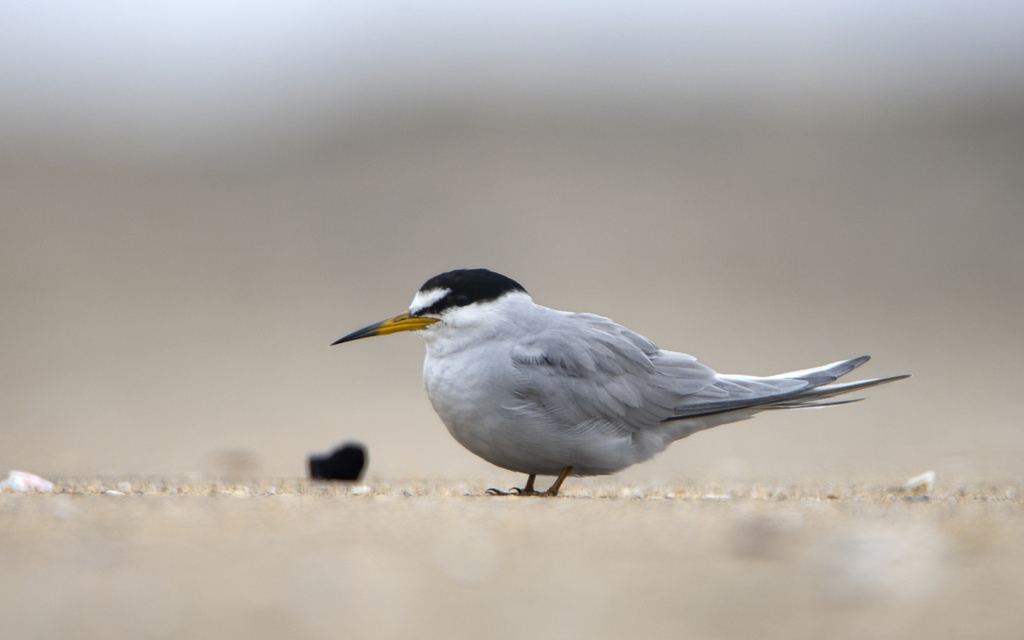
The Peruvian tern is a very small species with a length of about 24 cm (9.4 in). The upper half of the head and neck are black, and the remaining part of the head is white. The back, wings and tail are grey, the throat, chin and breast are white, and the chest, belly and flanks are pale grey. The under tail-coverts are white. The bill is yellow with a black tip, the irises are brown and the legs are yellowish. The pale grey underparts differentiate it from other small terns. It has a very rapid and characteristic wingbeat. The call is a shrill "kik" and a harsh "gree", and it also utters a descending series of "kee-ee-eer" notes.
Range & habitat
This species is endemic to the tropical west coast of South America. Its range extends from north and central Ecuador, through Peru to northern Chile, as far south as the Mejillones Peninsula. Its status in Ecuador is unclear and in Peru it is known from four confirmed sites, breeding at the back of the beach in association with wetlands. There are nine known sites in Chile, all in the vicinity of Mejillones, and at all of these the birds breed a little inland in the desert. There may be other breeding sites that have yet to be discovered, and some sites have not been revisited since they were recorded many years ago.
Wikipedia: “Distribution”
What it does
The diet has been observed to include the Peruvian anchoveta (Engraulis ringens), the king gar (Scomberesox scombroides), the Peruvian silverside (Odontesthes regia) and the mote sculpin (Normanichthys crockeri). Breeding takes place between August and February but is mostly concentrated between October and January. The nests are widely separated in loose colonies of up to twenty-five pairs. They are often found near coastal wetlands and lagoons where the birds forage. Some birds nest on beaches and dunes one to two hundred metres inland from the high tide mark, but others nest one or more kilometres inland on sandy plains. One or two eggs form a clutch, and both eggs and chicks are well-camouflaged to avoid detection. After breeding, the birds leave the coast and may move out to sea. In El Niño years, they are also absent from the shore, do not make any attempt to breed and probably remain at sea.
Wikipedia: “Ecology”
Listen
Looking for field recordings…
Where it lives
Recorded sightings
—
geo-referenced records in GBIF, from museums, herbaria and field observers.
Drag the globe to turn it. Dots are where records exist, not a range map; darker means more records.
In the stacks
Searching the stacks…
Every page naming Sternula lorata in the Biodiversity Heritage Library →
This page is assembled live from iNaturalist, GBIF, Wikipedia, the Source Library and the Internet Archive. It is not yet part of the hand-edited codex. iNaturalist taxon 144533.