- Animals
- ›Chordates
- ›Vertebrates
- ›Birds
- ›Shorebirds and Allies
- ›Gulls, Terns, and Skimmers
- ›Gulls
- ›Ichthyaetus
On eBird ↗
Relict Gull
Live sightings near you, the range map, bar charts of when it is seen, and Macaulay Library photos and recordings.
Relict Gull
Ichthyaetus relictus
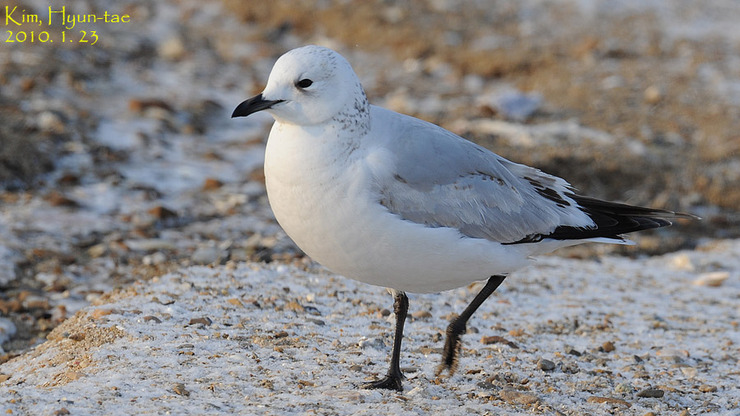
The relict gull or Central Asian gull (Ichthyaetus relictus) is a medium-sized gull. It was believed to be an eastern race of the Mediterranean gull until 1971 and was traditionally placed in the genus Larus.
From the article Relict gull on Wikipedia (CC BY-SA), quoted section by section
Description
The gull is 44 to 45 cm long with a stocky, thick body. Non-breeding adults feature uniformly dark-smudged ear-coverts and hind crown, white-tipped wings, prominent, isolated black subterminal markings on outer primaries, and no white leading edge to outer wing. Breeding birds have black hoods (including napes) with grey-brown foreheads, and broad, white, half-moon colouring behind, below, and above their eyes. Their legs are orange and their bills scarlet. The name comes from its status as a relict species.
Range & habitat
The gull breeds in several locations in Mongolia (e.g., Galuut Lake, Khukh Lake, and Chukh Lake), two in Kazakhstan, one in Russia, and one in China (Lake Hongjiannao). Small numbers appear to migrate to South Korea during the nonbreeding period. There is additional evidence that larger numbers may migrate to eastern China as well, but this is not verified. The gulls breed starting in early June and going through early August in colonies on islands in saltwater lakes. These sites are fragile. Nesting does not occur when lakes dry up or when water levels are too high. When islands become too small or overgrown with vegetation or so large that they join at the shore, the birds do not nest either. During non-breeding periods, the birds can be found on estuarine mud and sandflats.
Wikipedia: “Distribution and habitat”
Listen
Looking for field recordings…
Where it lives
Recorded sightings
—
geo-referenced records in GBIF, from museums, herbaria and field observers.
Drag the globe to turn it. Dots are where records exist, not a range map; darker means more records.
In the stacks
Searching the stacks…
Every page naming Ichthyaetus relictus in the Biodiversity Heritage Library →
This page is assembled live from iNaturalist, GBIF, Wikipedia, the Source Library and the Internet Archive. It is not yet part of the hand-edited codex. iNaturalist taxon 144518.