- Animals
- ›Chordates
- ›Vertebrates
- ›Birds
- ›Hawks, Eagles, Kites, and Allies
- ›Hawks, Eagles, and Kites
- ›Typical Eagles and Hawk-Eagles
- ›Aquila
On eBird ↗
Cassin's Hawk-Eagle
Live sightings near you, the range map, bar charts of when it is seen, and Macaulay Library photos and recordings.
Cassin's Hawk-Eagle
Aquila africana
Cassin's hawk-eagle (Aquila africana) or Cassin's eagle, is a relatively small eagle in the family Accipitridae. Its feathered legs mark it as member of the Aquilinae or booted eagle subfamily. A forest-dependent species, it occurs in primary rainforests across western, central and (marginally) eastern Africa where it preys on birds and tree squirrels. It was named after John Cassin who first described it in 1865. Due to widespread habitat destruction, its populations are steadily declining but have not yet warranted upgrading its status from Least Concern.
From the article Cassin's hawk-eagle on Wikipedia (CC BY-SA), quoted section by section
Description
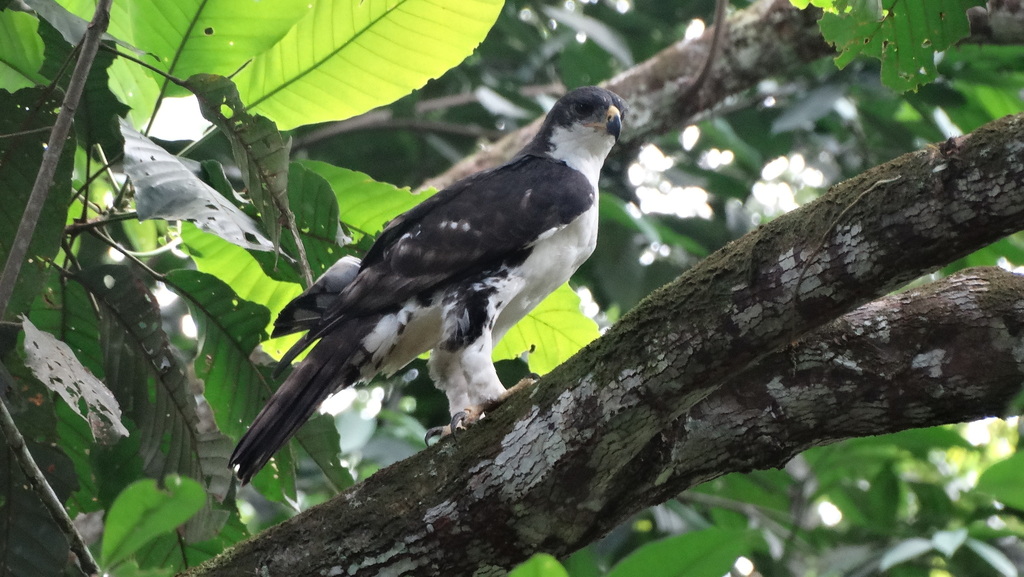
The adult Cassin's hawk-eagle appears as a small eagle, with short rounded wings and a long rounded tail. It has dark brown upperparts, with white spots and a brown tail with three black bars and a broad black subterminal band. The tarsi are white with black streaks, and the underparts are all white or white with black blotches along the sides of the lower breast. It has yellowish-brown eyes, pale yellow ceres and feet and a black bill. Immature and juvenile plumage is strikingly different from that of adults. A brown or rufous head with dusky lores and streaked black on the throat and centre of the crown is typical. The underparts are white and the breast russet with half-concealed blackish spots, while the belly and flanks are marked with dense black spotting. The tail is dark gray with a white tip and dark barring and the dark brown wings have white-tipped secondary feathers. In flight, the juvenile shows pale underwing coverts whereas an adult has dark underwing coverts and a black band along the rear edge of the wing. The immature gains its adult plumage by becoming blacker above and whiter below. A fairly small eagle, under current classification, Cassin's hawk-eagle is the smallest member of the Aquila genus. Measuring 50–56 cm (20–22 in) in length, it has a wingspan of 103–113 cm (41–44 in) and weighs in at 0.9–1.2 kg (2.0–2.6 lb). …
Range & habitat
West, central and marginally east Africa; from Sierra Leone east to western Uganda and south through the Congo Basin to northern Angola. Restricted to primary rainforest, A. africana is thought to have been more widespread in the past but its distribution has since contracted with the continued destruction of the Guinea-Congolian Forests. Repeated sightings of individuals in primary rainforest fragments in Kenya's Imenti Forest and the Ndundulu Forest in Tanzania have been interpreted as biogeographical evidence for past links between isolated forests in East Africa and those much further West. Cassin's hawk-eagle's preference for primary forest is so strong that its presence is reduced even in slightly disturbed forest and it is completely absent from secondary forest and open biomes which explains its absence between the forests.
Wikipedia: “Distribution and habitat”
What it does
The details of the ecology and behaviour of Cassin's hawk-eagle, like most hawk-eagles, are barely known as it is a secretive and rarely observed species, usually seen when soaring over the forest canopy. Its habitat of choice, primary rainforest, is also notoriously difficult to navigate, making surveys and studies extremely difficult. Before 1970, almost nothing was known about its breeding habits but since then multiple studies have uncovered some details. Both sexes help construct the nest with sticks more than 25 m (82 ft) above the forest floor in the canopy of a tree where it is lined with fresh foliage. The clutch size is 1-2 eggs which are laid from October–December in Ghana and Gabon, and in December in Uganda, therefore making it an annual breeder. The length of incubation is unknown but is likely between 40 and 45 days. During the 'branching period', the nestling typically spends most of the day off the nest, periodically half-jumping and half-flying from one branch of the nest tree to another. …
Wikipedia: “Ecology”
Listen
Looking for field recordings…
Where it lives
Recorded sightings
—
geo-referenced records in GBIF, from museums, herbaria and field observers.
Drag the globe to turn it. Dots are where records exist, not a range map; darker means more records.
In the stacks
Searching the stacks…
Every page naming Aquila africana in the Biodiversity Heritage Library →
This page is assembled live from iNaturalist, GBIF, Wikipedia, the Source Library and the Internet Archive. It is not yet part of the hand-edited codex. iNaturalist taxon 144466.