- Fungi Including Lichens
- ›Basidiomycete Fungi
- ›Higher Basidiomycetes
- ›Mushrooms, Bracket Fungi, Puffballs, and Allies
- ›Cantharellales
- ›Hydnaceae
- ›Cantharellus
- ›Parvocantharellus
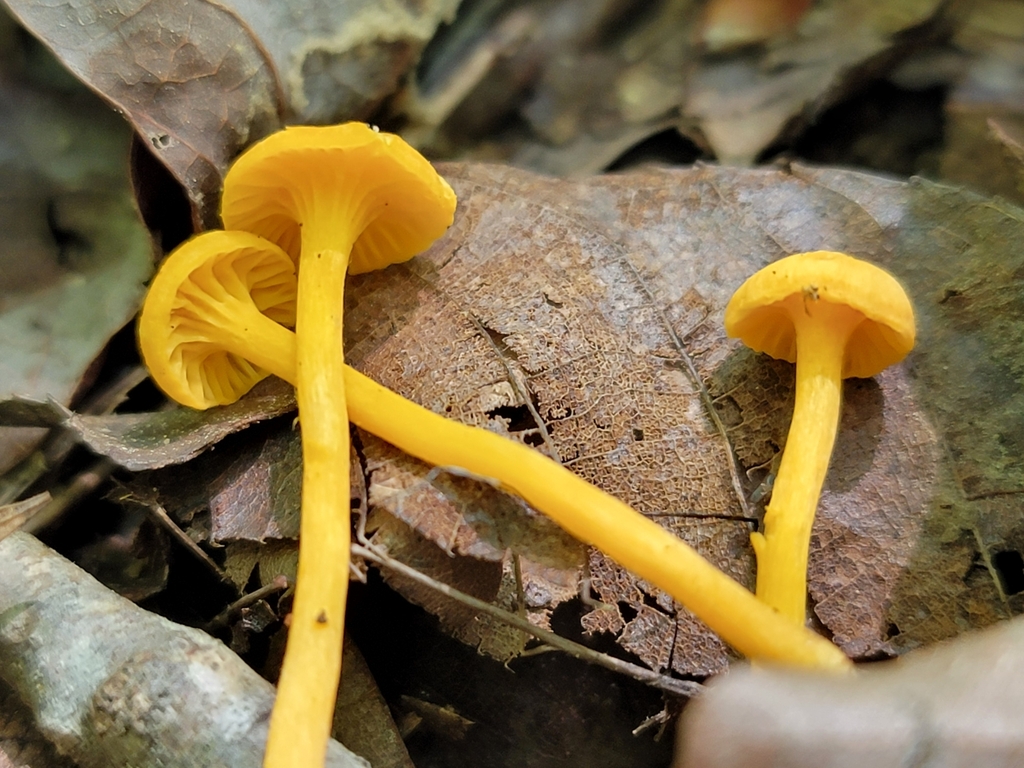
Small Chanterelle
Cantharellus minor
Cantharellus minor is a fungus native to eastern North America. It is one of the smallest of the genus Cantharellus, which includes other edible chanterelles. It is suspected of being mycorrhizal, found in association with oaks and moss. Recently, C. minor has been reported from semi-evergreen to evergreen forests in the Western Ghats, Kerala, India forming ectomycorrhizal associations with tree species like Vateria indica, Diospyros malabarica, Hopea parviflora, and Myristica species. The cap of C. minor ranges from...
From the article Cantharellus minor on Wikipedia (CC BY-SA), quoted section by section
Description
Cantharellus minor is colored bright yellow to yellowish-orange. The cap ranges from 0.5 to 3 centimetres (1⁄4 to 1+1⁄4 in) wide and is convex and umbonate, often shallowly depressed, becoming funnel-shaped in some. The yellowish gills are decurrent, fade to yellowish white in maturity, and may seem large in proportion to the small fruiting body. The stipe is 2–5 cm (3⁄4–2 in) tall and 3–6 millimetres (1⁄8–1⁄4 in) thick.
Similar species. Lookalikes include the Gulf Coast's C. tabernensis which has a darker center, Craterellus ignicolor which has shallower ridges and usually a depression in the cap, and Gloioxanthomyces nitidus which has a very circular margin, fairly straight stem and non-forking gills.
Range & habitat
Native to eastern North America, the fungi fruits from June to September. It is suspected of being mycorrhizal, found in association with oaks and moss. Recently, C. minor has been reported from semi-evergreen to evergreen forests in the Western Ghats, Kerala, India forming ectomycorrhizal associations with tree species like Vateria indica, Diospyros malabarica, Hopea parviflora, and Myristica species.
Wikipedia: “Distribution and habitat”
Where it lives
Recorded sightings
—
geo-referenced records in GBIF, from museums, herbaria and field observers.
Drag the globe to turn it. Dots are where records exist, not a range map; darker means more records.
In the stacks
Searching the stacks…
Every page naming Cantharellus minor in the Biodiversity Heritage Library →
This page is assembled live from iNaturalist, GBIF, Wikipedia, the Source Library and the Internet Archive. It is not yet part of the hand-edited codex. iNaturalist taxon 143312.