- Fungi Including Lichens
- ›Basidiomycete Fungi
- ›Higher Basidiomycetes
- ›Mushrooms, Bracket Fungi, Puffballs, and Allies
- ›Agaricomycetidae
- ›Common Gilled Mushrooms and Allies
- ›Marasmiineae
- ›Mycenaceae
- ›Mycena
- ›Sacchariferae
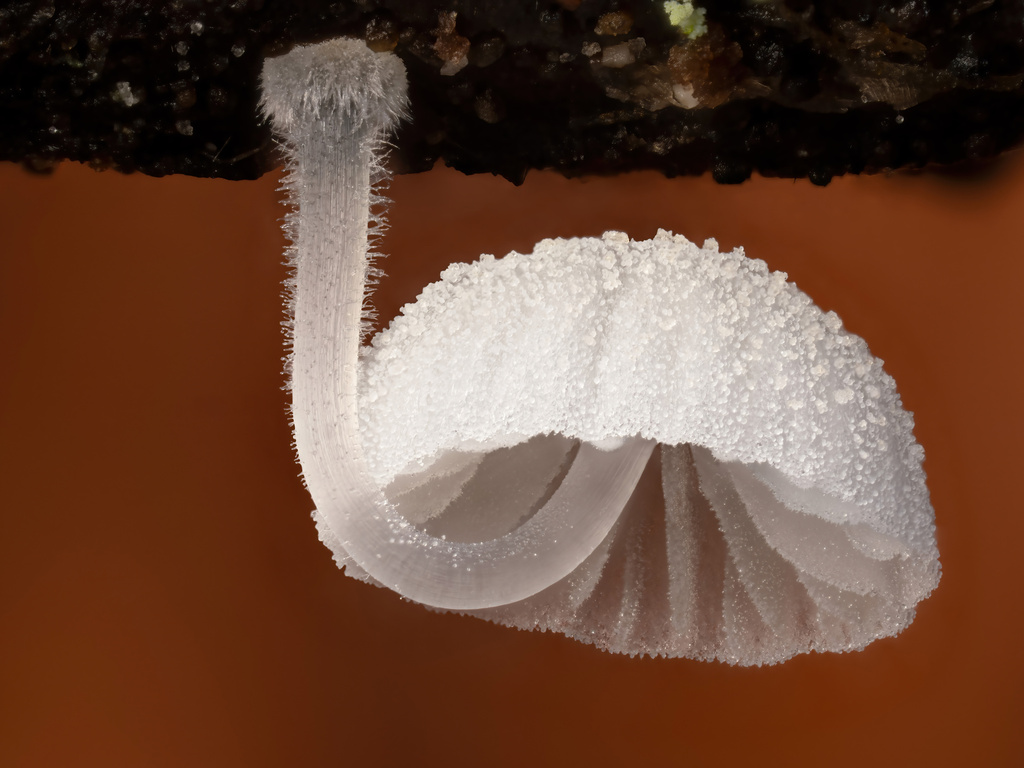
frosty bonnet
Mycena tenerrima
Mycena adscendens, commonly known as the frosty bonnet, is a species of fungus in the family Mycenaceae. The fungus produces small white fruit bodies (mushrooms) with caps up to 7.5 mm (0.3 in) in diameter that appear to be dusted with sugar-like granules. Caps are supported by thin, hollow stems up to 20 mm (0.8 in) long, which are set on a disc-like base. Its distribution includes Europe, Turkey and the Pacific coast of the United States. The fruit bodies grow on fallen twigs and other woody debris on the forest floor, including fallen hazel nuts. The variety carpophila is known from Japan. There are several small white Mycena species that are similar in appearance to M. adscendens, some of which can be reliably distinguished only by examining microscopic characteristics.
From the article Mycena adscendens on Wikipedia (CC BY-SA), quoted section by section
Description
The cap is white and small, with a diameter typically ranging from 2.5 to 7.5 mm (0.1 to 0.3 in). Initially convex to cucullate (hood-shaped), it flattens during maturity, developing visible surface grooves that correspond to the gills underneath the cap; the surface may also be covered with glistening particles, remnants of the partial veil. The cap is pallid gray with a whitish margin when young, but soon becomes white overall. The flesh is membranous, fragile, and thin (less than 0.5 mm). The gills are free from attachment or narrowly attached (adnexed) to the stem. They are up to 0.5 mm broad, distantly-spaced (usually numbering between 7 and 12), and sometimes adhering to each other to form a slight collar (a pseudocollarium) around the stem. They are translucent-white throughout their development, with a fringed, white edge. The hollow stem is 0.5 to 2 cm (0.2 to 0.8 in) long, and usually curved and threadlike. The bottom of the stem is enlarged into a slight bulb, which is initially nearly spherical. At the very base of the stem is a small, white, and hairy disk-like base that attaches to the substrate. …
Range & habitat
Fruit bodies of Mycena adscendens are found scattered to grouped together in twos or threes on fallen twigs, bark, and woody debris of hardwoods during the spring and autumn; it fruits less frequently on the wood of conifers. Fruitings are most common after periods of wet weather. They are also found growing on hazel nuts that have fallen to the ground; two other Mycenas known to grow on this substrate include M. discopus and M. nucicola. In the United States, it is known from Washington to California. It is also found in Europe, and has been collected in Amasya Province, Turkey. The variety carpophila, originally described from Denmark, was reported from Japan in 2003.
Wikipedia: “Habitat and distribution”
Where it lives
Recorded sightings
—
geo-referenced records in GBIF, from museums, herbaria and field observers.
Drag the globe to turn it. Dots are where records exist, not a range map; darker means more records.
In the stacks
Searching the stacks…
Every page naming Mycena tenerrima in the Biodiversity Heritage Library →
This page is assembled live from iNaturalist, GBIF, Wikipedia, the Source Library and the Internet Archive. It is not yet part of the hand-edited codex. iNaturalist taxon 1428084.