On eBird ↗
Banded Quail
Live sightings near you, the range map, bar charts of when it is seen, and Macaulay Library photos and recordings.
Banded Quail
Philortyx fasciatus
The banded quail (Philortyx fasciatus) is a species of bird in the family Odontophoridae. It is found only in Mexico where its natural habitats are subtropical or tropical dry forests, subtropical or tropical dry shrubland, subtropical or tropical high-altitude shrubland, and heavily degraded former forest.
From the article Banded quail on Wikipedia (CC BY-SA), quoted section by section
Description
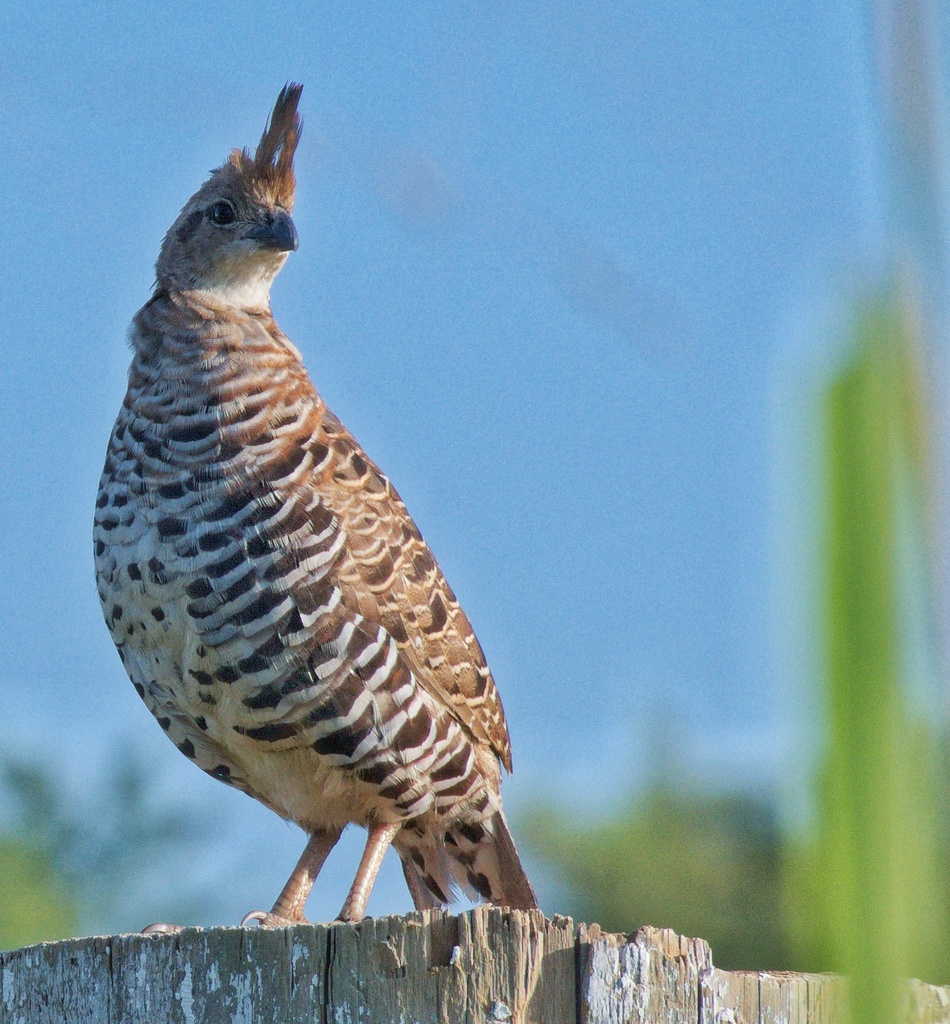
The banded quail is an inconspicuous brown bird with a comparatively long tail. It has a dark crest on its head, its throat is pale and its under tail-coverts are barred in black and white. The juvenile plumage is streaked with white at first but after a moult at eight to twelve weeks the plumage is similar to that of the adults apart from a nearly black face and throat. The full adult plumage develops at sixteen to twenty weeks.
Range & habitat
The banded quail is endemic to western central Mexico where its main habitat is dry scrubby countryside with shrubs but it also sometimes moves onto cultivated land and pasture. It is commonest in the region bordering on the Balsas River. Its elevational range is from sea level up to about 1,800 metres (5,900 ft) and it is a non-migratory species.
Wikipedia: “Distribution and habitat”
What it does
The banded quail is a ground-dwelling bird usually found in groups of about a dozen birds although sometimes larger groups of up to thirty are seen. It is a shy bird that seldom strays far from cover. When alarmed, it tends to run rather than fly, but when a group take to the wing, the individuals fly off in different directions which may confuse a potential predator. It feeds on a variety of seeds and on tubers, buds and insects, increasing the proportion of animal food when there are chicks to be fed. Breeding takes place between August and September and the crest is used during display behaviour. About five eggs are laid in a grass-lined nest that may be partially roofed and the incubation period is about twenty two days.
Wikipedia: “Behaviour”
Listen
Looking for field recordings…
Where it lives
Recorded sightings
—
geo-referenced records in GBIF, from museums, herbaria and field observers.
Drag the globe to turn it. Dots are where records exist, not a range map; darker means more records.
In the stacks
Searching the stacks…
Every page naming Philortyx fasciatus in the Biodiversity Heritage Library →
This page is assembled live from iNaturalist, GBIF, Wikipedia, the Source Library and the Internet Archive. It is not yet part of the hand-edited codex. iNaturalist taxon 1425.