On eBird ↗
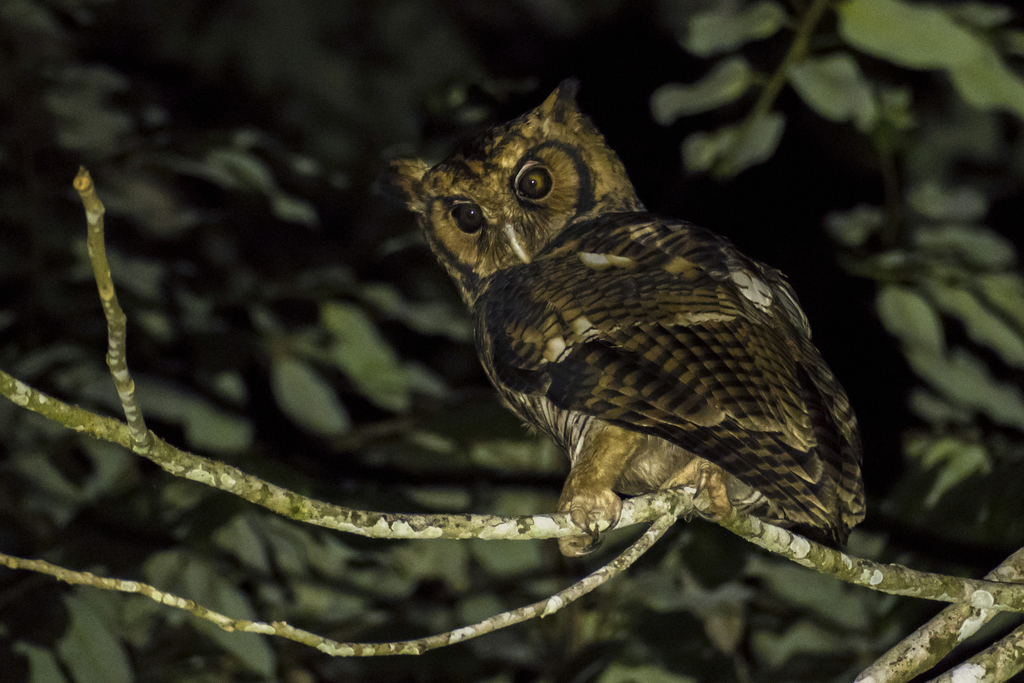
Fraser's Eagle-Owl
Live sightings near you, the range map, bar charts of when it is seen, and Macaulay Library photos and recordings.
Fraser’s Eagle Owl
Ketupa poensis
Fraser's eagle-owl (Ketupa poensis) is a species of African owl in the family Strigidae. It is named after the British zoologist Louis Fraser.
From the article Fraser's eagle-owl on Wikipedia (CC BY-SA), quoted section by section
Description
Fraser's eagle-owl is a relatively small species of eagle-owl that has rather "fluffy" ear-tufts and a facial disc with a distinct dark rim. The upperparts are rufous and buffy brown, barred with darker bars, the pale scapulars have dark-edged outer webs which show as a series of pale dots across the shoulder. The flight and tail feathers have narrow light and dark bars. The underparts are pale rufous shading to whitish on the belly and undertail coverts. Total length is 39–42 cm (15–17 in), with the females being larger than males. Compared with the nominate the subspecies K. p. vosseleri has heavier blotching on the breast and more widely spaced barring on the underparts.
Vocalization. The territorial song of the male Fraser's eagle-owl is a rapid, stuttering and long deep, guttural trill which has been said to resemble the noise made by an electricity generator. There is also a two syllable hoot, which is stereotypically owl-like, with the second syllable being higher pitched and more whistled. The double hoot is repeated at intervals of 3–4 seconds, and to the listener familiar with it, similar to the hoot of the European tawny owl. Another call, which is given by both sexes, is a single soft mewing "wooh". They snap their bills to communicate, as do many owls. The calls of K. p. vosseleri are not significantly different to those of the nominate form.
Range & habitat
It is widely spread across the African tropical rainforest; also found on Bioko. Their habitat is primarily forest, forest clearings, and cardamom plantations. They range from sea-level up to about 1,600 m (5,200 ft), in Cameroon.
Wikipedia: “Distribution and habitat”
What it does
Like most owls Fraser's eagle-owl is a nocturnal bird, roosting during the day hidden by leaves, about 40 m (130 ft) above the ground. The roost site is often located by small, diurnal birds which mob the owl. The birds stop roosting at dusk and become active. Singing is most often in the early evening and just after dusk, but they will also sing just before dawn. Its main prey is small mammals, such as mice, squirrels and galagos, and it also takes birds, frogs, reptiles, insects and other arthropods as well as occasionally feeding on fruit. The breeding biology of Fraser's eagle-owl is little known. In Gabon they are reported as singing in June–September but breeding seems to take place throughout the year, apparently varying geographically with egg-laying being recorded in February in Liberia, through to December in Uganda and Democratic Republic of Congo. As nestlings have been found on the ground then it has been suggested that Fraser's eagle-owl may nest on the ground; however, there has been at least one record of a nestling observed in a tree cavity. The eggs are white with no markings. The juveniles are apparently dependent on the adults for a long time and retain their juvenile plumage for about a year.
== References ==
Wikipedia: “Behaviour and ecology”
Listen
Looking for field recordings…
Where it lives
Recorded sightings
—
geo-referenced records in GBIF, from museums, herbaria and field observers.
Drag the globe to turn it. Dots are where records exist, not a range map; darker means more records.
In the stacks
Searching the stacks…
Every page naming Ketupa poensis in the Biodiversity Heritage Library →
This page is assembled live from iNaturalist, GBIF, Wikipedia, the Source Library and the Internet Archive. It is not yet part of the hand-edited codex. iNaturalist taxon 1423905.