On eBird ↗
Mountain Quail
Live sightings near you, the range map, bar charts of when it is seen, and Macaulay Library photos and recordings.
Mountain Quail
Oreortyx pictus
The mountain quail (Oreortyx pictus) is a small ground-dwelling bird in the New World quail family. This species is the only one in the genus Oreortyx, which is sometimes included in Callipepla. This is not appropriate, however, as the mountain quail's ancestors have diverged from other New World quails earlier than the bobwhites, no later than 6 mya.
From the article Mountain quail on Wikipedia (CC BY-SA), quoted section by section
Description
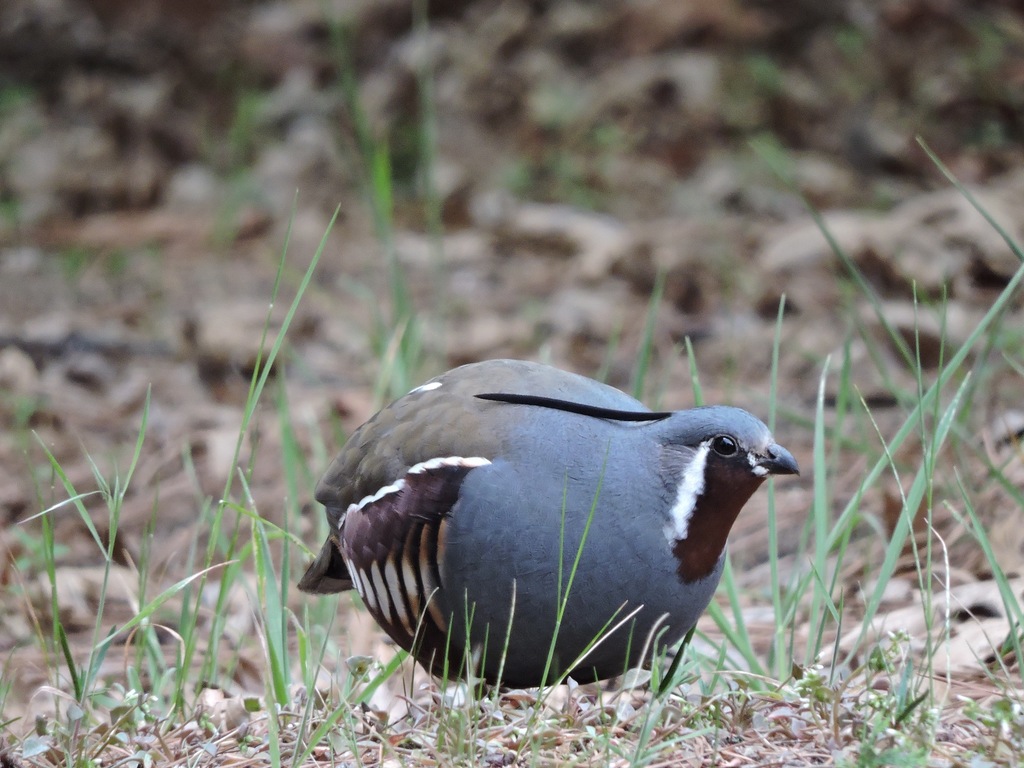
The bird's average length is 26–28 cm (10–11 in), with a wingspan of 35–40 cm (14–16 in). They have relatively short, rounded wings and long, featherless legs. These birds are easily recognized by their topknots, which are shorter in the female and change color with the seasons and geographic location of particular populations. They have a brown face, gray breast, brown back and primaries, and heavily white barred underside. Females display greater brown coloring on their dorsal side, a paler red on their undersides, and wider white barring on the flank than their male counterparts. Mountain quails lose the multi-color primary coverts on their wings as they age, and by 15 months old will only have solid-colored coverts.
Range & habitat
It inhabits mountainous chaparral west of the Rocky Mountains, from British Columbia in Canada, and some areas of Washington state in the United States, to Baja Peninsula, Mexico. It can be found up to 3,000 m (9,800 ft) above sea level. It is a non-migratory species; however some populations may be altitudinal migrants in some mountain ranges. Mountain quails also inhabit lava reefs in the Modoc Plateau of California, in addition to the chaparral and wooded areas of the Sierra Nevada Mountains and Coast Range.
Wikipedia: “Distribution and habitat”
What it does
Mountain quail primarily move about by walking, and can move surprisingly quickly through brush and undergrowth. In the late summer, fall and winter, the adults and immature young congregate into family groups of up to 20 birds. The birds' habits can be secretive. Any flight is usually short and explosive, with many rapid wingbeats followed by a slow glide to the ground.
Feeding. Its diet consists primarily of plant matter and seeds. The chicks are decidedly more insectivorous than adults, gradually consuming more plant matter as they mature.
Breeding. Breeding among mountain quail is monogamous and rarely gregarious. The female typically lays 9–10 eggs in a simple scrape concealed in vegetation, often at the base of a tree or shrub, usually close to water. Eggs measure 3.22–3.7 cm (1.27–1.46 in) in length and 2.46–2.67 cm (0.97–1.05 in) in width. Incubation lasts from 21 to 25 days, usually performed by the female and rarely by the male. However, preliminary research by the University of Nevada suggests that males have successfully incubated chicks on their own, which creates the possibility of a pair of mountain quails raising two broods in one breeding season. The chicks are precocial, leaving the nest with their parents within hours of hatching.
Wikipedia: “Behavior”
Listen
Looking for field recordings…
Where it lives
Recorded sightings
—
geo-referenced records in GBIF, from museums, herbaria and field observers.
Drag the globe to turn it. Dots are where records exist, not a range map; darker means more records.
In the stacks
Searching the stacks…
Every page naming Oreortyx pictus in the Biodiversity Heritage Library →
This page is assembled live from iNaturalist, GBIF, Wikipedia, the Source Library and the Internet Archive. It is not yet part of the hand-edited codex. iNaturalist taxon 1399.