- Animals
- ›Chordates
- ›Vertebrates
- ›Mammals
- ›Therians
- ›Placental Mammals
- ›Primates, Rodents, and Allies
- ›Primates
- ›Lemurs, Lorises, and Allies
- ›Lorises, Pottos, and Galagos
- ›Lorises and Pottos
- ›Lorises
- ›Xanthonycticebus
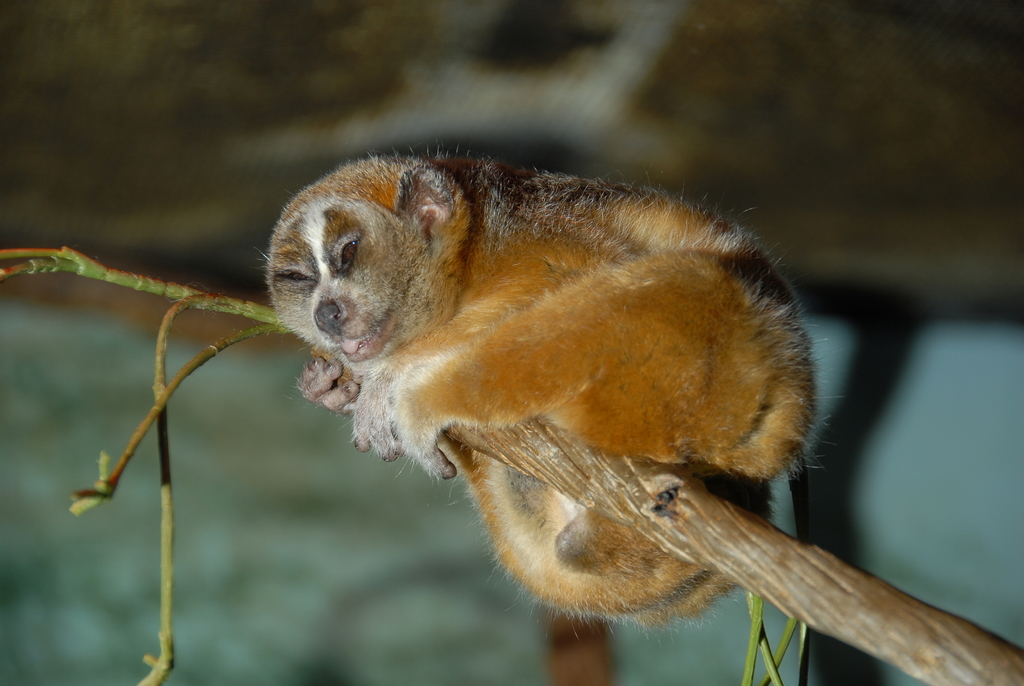
Pygmy Slow Loris
Xanthonycticebus pygmaeus
The pygmy slow loris (Xanthonycticebus pygmaeus) is a species of slow loris found east of the Mekong River in Vietnam, Laos, eastern Cambodia, and China. It occurs in a variety of forest habitats, including tropical dry forests, semi-evergreen, and evergreen forests. It was originally classified within Nycticebus until it was transferred to the genus Xanthonycticebus in 2022. Two species are recognised, the northern pygmy loris X. intermedius from northern Vietnam, Laos and China and the southern pygmy loris X. pygmaeus from southern Vietnam, Laos and Cambodia. The pygmy slow loris is nocturnal and arboreal, crawling along branches using slow movements in search of prey. Unlike other primates, it does not leap. It lives together in small groups usually with one or two offspring. An adult can grow to around 19–23 cm (7.5–9.1 in) long and has a very short tail. It weighs about 450 g (16 oz). Its diet consists of fruits, insects, small fauna, tree sap, and floral nectar. The animal has a toxic bite, which it gets by licking a toxic secretion from glands on the inside of its elbows. The teeth in its lower jaw form a comb-like structure called a toothcomb that is used for scraping resin from tree bark.
The pygmy slow loris mates once every 12–18 months and has one or two offspring after an average gestation period of six months. For the first few days, the young loris clings to the belly of its mother. The offspring will be nursed for an average of 4.5 months, but weaning can sometimes take up to 8 months.
From the article Pygmy slow loris on Wikipedia (CC BY-SA), quoted section by section
Description
The pygmy slow loris has a head and body length (measured from the top of the head to the base of the tail) of 195–230 mm (7.7–9.1 in); there is no significant difference in size between the sexes. The length of the skull is less than 55 mm (2.2 in). The tail is short, averaging 1.8 cm (0.71 in) in length. The bodyweight ranges between 360 and 580 g (13 and 20 oz), with an average mass of 420 g (15 oz) for males and 428 g (15.1 oz) for females. There are, however, large seasonal variations in bodyweight, and individuals up to 700 g (25 oz) have been recorded. The animal tends to have significantly higher bodyweights during the winter months, about 50 percent higher than the lowest values in the summer. The weight gains, achieved largely by increasing food intake, are triggered by changes in the length of the day and night. This seasonal change in bodyweight occurs in both sexes, in both pregnant and non-pregnant females—an adaptation thought to help ensure survival during winter when food resources become scarce. The species has distinctive teeth morphology: its third molar is triangular in outline and only slightly smaller than the first molar; its second molar is the largest. …
Range & habitat
The pygmy slow loris is distributed east of the Mekong River in Vietnam, eastern Cambodia, Laos, and Yunnan province in southern China. In Laos, populations have been recorded in Phou Khaokhoay, Nam Kading, Nam Theun, Nakai–Nam Theun, Khammouane Limestone, Dakchung Plateau, and Bolaven Northeast. In Vietnam, the pygmy slow loris was widespread throughout the country, but concern is increasing with conservation and rehabilitation efforts in Cat Tien National Park. Its encounter rate, determined from two field studies from Laos and Vietnam combined, was 0.05–0.08 lorises/km. In Cambodia, this value ranged from 0 in Mondulkiri Protected Forest to 0.10 in Phnom Prich Wildlife Sanctuary. In China, it has been recorded only in Pingbian, Hekou, Jinping, and Lüchun counties of Yunnan. It inhabits semi-evergreen, secondary, and Temperate broadleaf and mixed forests.
Wikipedia: “Distribution and habitat”
What it does
The pygmy slow loris is nocturnal, although it is least active on cold, moonlit nights and is generally active on dark nights, regardless of temperature. In the wild, it is normally encountered alone, or in small groups of two to four individuals. Males use scent marking to defend territories and mark their boundaries. Females prefer to mate with males whose scent is familiar. Males will also countermark—mark over or adjacent to another individual's mark deposited earlier—to advertise competitive ability to females. Females actively prefer countermarking males to males whose odors have been countermarked. The pygmy slow loris produces an apocrine secretion on scent glands near their elbow (brachial glands). This clear liquid, when mixed with its saliva, creates a volatile, noxious toxin. When startled, the slow loris licks its brachial glands and applies the secretion to its head. The oily secretion contains a complex mixture of volatile and semi-volatile components; one chemical analysis indicated over 200 components were present. One of the components is a member of the secretoglobin family of proteins, and similar to an allergenic protein found in cat dander. …
Wikipedia: “Behavior and ecology”
Listen
Looking for field recordings…
Where it lives
Recorded sightings
—
geo-referenced records in GBIF, from museums, herbaria and field observers.
Drag the globe to turn it. Dots are where records exist, not a range map; darker means more records.
In the stacks
Searching the stacks…
Every page naming Xanthonycticebus pygmaeus in the Biodiversity Heritage Library →
This page is assembled live from iNaturalist, GBIF, Wikipedia, the Source Library and the Internet Archive. It is not yet part of the hand-edited codex. iNaturalist taxon 1398534.