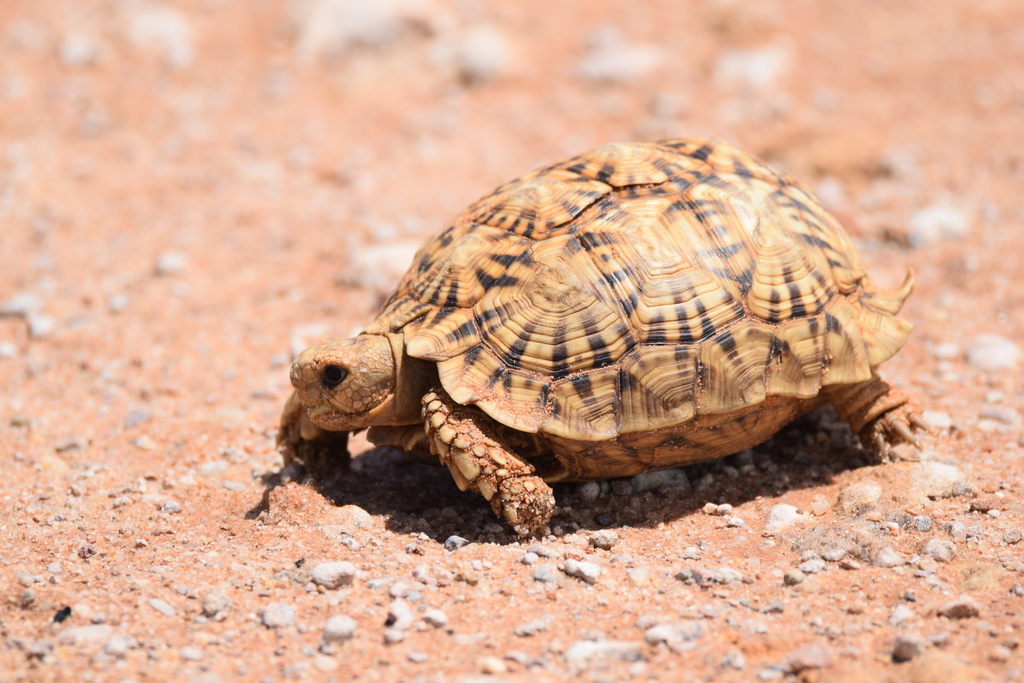
Serrated Tortoise
Psammobates oculifer
The serrated tortoise (Psammobates oculifer) German: Kalahari-Strahlenschildkröte is a species of tortoise that occurs in the Kalahari Desert regions of southern Africa. Also known as the Kalahari tent tortoise, it is one of three members of the genus, Psammobates.
From the article Serrated tortoise on Wikipedia (CC BY-SA), quoted section by section
Description
This species remains relatively small, with a shell length of 12–15 cm. While it shares much of its superficial outer appearance with its relatives in the genus Psammobates, it can be distinguished by its relatively low-domed shell which is strongly serrated along its margins at the front and back. Each shell scute is coloured with a radiating star-pattern of black rays on a tan background. The species has buttock tubercles and the shell's nuchal scute is wide and sometimes divided. The males have a longer tail and taller, more conical scutes on the back as well as a concave belly. The female lays a clutch of 1 or 2 eggs in December.
Range & habitat
The serrated tortoise is found in Southern Africa. Here it favours arid savanna and scrub desert vegetation types (e.g. Kalahari thornveld, bushveld and arid grassland). This area lies within the border regions of Botswana, Namibia, and the Republic of South Africa from extreme W Transvaal and the W Orange Free State northwestward across most of Botswana and central and eastern Namibia. In this range, which roughly matches the extent of the Kalahari Desert, its population is very sparse, and individuals are normally very rare and widely separated.
Wikipedia: “Distribution”
Where it lives
Recorded sightings
—
geo-referenced records in GBIF, from museums, herbaria and field observers.
Drag the globe to turn it. Dots are where records exist, not a range map; darker means more records.
In the stacks
Searching the stacks…
Every page naming Psammobates oculifer in the Biodiversity Heritage Library →
This page is assembled live from iNaturalist, GBIF, Wikipedia, the Source Library and the Internet Archive. It is not yet part of the hand-edited codex. iNaturalist taxon 1367330.