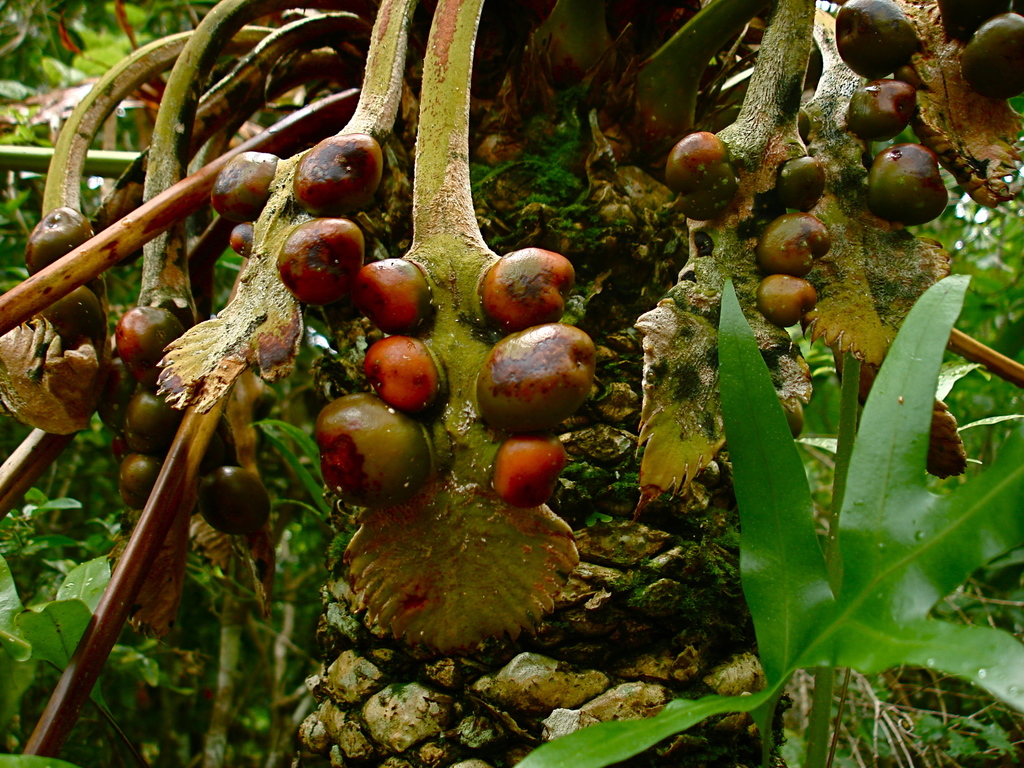
Micronesian Cycad
Cycas micronesica
Cycas micronesica is a species of cycad found on the island of Yap in Micronesia, the Mariana islands of Guam and Rota, and The Republic of Palau. It is commonly known as federico nut or fadang in Chamorro. The species, previously lumped with Cycas rumphii and Cycas circinalis, was described as a unique species in 1994 by Ken Hill. Paleoecological studies have determined that Cycas micronesica has been present on the island of Guam for about 9,000 years. It has been implicated as a factor in Lytico-Bodig disease, a condition similar to amyotrophic lateral sclerosis (ALS), due to the presence of the neurotoxin BMAA found in its seeds. Seeds were a traditional food source on Guam until the 1960s. The neurotoxin is present due to a symbiosis with cyanobacteria.
From the article Cycas micronesica on Wikipedia (CC BY-SA), quoted section by section
Description
Cycas micronesica is a medium-sized tree most commonly 2–5 meters tall but can reach heights up to 15 meters. The tree has a straight palm-like trunk ringed with frond scars.
Leaves. Leaves are 140–180 cm long, flat in section (opposing pinnae inserted at 180 degrees on rachis), with 130 -150 pinnae, terminated by a spine approximately 4mm long; petiole usually glabrous, usually unarmed, rarely spinescent for up to 20% of length, 35 – 45 cm long; median pinnae at 70-80 degrees to rachis, 240 – 280 mm long, 16 –17 mm wide, 0.35 - 0.45 mm thick, glabrous, dull green or slightly bluish-green when developing, becoming glossy mid-green at maturity, flat in section with slightly recurved margins, strongly discolorous, decurrent for 7–10 mm, narrowed to 5.0-6.0 mm at base, 17 – 20 mm apart on rachis apex attenuate; midrib not sharply raised, more or less equally prominent above and below, 1.2 -1.5 mm wide.
Reproductive organs. Like all cycads, Cycas micronesica are dioecious. Females possess clusters of ovules situated on modified leaves called megasporophylls. Male reproductive structures consist of modified leaves called microsporophylls, but each modified leaf has small, compact pollen sacks attached to their lower surface. …
Toxicity
Cycad seeds contain Β-Methylamino-L-alanine, a non-proteinogenic amino acid and neurotoxin. Chronic dietary exposure to BMAA is now considered to be a cause of the amyotrophic lateral sclerosis/parkinsonism–dementia complex (ALS/PDC) that had an extremely high rate of incidence among the Chamorro people of Guam. The Chamorro call the condition lytico-bodig. In the 1950s, ALS/PDC prevalence ratios and death rates for Chamorro residents of Guam and Rota were 50–100 times that of developed countries, including the United States. No demonstrable heritable or viral factors were found for the disease, and a subsequent decline of ALS/PDC after 1963 on Guam led to the search for responsible environmental agents. The use of flour made from cycad seed ) in traditional food items decreased as that plant became rarer and the Chamorro population became more Americanized following World War II. Cycads harbor symbiotic cyanobacteria of the genus Nostoc in specialized roots which push up through the leaf litter into the light; these cyanobacteria produce BMAA. In addition to eating traditional food items from cycad flour directly, BMAA may be ingested by humans through biomagnification. Flying foxes, a Chamorro delicacy, forage on the fleshy seed covering of cycad seeds and concentrate the toxin in their bodies. …
Where it lives
Recorded sightings
—
geo-referenced records in GBIF, from museums, herbaria and field observers.
Drag the globe to turn it. Dots are where records exist, not a range map; darker means more records.
In the stacks
Searching the stacks…
Every page naming Cycas micronesica in the Biodiversity Heritage Library →
This page is assembled live from iNaturalist, GBIF, Wikipedia, the Source Library and the Internet Archive. It is not yet part of the hand-edited codex. iNaturalist taxon 136213.